Posted on 2 Comments

Essence of Color

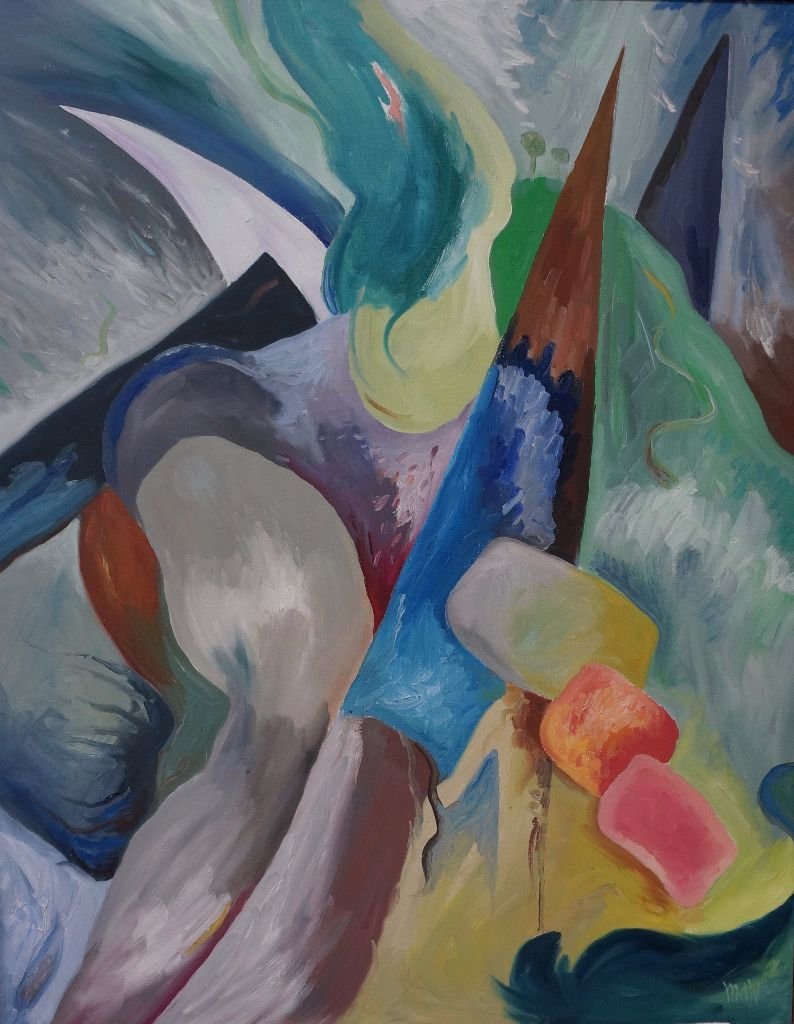
We have come to understand that in the pursuit of good design we often place the symphony of pure color in second place.  I am reminded of Tubular Bells by Oldfield and how fascinating the relatively simple patterns he creates stir us so deeply.  Essence of color in painting comes when we begin to place color as the foremost element.  Color after all has its own essence, its own purity.  It is even possible to abandon design entirely in creating beautiful art.  This is done by being sensitive to the purity of color itself, such as the relationship between tan/gold tones against those of blue and red combined or purple.  Those two properly and carefully juxtaposed creates a very unusual and effective dynamic.

abstract oil paintings with oranges, greens and grays
Symphony 20, 2017. Original painting by Michael A. Wilson

What we can call essence of color, where color itself is center stage depends greatly on contrast of hue and intensity.  A blue against gold as mentioned above is striking but when the contrast is deepened the energy increases proportionally.  There are no rules in this kind of arrangement but a heightened awareness is necessary.  Some colors seem completely muddied without employing proper contrast.  Though Rembrandt exercised extreme restraint for maximum results, the impressionists broke free from classic modeling to create scintillating dynamic compositions based essentially on pure color.  Blending of colors gave way to placing pure colors side by side to create a more vital, energetic effect…a dark hookers green placed adjacent to viridian (without blending) was discovered to be far more emblematic of nature itself.

Pluck one string on a guitar and then pluck an adjacent string in the same range creates a simple but resonating quality.  It seems the Tubular composition was after something like this – the subtlety of tones being predominate over particular style.  Painting with pure color arrangement, that is the dynamic of color effect and sublimating all design elements to the vitality of color is an exercise vital to the development of an artist’s maturity.  Tubular Bells by Oldfield depends on overlays.  This can also be accomplished with color arranging.  It is a fascinating process when executed skillfully.  In my own work I often start with hard-pressed drag painting.  This is done with dragging pigment across a hard primed panel.  This method creates wonderful though accidental effects.  These elements provide an excellent and dynamic base for a painting primarily concerned with the essence of color.  I then apply multiple overlays and critical accents.  Whereas Kandinsky would often title his paintings ‘Composition 20’ or such I find that composition does not suit this particular style of painting – this creative effort.  Though I made four or five preliminary sketches prior to beginning, I ultimately chose none of them but began to paint directly unto the panel.  The first layer was selective drag passages.  After that came multiple overlays and thus the reference (right or wrong) of Tubular Bells.  Then later, particular accents, deepening contrasts and adding some elements of design.  Therefore it seemed that the work was more of a symphony of color combinations rather than a composition per sey.  A symphony in my mind is a process of adding multiple instruments to create a complete structure, a complete piece of music.  Painting in this way seems to be very close to this creative process in music.  Spontaneous may not be accurate because though a painting like this stems from no particular composition, the work follows a process nevertheless, but it is a process that builds as it develops.  Each layer invites or evokes the next and myself the artist makes critical decisions which to choose.  Spontaneous tends to imply a impulse over thought but a painting like this definitely requires careful attention.  There must be a very conscious awareness of what the particular passages are ‘saying’ – what they elicit, what they require to follow.  I have titled this piece then,  ‘Summer Symphony  20’ .  This painting represents very clearly what occurs when essence of color takes precedence over compositional design. Summer Symphony 20 represents an important milestone for me personally because of this practically complete observance of painting  where color itself is the predominate element.

By the way I wish to thank my brother Jim and my sister in law Pam for their recent visit to my studio.  They spent considerable time looking over my work, even the several stacks against the walls.  It was fun sharing my work with them.  Both of them have a remarkable ‘keen eye’.

Posted on Leave a comment

Developing Concepts

What can be more fundamental in any artistic endeavor than developing concepts?  This represents the beginning, the essential kernel that spawns the artistic project.  However I feel that artists are stymied when their concept (however it is conceived) is not fully developed, either emotionally or visually in the case of the visual painter.  All of my articles are essentially about the visual painter as artist but it is quite easy to see how many of these written constructions also relate to the other arts such as music, dance and sculpture.  We begin with a concept and then the process begins with developing those concepts.

In my own case I rarely am fortunate enough to begin a painting with a fully developed concept or idea.  There is a germ, a spark, a feeling but this is often all we can go with.  We have to rely on that to begin.  We have to believe that this small spark of an idea can lead us into a finished product, a painting.  The process of developing a concept is however quite different than the actual process of completing a painting which is I think, often misunderstood in the art world.  Gerhardt Richter has a very large, expansive studio.  His process is to take a ‘so-called’ finished painting and bring it physically in to another room.  This room is uniquely un-cluttered and separated from where the painting had been conceived.  In the entirely new environment Richter will study the painting on and off for sometimes several weeks.  He studies it to ascertain how technically this painting should be completed, what nuances should be added, what tones need adjusting, if the painting ‘works’.  Most of us do not have the space or opportunity to remove our painting in to an entirely different environment for study.  The point is that the initial thrust of the painting strives to attain the concept.  The second part of the work is done by technically bringing the painting to its full completion.  Shapes and forms may have been articulated but in the second part of the painting’s development, those shapes and forms should be carefully delineated and the brushwork refined.  

This refinement is noticeable in Kandinsky’s work.  Each shape is technically refined and beautifully rendered.  In the developing concept this would have been impossible…it is enough to get the concept down in terms of location, design and coloring.  The second part of the process is necessary to bring the painting to its fullfillment.  In my own experience this is best done by studying it a week or two after the painting had been initially developed.  It is very rare when I find a painting that does not need further attention.  Elements inevitably need modulating.  Perhaps the best example might be the sculptor who works with the chisel to establish the basic shape of the form.  He or she gets it quite close to the concept or idea.  After that, however begins the long, tedious work of sanding and refining the various shapes.  Without this final attention the work is not truly ready, not truly finished.

Posted on Leave a comment

Visualizing Abstract Art Projects

Visualizing abstract art projects is the essential first step in creating a painting.  Visualizing (or developing a concept) is the process of creating a basic construct of the painting in your mind.  Through practice this process can become a more natural and less forced mental effort.  We all realize how incessant our mental activity is and often it is only with great difficulty that we can shut down our mental activity.  The visualization comes by channeling that mental energy towards your goal of creating art.  The mind then becomes a useful tool for the artist.  We can play with images, move them around, distort them and place them in different arrangements to fit what we are imagining.  This is not unlike a musician working up a new song or a choreographer imagining a dance routine or an athlete picturing a practiced extension to achieve a desired result.

This is however not always immediately effective.  Patience is required.  Sometimes our imagination will give us just a hint or suggestion and a sensitive artist will pay attention to this and meditate on this bare image.  Personally I try to keep a sketch pad handy in several areas of the home or studio to quickly sketch the suggestion.  These seem to be sub-conscious images that creep up in to our minds in small segments.  I have found with practice I can freeze, in a sense, these images and then begin to develop them mentally.  By directing our mind away from unimportant thoughts to those of the desired art image we begin to use our mental constructs to advantage.  For the artist this visualizing process tends to go with the trade – artists by nature can ‘see’ the forms mentally.   There are times when an image will keep re-occurring over and over when I meditate but nothing seems to follow.  There seems to be nothing beyond the simple form presented, even after several days of mulling over that particular simple image.  In those cases I will go out to the studio and prepare to paint that simple image.  Often and remarkably after that initial start, the painting will begin to suggest the next form or color or shape.  The painting then develops, for lack of a better word, organically.  It seems to come from its own quite naturally.  There is a sensitivity required to this natural development.  Past experience is fused with these new developments.  Personal preferences and color choices are employed to enhance the developing painting and curiously the imagination begins to expand as the painting develops.

Conversely a painting is often more thoroughly imagined before it is begun.  In this case the visualization process is taken to a more complete stage.  It is remarkable in these cases that a painting can be so substantially established even to the point of color selections.  On these occasions it is essential to have a drawing pad handy to draw out the development.  Fortunately once the drawings are made (and sometimes I will do several) the image becomes fairly locked in mentally.  The drawings are signposts and I find that inevitably the painting will become considerably changed and refined as the paint is applied.  In these cases I do draw out the visualized image on the canvas or board.  Between these two extremes of something starting from just the smallest seed or idea and from a highly visualized starting point are many, many variations that artists employ to begin a painting.  The point behind this article is to encourage the mental or meditation visualization process.  With practice you will discover that it becomes a fairly natural process to use the mind as an effective tool – tool of the imagination.  There seems to be a deep and vast wealth of sub-conscious material that is waiting to be discovered, waiting to be manifested by the abstract artist.  The key is patience.  Allow the images to come without forcing them but once they arrive (however small and insignificant) pay attention to them…begin the visualization process.

Posted on Leave a comment

The Purpose in Drawing

The very first step in the creation of art is most often the simple sketch. When the drawing is efficient, perceptive, decisively created, then the drawing gives the piece a good chance of success. The purpose in drawing lies in the process of the discovery of essential form. It is suggested by a very well known art instructor, Nicolaides that drawing well comes only after several years of essential discovery. During those early years no attempt should be made at creating ‘nice drawings to show others’. These several formative years are about truly seeing and understanding form – even seeing within the form to its essential characteristic. No attempt should be made in making it pretty. The training has to do with responding to form with our multiple senses and learning how to honestly capture that response with simple graphite. Drawing then becomes simply a means of responding. The graphite pencil or chalk or conte become the basic tools.
We know that this long period of study eventually pays dividends. Through study and perception an artist slowly begins to truly see, even as a musician learns to hear the critical nuances of notes. Subtle shifts are noted, the softening of form can be delineated, followed and then drawn. As we mature as artists we draw more quickly yet with more effectiveness. Because we have learned to study and see, this ability to draw becomes the critical stepping stone to painting. We find that even though we draw on the canvas our idea, very quickly those lines are absorbed by paint. When this happens we begin to (in effect) draw with our paint brush. All that we had learned from drawing with graphite is now becoming dynamic. Paint is deepened and lightened to create depth and highlight.
The purpose in drawing must also be understood as the artists gateway to finding him or herself as an inner person. This realization of our inner self is what makes art such a potent and critical part of the human race. Drawing makes a way to realize the inherent character of the many forms around us. Our own interior space, our inner self is uplifted and transformed
by these realizations. When line drawing gives way to the fuller expression of painting with brush, we are more capable of expressing ourselves. Color becomes the key and second ingredient to the design itself. Color enhances everything. Color will attempt to overtake the design and smother the original conceptual drawing. Maturity is required to keep the two in tension and balance. Picasso did this brilliantly.
The spiritual aspect of drawing and of painting is undeniable though our understanding of the process seems to barely touch the surface. We know that as we absorb our full attention to the work at hand, the drawing in process, then we grow naturally in our understanding. It is this profound understanding that brings us to a more transformative state. Little by little we see more clearly. We grow up in our awareness…we become more skillful in responding.

Posted on Leave a comment

The Essential Purpose of Art

I truly cannot remember any of my art professors discuss the essential purpose of art. It would seem vital to an art education – a young student venturing in to the field of art, to understand where they are going and for what purpose. They have chosen to express themselves as artists and so, it would seem important to lecture them or help them understand what exactly is the essential purpose of art. Perhaps things have changed now at the academies – I hope so.
Perhaps art instructors now have a better grasp of the purpose of expression, the reason for art in our lives.
If a student were to better understand the purposes that surround their experience then it would seem to follow that their own art would benefit. A broader understanding would naturally yield a higher clarity to ones own work. I attended a number of art schools both in and out of a University setting and generally the environment was less than inspired. In retrospect this was a shame and I truly hope that the schools have realized the necessity to re-invigorate themselves.
Art is and certainly should be the higher reflection of a higher understanding, a greater awareness, a more directed consciousness. In fact the very nature of art is derived from the awareness of form to the point of understanding the essential nature of form. Art is, after all awareness. The artist studies form to realize the inner aspect of form and then to manifest that understanding to the viewer. This is the artist’s purpose. We understand that form simply observed, reveals little to our understanding. It is the artists purposed to search it out, discover the inherent meaning and to ascertain the poignant metaphors. When we see good art we should be moved, we should be transformed, even if slightly. The subject matter may be abstract. It need not be a realistic reflection of nature.
Perhaps we are at a critical period now, as Ekhardt Tolle suggests – that our spiritual and inner self is at a critical point of survival. Perhaps this reflects what is also happening to our physical world, now beset with dynamic climate change. One seems to run parallel to the other. The scientist makes us aware of these physical dynamics that affect our lives and the responsible artist should heighten our awareness of our own developing consciousness- the non-physical world.
Every time an artist makes even a small discovery of what is inherently true, then we as a society grow. Every understanding by the artist helps us in our own awareness – or should.
The essential purpose of art has very much to do with discovery. A very inspired drawing instructor named Nicholaides suggested that the beginning art student should forget about making ‘nice drawings to be admired’. The first years of study should be devoted to discovery of the inner nature of form. I think this comes close to defining the essential purpose of art. When we become enthralled by the simple contour, we begin to gain an appreciation for the wonder of life itself – the great energy that supports and sustains life. The artist’s purpose then is critical if we are to grow spiritually in this dynamic period of history. There is a deep responsibility required of the artist to seek honestly and diligently whether he or she paints objectively or abstractly. Concentrated study will always be rewarded. Curiously a drawing which reflects the essential nature of its subject, by degrees cannot help but reflect a certain beauty. The closer we ascertain the nature of a thing, the more mysterious and beautiful it becomes to us.

Posted on Leave a comment

Why buy Abstract Art

When it comes time to decorate your home or office, the question will inevitably come up – why buy abstract art? Millennials especially are looking for more adventurous art, bold forms and larger art that enlivens an interior. Prosaic landscapes and still life paintings, though charming lack the dynamism that an abstract piece carries.
There are so many good, contemporary abstract artists today. They are also easy to find on the internet. Purchases are easier and the paintings can often be purchased framed and ready to hang. Paintings found on the internet will usually note the size so you can make sure the wall you have in mind will accomodate the piece nicely. The beauty of a painting is appreciated when there is adequate lighting – especially at night. Consider hiring an electrician to install perfect spot lighting for your new purchase.
If you are asking yourself, why buy abstract art – consider how the right painting can truly enhance an interior environment. Many abstract paintings contain a certain mystery or metaphor that is intriguing. Mature, good abstract paintings still employ the fundamentals of good classical painting – those of balance, movement, harmony of form. A purchase of a quality abstract painting will retain its value, however always purchase a painting that resonates for you personally.
The price of a quality abstract painting, especially by a contemporary artist is usually very reasonable. There is of course something very special in buying a signed original painting. There really is no comparison to a flat image print – even when the print is by a known master. Prepare to pay an inflated price when buying from a gallery, though admittedly a gallery will often host excellent work by new, emerging abstract artists.

Posted on Leave a comment

Symbols in abstract art

Shapes will often take on the aspect of symbols in abstract art.  Even without conscious effort or design, certain shapes will naturally morph themselves in to often meaningful symbols.

I have often felt in Kandinsky’s work that the triangle often meant the ‘man-made’ whereas the circle related more to the universal and the organic.  The various squared shapes he used seemed to imply defined composition.  These however are my personal impressions.  Certain images become more clear than others – for example when we see the point of a triangle reaching up and touching a defined circle then we feel like the ‘man-made’ is invading the organic and universal.  When shapes over-lap we sense that they are merging, that they are symbolically merging.

The beauty of abstract art is that each person will often see something entirely different.  Impressions are received quite differently.  Some psychologists feel this is basically due to our backgrounds and historical perspective.  When a painting is composed almost entirely of circular shapes it is almost impossible to imagine anything other than a certain cosmology, a sense of the universe and not something man-made.   As we live on Earth or Urantia (whichever term you prefer) we relate to images that we see, even while we might imagine a certain life beyond.  These two apparent disparate cultures can often be represented in an abstract painting.   Sometimes they appear as almost parallel universes.  A wonderful tension and force is created when they are represented on the same visual plane.

Sometimes an artist will be partially successful in pre-determining how to interpret symbols.   This takes a certain amount of understanding and planning.  Exploring how shapes can invigorate and define the selected symbols is an exciting process.  As I have often said in previous articles, the important thing is to paint.  Painting beautiful images, painting shapes and forms well is the first step.  Integrating them to themselves is the next.  It is certainly not necessary to ‘pre-establish’ any sense of symbology.  Often shapes and images will just exist in a playful mode – floating quite nicely on their own.   We paint them thus because we are delighted in them.

Posted on Leave a comment

Re-working Your Oil Painting

There are some die-hard art critics, and artists who consider it taboo when it comes to re-working your oil painting.  Somehow they think it renders the painting impure, as if it compromises the initial inspiration.  Personally I think this is absurd.DSC03313

Re-working your oil painting is a vital, important step in the completion of your painting, even an abstract painting.  I like how Gerhard Richter will take a painting into a completely different room to view and analyze the new painting, and to see what further needs to be done.  I understand that in severe cases he will abandon the painting because it just did not achieve what he had hoped.  But we are not in that stratosphere, are we.

I have found that even an abstract painting will have within it a certain emphasis, impulse, rythmn or cadence.  By looking at these and understanding them, studying them, these often become even more apparent than when first conceived.  Initially the entire painting is being rendered and it is impossible to fully create critical emphasis.  Going back however two or three weeks later and setting it on the easel to study, the forms and cadence tend to come forward.  It is these that we want to enhance and reinforce.  This needs to be done carefully of course so that any new addition is in concert with the initial thrust of the painting.  I tend to look towards the areas that need greater contrast.  Perhaps a tone or color is too weak.  Sometimes a line is not distinct enough.  Very often I realize that a painting was in reality only 85% complete.  By carefully augmenting the painting and discovering more fully the intent of the piece through study, the painting becomes more fully complete.  This is a satisfying process and one that I strongly endorse, especially with oil paintings.

Posted on Leave a comment

BEGINNING ABSTRACT OIL PAINTINGS

For over four centuries all of art representation was figurative and scenic.  It was highly formulaic and it was not considered ‘good’ art if brush strokes were detected.  All of this thankfully changed during the French Impressionist period.  The range of subject matter increased dramatically and now brush strokes became not only visible but seemed to show the vigor and intensity of the painting.  Of course the public was slow to appreciate this dramatic departure from the careful studio paintings of the past.DSC02551

The impressionists paved the way for Miro, Matisse, Braque and of course Picasso.  Then Kandinsky came on the scene, which brings me to my subject of Beginning abstract oil paintings.  He was not originally a painter but once he began to paint the process consumed him.  At his height of production he was producing over two hundred paintings a year.  Because of the war years he was compelled to always be moving his studio locations and yet he continued to explore and discover breakthrough methods of painting.  His work should be studied by anyone interested in seriously painting abstracts.

When you do study his work it will by degrees come over you just how technically perfect are his paintings.  The patterns, the balance, the colors are all very carefully thought out.  If one can successfully compose a painting will not succeed as a whole unless it is painted with technical skill and Kandinsky’s skill was unmatched.  His use of the brush and his great skill with the brush is clearly demonstrated in every painting.  This virtuosity came as a result of painting often and much.   The beginner painter and even more advanced students must realize and face the harsh truth that only with copious practice can these kinds of results be achieved.  In my view he was more skilled than, say Picasso in terms of sheer ability with the brush.

It is not unlike the young violinist who must practice a piece over and over until the music is mastered.  There is however great joy in the mastering.  It is the same with painting.  As one develops the technical skills, a steady hand and mastery of the brush – a distinct pleasure will arise at being able to execute what the heart and mind envision.

Posted on Leave a comment

HOW TO STOP PAINTING

Now there’s a catchy title for an Article, ‘How to stop painting’.  We have all seen those 18″ x 24″ paintings so completely overworked that the very life has been drubbed out of the piece.  There is no vitality because the artist had no conception of when to stop but just kept daubing on.  Knowing when to walk away is vital.  Fortunately I have a garden out back and I will retreat to weeding when I begin to sense that I am mindlessly daubing.picasso-girl-with-boat

It is imperative to study your work and make some critical determinations along the way, especially when you feel that the painting is nearing completion.  One excellent way to do this is by dividing up your work into quarters.  If the painting is especially large and elongated you can divide it by thirds across the top and then by thirds across the bottom for six equal panels.  Assuming that your work is sufficiently dry, take the smallest width blue painters tape and divide up the canvas…press the tape on lightly.

This will be an invaluable aide to study the painting by sections though I prefer to call them passages.  Does the panel have its own inherent interest?  Do the applied colors work well with each other?  Is there vitality or a sense of energy in each panel ?  I am of course primarily talking about abstract work here.  Then ask yourself if the panels or passages are relating to its neighbor?  Is there an implied tension between the parts?  Always look to see if the principle of balance is working in each panel, and then in relation to the other panels.

Eventually as you mature as a painter it will be unnecessary to use the tape because the eye will be able to divide up the canvas by experience.  You will learn to make every passage ‘work’, first within itself and then in relation to the whole.  I learned from Kandinsky how to make my backgrounds (those massed areas of color behind defined forms) more interesting, more energetic and more related to the entire piece.

There is always an impetus to any abstract painting, often short-lived.  It is therefore imperative to keep the painting fresh and responsive to that initial impetus…even days later.  This is why we find those photos of Picasso standing for an hour before applying a critical brush of color – especially as the painting is nearing completion.  I read of Sargent who would get a painting 98% and then go out to his studio for one last application of certain, final highlights that would make the final painting zing.  Then he would put the brush down.