Posted on Leave a comment

Line Value in Abstract Art

Perhaps more than any other painting genre, abstract art employs lines to border forms.  Line value in abstract art becomes practically an art in itself.  Line value in this sense refers to the relative strength and thickness of the painted line.  It often also refers to the shade or darkness of the line.
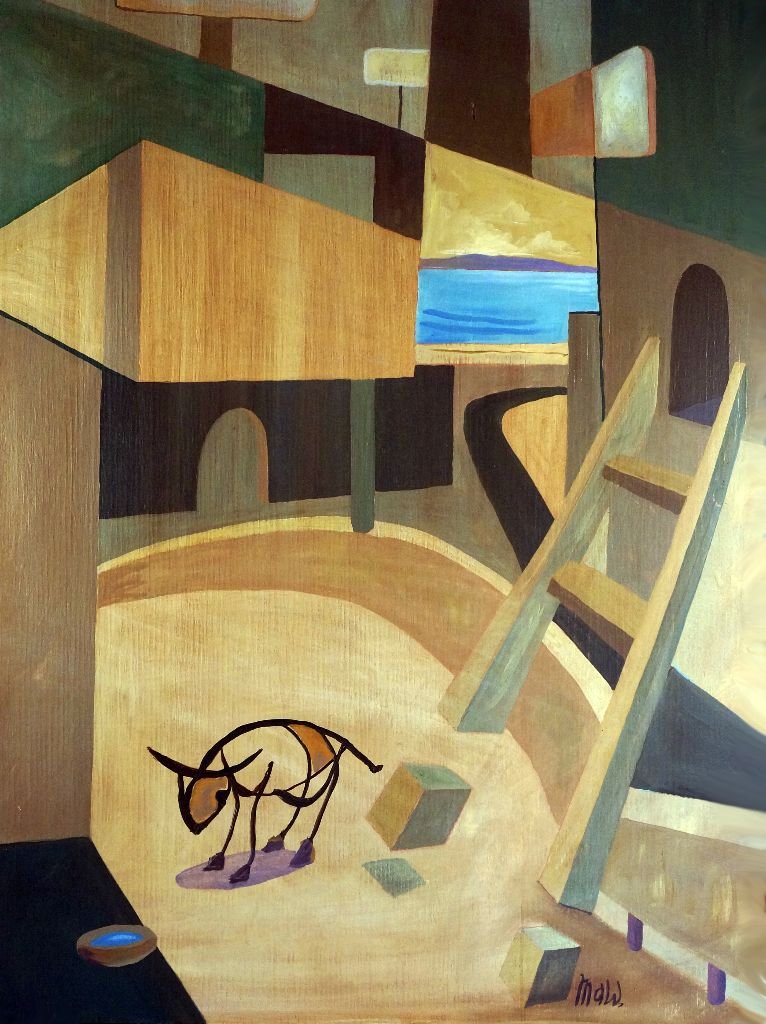
Line value in Abstract art is used of course to enhance a particular form and to draw attention to a certain feature.  It is used selectively and rarely is every form bordered with a dark line which would appear repetitive.   Van Gogh would often employ lines to border forms and figures in his paintings so that they would stand out from the background or from other forms.  Van Gogh was not one to carefully blend his forms from dark to light.  The use of the heavy line served to distinguish his forms.  In one painting of a friend sitting in a chair, he used a heavy red line completely around the figure which literally popped out from the background.  It appears he painted this dark, red line while the painting was still wet so that in places the red line mixed with the image of the figure.

Kandinsky appears to paint his lines after the forms have been placed, set and dried.  This allowed him to paint very distinct, sharp delineation.  Line value in abstract art took on a whole new meaning as Kandinsky began to explore true abstract art.  His lines are remarkably painted with highly skilled brushwork.   I expect he used very refined round sable brushes for this kind of delicate work, especially the circles that he drew so often.

Posted on Leave a comment

Symbols in abstract art

Shapes will often take on the aspect of symbols in abstract art.  Even without conscious effort or design, certain shapes will naturally morph themselves in to often meaningful symbols.

I have often felt in Kandinsky’s work that the triangle often meant the ‘man-made’ whereas the circle related more to the universal and the organic.  The various squared shapes he used seemed to imply defined composition.  These however are my personal impressions.  Certain images become more clear than others – for example when we see the point of a triangle reaching up and touching a defined circle then we feel like the ‘man-made’ is invading the organic and universal.  When shapes over-lap we sense that they are merging, that they are symbolically merging.

The beauty of abstract art is that each person will often see something entirely different.  Impressions are received quite differently.  Some psychologists feel this is basically due to our backgrounds and historical perspective.  When a painting is composed almost entirely of circular shapes it is almost impossible to imagine anything other than a certain cosmology, a sense of the universe and not something man-made.   As we live on Earth or Urantia (whichever term you prefer) we relate to images that we see, even while we might imagine a certain life beyond.  These two apparent disparate cultures can often be represented in an abstract painting.   Sometimes they appear as almost parallel universes.  A wonderful tension and force is created when they are represented on the same visual plane.

Sometimes an artist will be partially successful in pre-determining how to interpret symbols.   This takes a certain amount of understanding and planning.  Exploring how shapes can invigorate and define the selected symbols is an exciting process.  As I have often said in previous articles, the important thing is to paint.  Painting beautiful images, painting shapes and forms well is the first step.  Integrating them to themselves is the next.  It is certainly not necessary to ‘pre-establish’ any sense of symbology.  Often shapes and images will just exist in a playful mode – floating quite nicely on their own.   We paint them thus because we are delighted in them.