Posted on Leave a comment

BEGINNING ABSTRACT OIL PAINTINGS

For over four centuries all of art representation was figurative and scenic.  It was highly formulaic and it was not considered ‘good’ art if brush strokes were detected.  All of this thankfully changed during the French Impressionist period.  The range of subject matter increased dramatically and now brush strokes became not only visible but seemed to show the vigor and intensity of the painting.  Of course the public was slow to appreciate this dramatic departure from the careful studio paintings of the past.DSC02551

The impressionists paved the way for Miro, Matisse, Braque and of course Picasso.  Then Kandinsky came on the scene, which brings me to my subject of Beginning abstract oil paintings.  He was not originally a painter but once he began to paint the process consumed him.  At his height of production he was producing over two hundred paintings a year.  Because of the war years he was compelled to always be moving his studio locations and yet he continued to explore and discover breakthrough methods of painting.  His work should be studied by anyone interested in seriously painting abstracts.

When you do study his work it will by degrees come over you just how technically perfect are his paintings.  The patterns, the balance, the colors are all very carefully thought out.  If one can successfully compose a painting will not succeed as a whole unless it is painted with technical skill and Kandinsky’s skill was unmatched.  His use of the brush and his great skill with the brush is clearly demonstrated in every painting.  This virtuosity came as a result of painting often and much.   The beginner painter and even more advanced students must realize and face the harsh truth that only with copious practice can these kinds of results be achieved.  In my view he was more skilled than, say Picasso in terms of sheer ability with the brush.

It is not unlike the young violinist who must practice a piece over and over until the music is mastered.  There is however great joy in the mastering.  It is the same with painting.  As one develops the technical skills, a steady hand and mastery of the brush – a distinct pleasure will arise at being able to execute what the heart and mind envision.

Posted on 21 Comments

Abstract Oil Paintings for Beginners

Are you new to oil painting in general or just to oil painting of abstracts?  In either case you will want to have an understanding of what defines the Abstract genre.  What defines Abstract and Non-Objective painting?  If you can have a clear aim in sight, this will help you develop your work, right?

Kandinsky attempted to define what he was doing when he worked as a teacher at the Bauhaus.  He wrote the small book titled, Concerning the Spiritual in Art.  Considered the ‘Father’ of Abstract art it was apparently necessary for him to define his new directions.  We read for example of his painting from an inner need and from an inner compulsion.  This required a break from conventional known or recognizable forms.  I think the book explains his position fairly well and his departure from object forms.

It is an interesting comparison in reading Ekhart Tolle’s book, The Power of Now.  This book talks about the relative illusion of form.  He describes a process of seeking a higher consciousness by recognizing form as being an illusion.  He points out that true reality lies within and is quite separate from what we perceive as form.  This seems to resonate with what Kandinsky wrote fifty years ago when he states the need to paint from an inner resource and to give that inner feeling expression.  Tolle however is able to give us a more clear understanding of that inner dimension.  His book is a valuable resource for an artist.

I was watching a Facebook video clip of a niece, just three at work on a painting.  The painting was nearing completion and she was standing before it brush in hand.  There were all kinds of swishes and circles and dashes of varying colors – a very exciting painting.  She began to mix on her brush some reddish tones and then carefully reached up and put two deliberate swatches of red near the top but separate from each other.  Why did she choose to do that?  Why were they the final strokes to the painting?  This process should be similar to our own means to create Abstract art.  We should be studying the canvas and placing shapes and colors in response to an inner feeling.  We should also be sensitive to the other colors and shapes on the canvas so that we create a symphony.  As in a symphony all the various components work together to create an effect.  08

Ultimately painting an abstract oil should be a joyful expression.  We should not worry about ‘wasting’ paint.  This should be our time to draw out our inner feelings and to express them with relative freedom unrestrained by the forms we see around us.  This is what makes Abstract art, for me so special and so intriguing.  The other advantage is that we have a more broad free range of colors to implement.  As a painting develops we can creatively use colors that best suit the needs of the painting – we need not be bound by ‘what is before us’.

Posted on Leave a comment

How to Start an Abstract Painting

How to start an Abstract painting

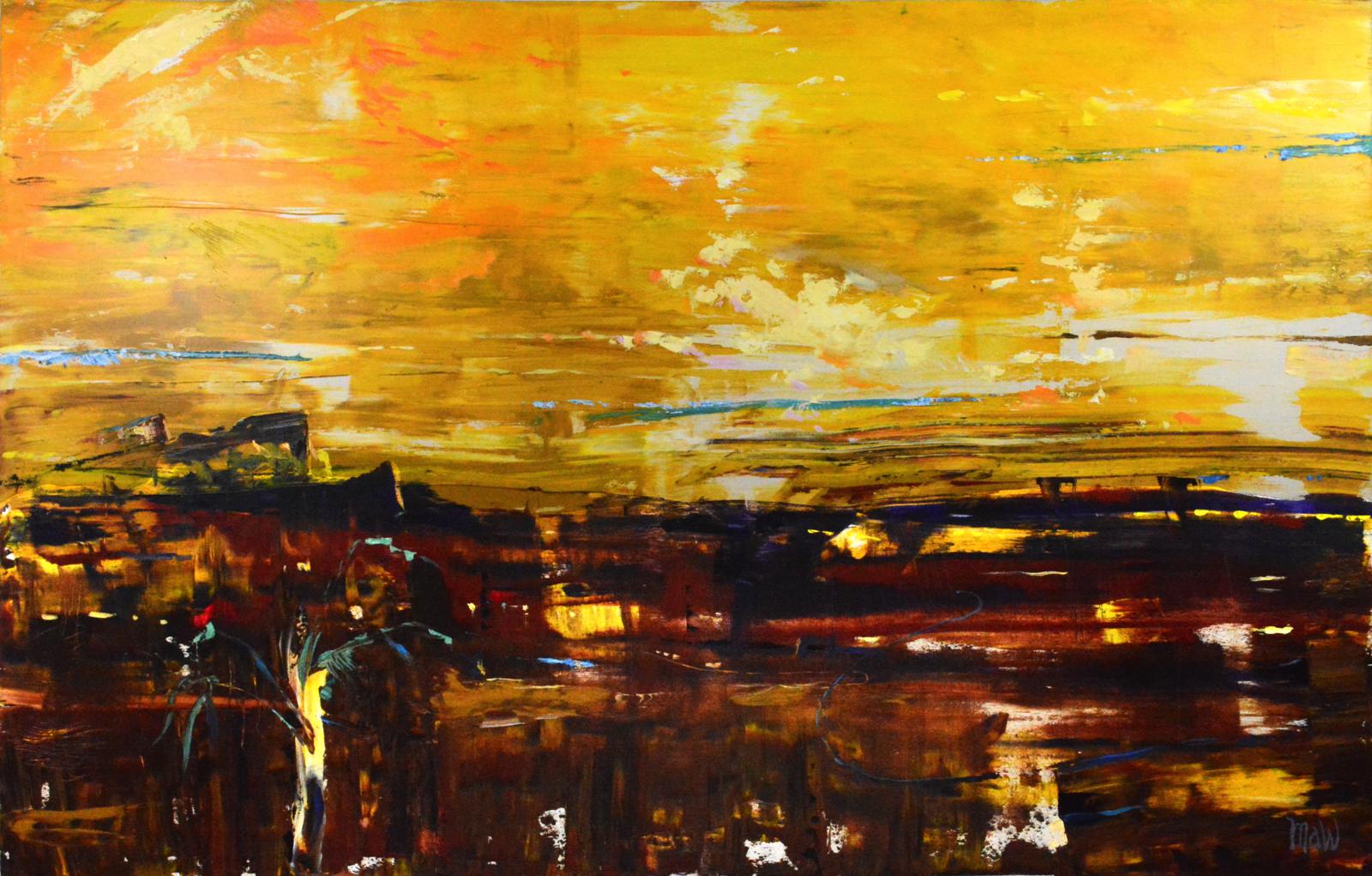
03Especially for the novice painter, commencing an abstract painting can be intimidating. There are no visual clues or subject references which realistic painting offers. I will briefly describe the process I often use – the ‘drag painting’ technique. Gerhardt Richter is probably most noted for this method. I recommend using hardboard or primed plywood panels, preferably large and reinforced to keep them straight. Using the board instead of canvas takes more setup but helps immensely with the process when it comes time to literally drag paint across the surface. This drag technique is an excellent way to start an abstract painting.
It is best to work flat. Squeeze out the colors you want across the board, with a liberal use of white. These might appear as semi-planned globs on the hard panel. Take a squeegee and pressing hard go from one side to the other in a firm, deliberate pass across the board. Keep working yourself down the panel in this manner,dragging the pigment horizontally. Try to be quite firm to leave a minimum of paint on the surface. Stand back and admire the accidents and surprises that will come from this effort. I am always surprised at the affects that are created. It is necessary to wipe and clean off the squeegee through the process so that each swipe is fairly clean.
This can be done in one sitting. I rarely consider this the final step in developing an abstract painting but this provides an excellent background or base to work from. I set this aside to dry for about two weeks. If I am anxious to work on it, setting it out in the sun speeds up the drying. I try to have a couple of these laying around to work on after they dry. The purpose of this brief article is to give you an idea how to start an abstract painting. This drag technique will give you an excellent way to get paint on the surface. It is certainly possible to make it tonally very deep or very light depending on the colors you use. White will quickly be absorbed. You will quickly discover the best locations to apply the ‘gobs’ of pigment. Admittedly this does tend to waste expensive oil paint. What you do get, as a beginner or a novice is an very creative way to create a base for your painting. It already has the look of an oil painting.
Canvas of course can be used though the effect is not as dramatic. If you use store bought canvas, I suggest at least two coats of gesso first to fill the exposed pattern of canvas — in other words the smoother surface, the better. I intend in the near future to do a demo video which will quickly explain this process more completely.