Posted on 2 Comments

Essence of Color

We have come to understand that in the pursuit of good design we often place the symphony of pure color in second place.  I am reminded of Tubular Bells by Oldfield and how fascinating the relatively simple patterns he creates stir us so deeply.  Essence of color in painting comes when we begin to place color as the foremost element.  Color after all has its own essence, its own purity.  It is even possible to abandon design entirely in creating beautiful art.  This is done by being sensitive to the purity of color itself, such as the relationship between tan/gold tones against those of blue and red combined or purple.  Those two properly and carefully juxtaposed creates a very unusual and effective dynamic.

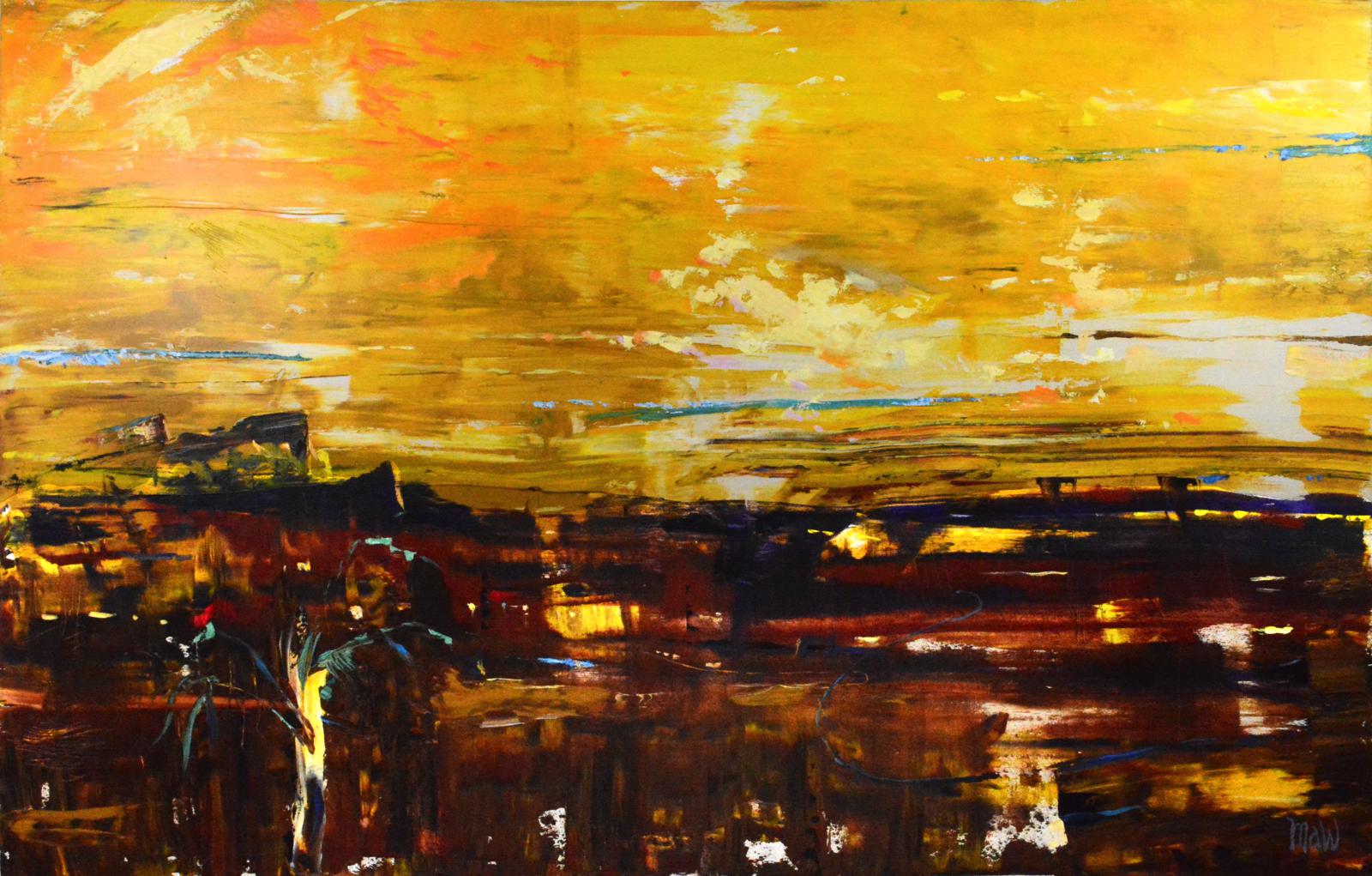
abstract oil paintings with oranges, greens and grays
Symphony 20, 2017. Original painting by Michael A. Wilson

What we can call essence of color, where color itself is center stage depends greatly on contrast of hue and intensity.  A blue against gold as mentioned above is striking but when the contrast is deepened the energy increases proportionally.  There are no rules in this kind of arrangement but a heightened awareness is necessary.  Some colors seem completely muddied without employing proper contrast.  Though Rembrandt exercised extreme restraint for maximum results, the impressionists broke free from classic modeling to create scintillating dynamic compositions based essentially on pure color.  Blending of colors gave way to placing pure colors side by side to create a more vital, energetic effect…a dark hookers green placed adjacent to viridian (without blending) was discovered to be far more emblematic of nature itself.

Pluck one string on a guitar and then pluck an adjacent string in the same range creates a simple but resonating quality.  It seems the Tubular composition was after something like this – the subtlety of tones being predominate over particular style.  Painting with pure color arrangement, that is the dynamic of color effect and sublimating all design elements to the vitality of color is an exercise vital to the development of an artist’s maturity.  Tubular Bells by Oldfield depends on overlays.  This can also be accomplished with color arranging.  It is a fascinating process when executed skillfully.  In my own work I often start with hard-pressed drag painting.  This is done with dragging pigment across a hard primed panel.  This method creates wonderful though accidental effects.  These elements provide an excellent and dynamic base for a painting primarily concerned with the essence of color.  I then apply multiple overlays and critical accents.  Whereas Kandinsky would often title his paintings ‘Composition 20’ or such I find that composition does not suit this particular style of painting – this creative effort.  Though I made four or five preliminary sketches prior to beginning, I ultimately chose none of them but began to paint directly unto the panel.  The first layer was selective drag passages.  After that came multiple overlays and thus the reference (right or wrong) of Tubular Bells.  Then later, particular accents, deepening contrasts and adding some elements of design.  Therefore it seemed that the work was more of a symphony of color combinations rather than a composition per sey.  A symphony in my mind is a process of adding multiple instruments to create a complete structure, a complete piece of music.  Painting in this way seems to be very close to this creative process in music.  Spontaneous may not be accurate because though a painting like this stems from no particular composition, the work follows a process nevertheless, but it is a process that builds as it develops.  Each layer invites or evokes the next and myself the artist makes critical decisions which to choose.  Spontaneous tends to imply a impulse over thought but a painting like this definitely requires careful attention.  There must be a very conscious awareness of what the particular passages are ‘saying’ – what they elicit, what they require to follow.  I have titled this piece then,  ‘Summer Symphony  20’ .  This painting represents very clearly what occurs when essence of color takes precedence over compositional design. Summer Symphony 20 represents an important milestone for me personally because of this practically complete observance of painting  where color itself is the predominate element.

By the way I wish to thank my brother Jim and my sister in law Pam for their recent visit to my studio.  They spent considerable time looking over my work, even the several stacks against the walls.  It was fun sharing my work with them.  Both of them have a remarkable ‘keen eye’.
Posted on Leave a comment

ABSTRACT ART FOR BEGINNERS

One of the methods I employ for painting is ‘Drag Painting’.   This is an excellent way to create abstract art for beginners.   Drag painting provides an immediate means to create accidental effects.  We are trained to control our art but this often gets in the way of creativity.  Drag painting allows you, the beginner to create exciting and often astonishing images without the use of a brush.

You will need to use hardboard as a surface.  Canvas just will not work.  I use plywood with 1 x 2 sticking on the back to keep the 1/2 inch plywood from warping.   This tends to be a tedious bit of work so it is best to build several at once.  The lumber store can cut your panels to size for a minimal cost.  The 1 x 2’s do not need to meet precisely in the corners but do need to be glued.  Gun nails are preferred though hand nailing small finish nails will also work.  Set and spackle all nail holes.  Your panels should be a minimum of 2 ft. x 3 ft. and larger is even much better.

It is best to build two or three at once.  The panels will require several coats of primer and I sand primers between coats.  Water based primers work well enough.  Two or three coats of primer should give you a very nice even, flat surface.  Unlike painting on canvas I lay my panels down flat on an easel.   The tools you will need are simply several sets of squeeges – the type to wash windows.  I also use silk screen squeeges and then smaller, plastic scrapers about 4 inches across.

Apply paint directly on the panel from the tube in whatever location that suits you though I recommend by putting pigment towards the top of the panel.  Applying pressure lay the squeege above the pigment and pull down .  Try to pull the pigment all the way down to the bottom of the panel – yes, this requires a fair amount of paint.  If you had applied several colors side by side you will see how they blend wonderfully when dragged down together.  No brushes are needed.  Cover the entire panel by spreading with the large and small squeeges.  Go across if you want and then vertically again but always press the paint hard in to the panel.  You will be surprised at the dramatic effects created this way.  THis is an excellent way to create abstract art for beginners.

Posted on Leave a comment

Now is the time to paint!

I am about to go on a vacation for a week or so.  I thought, ‘what would I write if this might become my final article on abstract painting’?  Knowing that beginners as well as more advanced artists read these, I would say to both, ‘Now is the time to paint!’  If you are an artist then paint.  I have said that often.  Don’t wait for inspiration. You have a canvas or board before you, brushes, thinner, a pallete and pigments….paint a square and then next to it paint another square and then relate them to one another.  There, you have made a start. See where it takes you.  How good are you at painting circles within a circle?  Paint one.  See where that goes.03

What is important here after all?  The arts, your own progression, you expressing yourself, your experiencing inner feelings, the manifestations of those feelings!  Now more than ever as our civilization becomes more and more mechanized, more absorbed in the vast internet we can easily lose our own development and our own inner fruition.  Art is there to serve that great hunger and that great need.   Art is personal expression and personal interpretation.  Much in the way that dreams are to reflect back our feelings and experiences unconsiously,  art serves to do the same only consciously and deliberately.  The curious thing is when the ‘border’ is reached between the un-conscious and the conscious, between form and spiritual or…when we are able to manifest (bring forth) what we are trying to understand internally.  Art is intuitively a form of discovery.  That is its supreme purpose.

Now is the time to paint….now is the time to discover.  Great themes, perfect diagrams, wonderful effects are irrelevant and even stand as blockades.  Don’t foolishly wait for weeks for them to come.  By painting you will inevitably become better with your brushstrokes.  You will learn more about mixing colors, about balance, about transforming shapes but most importantly, you will discover yourself.   Like peeling an onion you will discover what is vital for you and even what is essential for you as a progressing human being.  Abstract painting is the perfect vehicle.