Posted on Leave a comment

Visualizing Abstract Art Projects

Visualizing abstract art projects is the essential first step in creating a painting.  Visualizing (or developing a concept) is the process of creating a basic construct of the painting in your mind.  Through practice this process can become a more natural and less forced mental effort.  We all realize how incessant our mental activity is and often it is only with great difficulty that we can shut down our mental activity.  The visualization comes by channeling that mental energy towards your goal of creating art.  The mind then becomes a useful tool for the artist.  We can play with images, move them around, distort them and place them in different arrangements to fit what we are imagining.  This is not unlike a musician working up a new song or a choreographer imagining a dance routine or an athlete picturing a practiced extension to achieve a desired result.

This is however not always immediately effective.  Patience is required.  Sometimes our imagination will give us just a hint or suggestion and a sensitive artist will pay attention to this and meditate on this bare image.  Personally I try to keep a sketch pad handy in several areas of the home or studio to quickly sketch the suggestion.  These seem to be sub-conscious images that creep up in to our minds in small segments.  I have found with practice I can freeze, in a sense, these images and then begin to develop them mentally.  By directing our mind away from unimportant thoughts to those of the desired art image we begin to use our mental constructs to advantage.  For the artist this visualizing process tends to go with the trade – artists by nature can ‘see’ the forms mentally.   There are times when an image will keep re-occurring over and over when I meditate but nothing seems to follow.  There seems to be nothing beyond the simple form presented, even after several days of mulling over that particular simple image.  In those cases I will go out to the studio and prepare to paint that simple image.  Often and remarkably after that initial start, the painting will begin to suggest the next form or color or shape.  The painting then develops, for lack of a better word, organically.  It seems to come from its own quite naturally.  There is a sensitivity required to this natural development.  Past experience is fused with these new developments.  Personal preferences and color choices are employed to enhance the developing painting and curiously the imagination begins to expand as the painting develops.
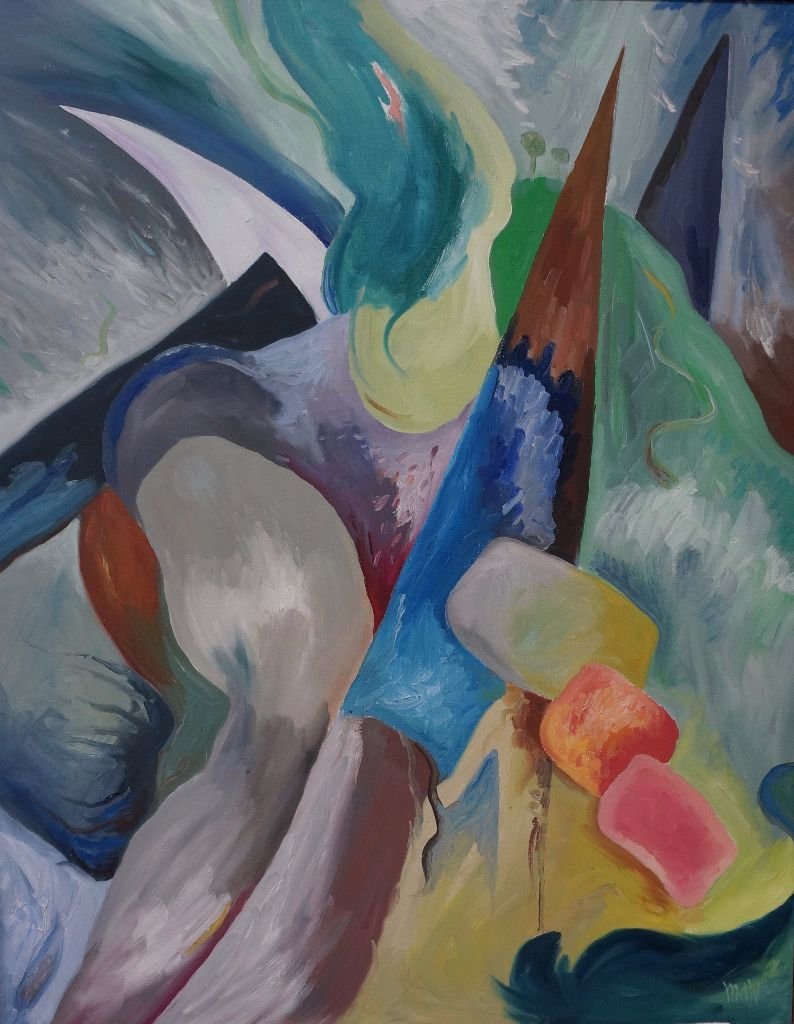
Conversely a painting is often more thoroughly imagined before it is begun.  In this case the visualization process is taken to a more complete stage.  It is remarkable in these cases that a painting can be so substantially established even to the point of color selections.  On these occasions it is essential to have a drawing pad handy to draw out the development.  Fortunately once the drawings are made (and sometimes I will do several) the image becomes fairly locked in mentally.  The drawings are signposts and I find that inevitably the painting will become considerably changed and refined as the paint is applied.  In these cases I do draw out the visualized image on the canvas or board.  Between these two extremes of something starting from just the smallest seed or idea and from a highly visualized starting point are many, many variations that artists employ to begin a painting.  The point behind this article is to encourage the mental or meditation visualization process.  With practice you will discover that it becomes a fairly natural process to use the mind as an effective tool – tool of the imagination.  There seems to be a deep and vast wealth of sub-conscious material that is waiting to be discovered, waiting to be manifested by the abstract artist.  The key is patience.  Allow the images to come without forcing them but once they arrive (however small and insignificant) pay attention to them…begin the visualization process.

Posted on Leave a comment

Fifty shades of Grey

As the story goes when John Singer Sargeant was painting outdoors in Paris with Manet he asked his friend for black to which Manet replied, “I have none, I never paint with black”.  Singer then replied, “ah well, then I cannot paint.”  True or not, it speaks to how we perceive shadow and shaded items.  There probably are fifty shades of grey and not attained just by gradations of white and black but infinite variations that may include, for example French Ultramarine, Hookers Green Deep and Cadmium red mixed of course with Raw Umber.  It is my guess that Sargeant could have done well enough with Raw umber.DSC03317

When one studies Rembrandt’s portraits we rarely see true black in the dark shadows of the face (the side opposite the source of light) but very deep shades of violet.  He seemed to retain black itself for the rich, velvet black sateen that men often wore in those days as capes and such.  Indeed, by using French Ultramarine which inherently has a violet cast, Raw Umber and Cadmium red deep, one can mix tones deep enough to emulate black.  These three pigments in fact lend a certain luminosity to shadows that black cannot match.

In landscapes where foliage in shadows becomes very deep and dark, adding in Hooker’s Green deep to the Raw Umber and to the Ultramarine Blue/Cadmium mix seems to bend the shadows tone nicely towards the other, lighter greens in the landscape.  Veridian I find is just too brilliant to use in shadow.  There is a new tube grey out now called Torrit Grey which I bought as a whim and I like how they have bent it towards a dark, green grey.  Adding white gives it a pleasant transition hue – a quicker way to achieve a grey/green tone.  This is by the way distinctly different than Payne’s grey which leans markedly towards dark blue.  When we think of Van Gogh’s work we think of very bright, rich pigments but his famous painting the Potato Eaters was somber in tone, extensively using deep shadows for effect and of a predominate green cast with gradations towards blue greys.  His winter landscapes I think are his best work where he carefully picked his way through subtle shades of greys within the snowy fields and shadows of trees, walls and figures along the road.

Of course every painter will eventually discover that various shades of grey carefully mixed and rendered adds an important ‘base’ to a painting – even one titled White Line by Kandinsky.  The stark bent, white line gains importance vibrating in front of the beautiful green, umber and blue greys that border the painting.  Some painters even prefer to paint the entire canvas grey before beginning.  This deep tone provides an entirely new reference than stark white when first starting a new painting.

michael wilson

Posted on Leave a comment

HOW TO STOP PAINTING

Now there’s a catchy title for an Article, ‘How to stop painting’.  We have all seen those 18″ x 24″ paintings so completely overworked that the very life has been drubbed out of the piece.  There is no vitality because the artist had no conception of when to stop but just kept daubing on.  Knowing when to walk away is vital.  Fortunately I have a garden out back and I will retreat to weeding when I begin to sense that I am mindlessly daubing.picasso-girl-with-boat

It is imperative to study your work and make some critical determinations along the way, especially when you feel that the painting is nearing completion.  One excellent way to do this is by dividing up your work into quarters.  If the painting is especially large and elongated you can divide it by thirds across the top and then by thirds across the bottom for six equal panels.  Assuming that your work is sufficiently dry, take the smallest width blue painters tape and divide up the canvas…press the tape on lightly.

This will be an invaluable aide to study the painting by sections though I prefer to call them passages.  Does the panel have its own inherent interest?  Do the applied colors work well with each other?  Is there vitality or a sense of energy in each panel ?  I am of course primarily talking about abstract work here.  Then ask yourself if the panels or passages are relating to its neighbor?  Is there an implied tension between the parts?  Always look to see if the principle of balance is working in each panel, and then in relation to the other panels.

Eventually as you mature as a painter it will be unnecessary to use the tape because the eye will be able to divide up the canvas by experience.  You will learn to make every passage ‘work’, first within itself and then in relation to the whole.  I learned from Kandinsky how to make my backgrounds (those massed areas of color behind defined forms) more interesting, more energetic and more related to the entire piece.

There is always an impetus to any abstract painting, often short-lived.  It is therefore imperative to keep the painting fresh and responsive to that initial impetus…even days later.  This is why we find those photos of Picasso standing for an hour before applying a critical brush of color – especially as the painting is nearing completion.  I read of Sargent who would get a painting 98% and then go out to his studio for one last application of certain, final highlights that would make the final painting zing.  Then he would put the brush down.

Posted on 4 Comments

The Joy of Painting


This is a brief  article on the Joy of Painting.    My younger brother is a classical pianist, but plays all kinds of music and has a vast repetoire.  He has reminded me that a passage must often be played hundreds and thousands of times to ‘get it smooth’.  I imagine what he means is that a piece will have many subtle variations of tonality, crescendos and transitions.  These are written of course in the music but I expect that by playing one becomes gradually aware of the deeper inferences written in the bars.DSC02551

In oil painting we have no scores, no bars to guide us.  We do have  however certain established relationships of tonality, of hue and of contrast to name a few.  If you are a painter serious in becoming truly adept you will need to practice often to learn these rules and relationships.  There is also the need to develop the required dexterity in using the brush.  Much of my work is wet on wet – that is,  I paint along side applied paint, cutting a line defining one to the other or, I choose to blend them.  There are multiple ways to accomplish those tasks and those effects.  The Joy of Painting resides in these practice sessions.  The only way to get ‘good’ is to practice these effects.

If you are waiting for some grand theme, some great inspiration you will eventually find yourself bankrupt.  Far better to experience the simple joy of painting by application.  Place one hue on the canvas that pleases you and then another beside it and then mix another.  Determine how much white to add.  The shapes you choose are irrelevant…just become expert in your brushwork, and learn to paint wet on wet.  If you want,  paint on small canvases.  The beauty of abstract art allows you all manner of freedom – learn to trust your intuition.  Don’t rush and learn to develop a steady hand.  Study each effort and pause before mixing subsequent hues.  Work in small passages until they are visually effective.  Ask yourself, ‘does this area, this passage resonate with me?’  Eventually you will learn how to integrate all of the passages into a whole painting, but that comes later.   The thing to do is to practice painting…you must paint often.

Posted on Leave a comment

Drag Painting Process

Choosing to produce a drag painting on ply board is a tedious process.  The end results however are not possible with canvas.  The canvas is too flexible and the weave is not conducive to the desired effect.   The photos show the first drag of just basic colors.  The second completed image shows the finished product…notice the dark shapes in the foreground which were also dragged over the base layer, giving some wonderful surprising effects.   Here are the steps briefly for the drag painting process  outlined:

Choose any size 1/2 in. ply board and you will tell the supplier you want one good side.  Prime twice and sand thoroughly.  I routinely sand between coats but a good sanding after the second is critical.  Use an orbital sander with 100 grit.  A water based primer is acceptable.

If the panel is  three feet or larger you will need to reinforce the back with stiffeners to keep the panel from bowing or warping.  A flat, even surface is necessary  for a good drag effect but also when you frame the piece.   I use 1 x 2 hardwood as a frame stiffener on the back, glued and nailed.  Yes, you have to putty the nail holes and prime those as well.  Like I say, tedious work.  I try and do three of these at at time which helps on labor time.

Work is best done flat.  Squeeze paint directly from the tube unto the surface – mostly along one edge.  Try to think in terms of horizontal bands of color and which hues you would like to see near the top and which in the middle and which colors will predominate on the lower section.  Squeeze your paint out accordingly.  Use a squeege that is at least half the width of the primed panel.  Place it on the edge where the paint is and applying even pressure now drag from side to side without stopping.  Now drag the center section and then if necessary the lower section.

You will be quite surprised at the wonderful blending of all the paints.  Take time now to study what you have done.  This is just the beginning.  You may want to drag certain sections again or add paint and drag again.  Some areas may require lightening or darkening.  Remember that once this first pass dries you will come back with additional passes in a couple weeks.  Also in a couple weeks after the base has dried is when I add in certain overlays with a brush.

Summary:  This is a wonderful way to get started in painting abstracts.  The drag painting provides an immediate and s


Posted on Leave a comment

Abstract Drag Painting Details

In this brief article I shall provide some important details for executing a ‘drag painting’.  Abstract drag painting details will help you get the results you are looking for.  To begin with I would strongly recommend not painting on canvas but using a hard surface such as 1/2 inch plywood.  If you decide to use a larger format, say 36 ” x 42 ” you will need to screw or nail support backers to keep the board nice, straight and flat.01.jpg

Any water base primer will work to prime the plywood or panel surface.  I usually apply at least two coats.  It is necessary to thoroughly sand the surface and then get it clean before starting your drag painting.  You may want to refer to my previous articles but a drag painting is simply applying oil paint with a hard squeege, usually from edge to edge in a slow, steady pull.

Canvas is just too flexible to get a good press with the squeege.  Besides I actually prefer the ply surface because of all the interesting effects that occur when the paint (during drag) gets caught in all the small wood ‘pits’.  There are several good methods of dragging.  One is to press hard and drag.  This leaves a thin skin of paint on the primed surface.  I will usually look for patterns and play with them, dragging back and forth to accentuate those emerging patterns.  Often with this heavy press method the actual grain of the ply will emerge even through the primed surface.  The other method is to apply the paint more thickly and drag that side to side.  Across the board this will create its own affects depending on where you placed your pigment.  I tend to squeeze paint direct from the tube in random placement across the surface.  As the paint is dragged it will pick up and disburse the oil paint.  On the first pass try to go all the way from edge to edge.  You will be surprised at the very interesting accidents created as the pigments mix on the surface.

Look for patterns that have been accidentally created.  Re-drag where you think it will accent these.  Add pigment and drag again in you wish.  Drag paintings often take longer to dry due to the heavy use of oil pigment.  I set my aside for several weeks and then pull them out and study them.  I am looking for strong or weak areas…areas that are not so interesting will require a new application.  By passing over with new pigment over the existing hues even more interesting effects are created – often certain ‘skips’ that are quite intriguing.  Sometimes I will even come back with selective brush work additions.  This can add visual interest and contrast, though use brush sparingly…try not to have them especially obvious.  You don’t want to detract from the free, spontaneous look of the drag painting.