Posted on Leave a comment

Fifty shades of Grey

As the story goes when John Singer Sargeant was painting outdoors in Paris with Manet he asked his friend for black to which Manet replied, “I have none, I never paint with black”.  Singer then replied, “ah well, then I cannot paint.”  True or not, it speaks to how we perceive shadow and shaded items.  There probably are fifty shades of grey and not attained just by gradations of white and black but infinite variations that may include, for example French Ultramarine, Hookers Green Deep and Cadmium red mixed of course with Raw Umber.  It is my guess that Sargeant could have done well enough with Raw umber.DSC03317

When one studies Rembrandt’s portraits we rarely see true black in the dark shadows of the face (the side opposite the source of light) but very deep shades of violet.  He seemed to retain black itself for the rich, velvet black sateen that men often wore in those days as capes and such.  Indeed, by using French Ultramarine which inherently has a violet cast, Raw Umber and Cadmium red deep, one can mix tones deep enough to emulate black.  These three pigments in fact lend a certain luminosity to shadows that black cannot match.

In landscapes where foliage in shadows becomes very deep and dark, adding in Hooker’s Green deep to the Raw Umber and to the Ultramarine Blue/Cadmium mix seems to bend the shadows tone nicely towards the other, lighter greens in the landscape.  Veridian I find is just too brilliant to use in shadow.  There is a new tube grey out now called Torrit Grey which I bought as a whim and I like how they have bent it towards a dark, green grey.  Adding white gives it a pleasant transition hue – a quicker way to achieve a grey/green tone.  This is by the way distinctly different than Payne’s grey which leans markedly towards dark blue.  When we think of Van Gogh’s work we think of very bright, rich pigments but his famous painting the Potato Eaters was somber in tone, extensively using deep shadows for effect and of a predominate green cast with gradations towards blue greys.  His winter landscapes I think are his best work where he carefully picked his way through subtle shades of greys within the snowy fields and shadows of trees, walls and figures along the road.

Of course every painter will eventually discover that various shades of grey carefully mixed and rendered adds an important ‘base’ to a painting – even one titled White Line by Kandinsky.  The stark bent, white line gains importance vibrating in front of the beautiful green, umber and blue greys that border the painting.  Some painters even prefer to paint the entire canvas grey before beginning.  This deep tone provides an entirely new reference than stark white when first starting a new painting.

michael wilson
Posted on Leave a comment

How to establish the correct TONE and HUE in a painting

Most artists, myself included are rarely able to establish the correct tone of a painting right from the beginning.  How to establish the correct tone and hue in a painting is of course vital to the effect of the piece.

Tone and hue in a painting is different than contrast.  It has to do with color saturation, how much white is added, how much umber or black, but also describes the actual color or hue for any given area of a painting.  Because a painting builds incrementally in relation to all the adjacent hues, creating the right tone and hue is nearly impossible from the beginning, unless you are Michelangelo reincarnated.  For narrative paintings that have background, figures, objects and foregrounds I try to apply the first paint application with careful and delicate brushstrokes so that it lays in flat and even.  As the painting develops and you can better understand what hue and tone is correct, you will not be hampered with halfhazard and distracting brushstrokes.

In oil painting all base coats are dry enough in a few days to go back and adjust them.  Usually in my case, they are typically deepened.  You will find as one area is deepened (less white added to the pigment), then adjacent tones will also require the same relative treatment.  In this way, little by little the painting develops into a unified whole where all colors are suffused with a pleasing balance, one to the other .

The point to stress is not struggle getting started by not getting the right tone of the painting.  Put down what you think it might be in your imagination.  Make your best mix and paint.  Remember that later tone changes are easy enough, just paint over the existing.  Sometimes a very pleasing effect is created when overlay tones are applied almost as a wash allowing the original tone under the wash to come through.  This kind of painting requires patience and time.  The result however will certainly pay off creating the tonal effect you were after.DSC03309

Posted on 4 Comments

The Joy of Painting


This is a brief  article on the Joy of Painting.    My younger brother is a classical pianist, but plays all kinds of music and has a vast repetoire.  He has reminded me that a passage must often be played hundreds and thousands of times to ‘get it smooth’.  I imagine what he means is that a piece will have many subtle variations of tonality, crescendos and transitions.  These are written of course in the music but I expect that by playing one becomes gradually aware of the deeper inferences written in the bars.DSC02551

In oil painting we have no scores, no bars to guide us.  We do have  however certain established relationships of tonality, of hue and of contrast to name a few.  If you are a painter serious in becoming truly adept you will need to practice often to learn these rules and relationships.  There is also the need to develop the required dexterity in using the brush.  Much of my work is wet on wet – that is,  I paint along side applied paint, cutting a line defining one to the other or, I choose to blend them.  There are multiple ways to accomplish those tasks and those effects.  The Joy of Painting resides in these practice sessions.  The only way to get ‘good’ is to practice these effects.

If you are waiting for some grand theme, some great inspiration you will eventually find yourself bankrupt.  Far better to experience the simple joy of painting by application.  Place one hue on the canvas that pleases you and then another beside it and then mix another.  Determine how much white to add.  The shapes you choose are irrelevant…just become expert in your brushwork, and learn to paint wet on wet.  If you want,  paint on small canvases.  The beauty of abstract art allows you all manner of freedom – learn to trust your intuition.  Don’t rush and learn to develop a steady hand.  Study each effort and pause before mixing subsequent hues.  Work in small passages until they are visually effective.  Ask yourself, ‘does this area, this passage resonate with me?’  Eventually you will learn how to integrate all of the passages into a whole painting, but that comes later.   The thing to do is to practice painting…you must paint often.

Posted on Leave a comment

Elements of color

We are a society consumed with form.  Randomness is not acceptable, so we cling to it and in fact almost embrace it.  Artists are no less vulnerable and you see them everywhere trying to interpret the forms they see about them.  Sometimes they do it well and sometimes the product is a disaster.  DSC02979

Ekhardt Tolle talks about how we must associate with form to make mental constructs that give us a false sense of security, of wholeness but it merely feeds the ego.  The entire effort is fruitless and it does not lead to happiness.  It is an identification with something outside us.  It prevents us from looking inside – the essence within us that links us to something very vast and very wonderful.

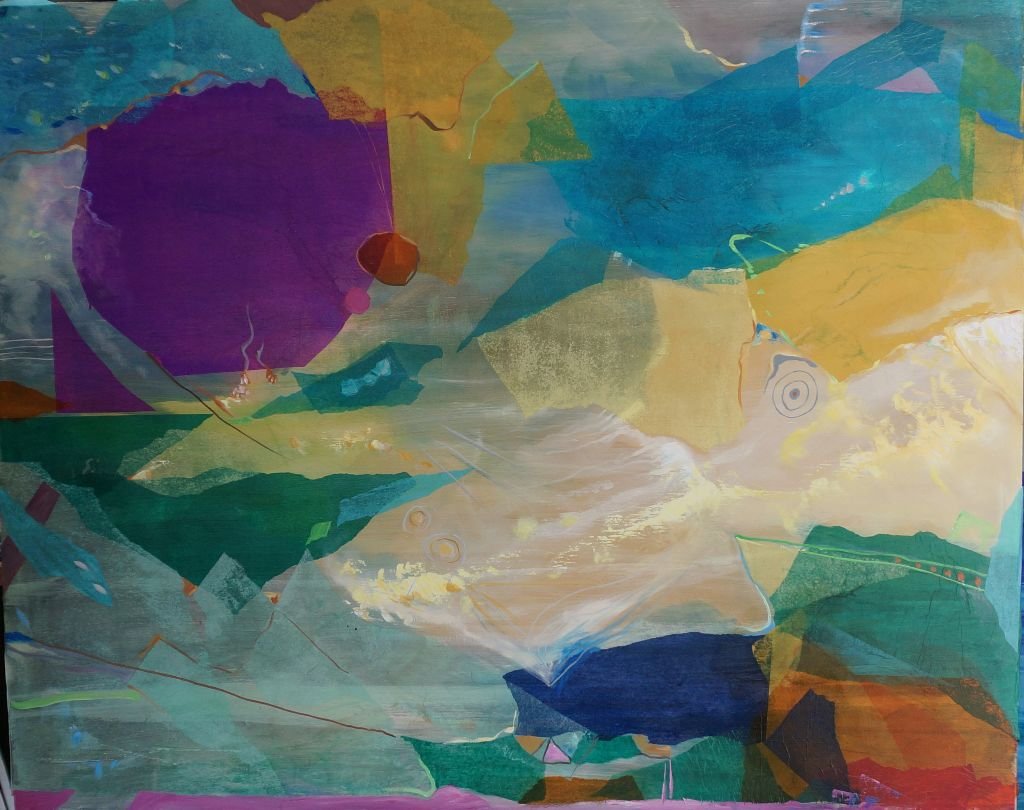
It us curious then that so many artists fall prey to the same beguiling enchantments perhaps because they are not trying hard enough or maybe someone just has not turned the light on for them.  When we take art down from its pedestal and we are staring at a blank canvas, can we put aside identification with form for just one painting?  Can we re-discover color for colors sake?  Try mixing a tone that pleases you and place it on the white canvas.  Study it.  What would go nicely next to it?  What would blend it nicely?  Curiously some colors tend to even express a certain shape (elicit a certain shape) and so now there are colors being placed with a certain shape and even rhythm.  This is a wonderful experience.

What is going on with this practice?  It is simply allowing yourself to experience pure color – the joy of color.  There are multiple variations to explore.  Free yourself of form, some grand theme and experiment with the application of color.  Try to do on a fairly large platform – not too small.  This is the beginning of abstract painting.  It is what you used to do as a child so you will find yourself coming full around.