Posted on Leave a comment

Creating a Collage Abstract

Creating a collage abstract is yet another excellent way to begin expressing yourself.  In previous articles I have talked about how and why to be creative with drag paintings.  Drag paintings can be expressive and fun without getting hung up on representing some known form or trying to duplicate on nature.  Collage has that similar characteristic.DSC02678.jpg
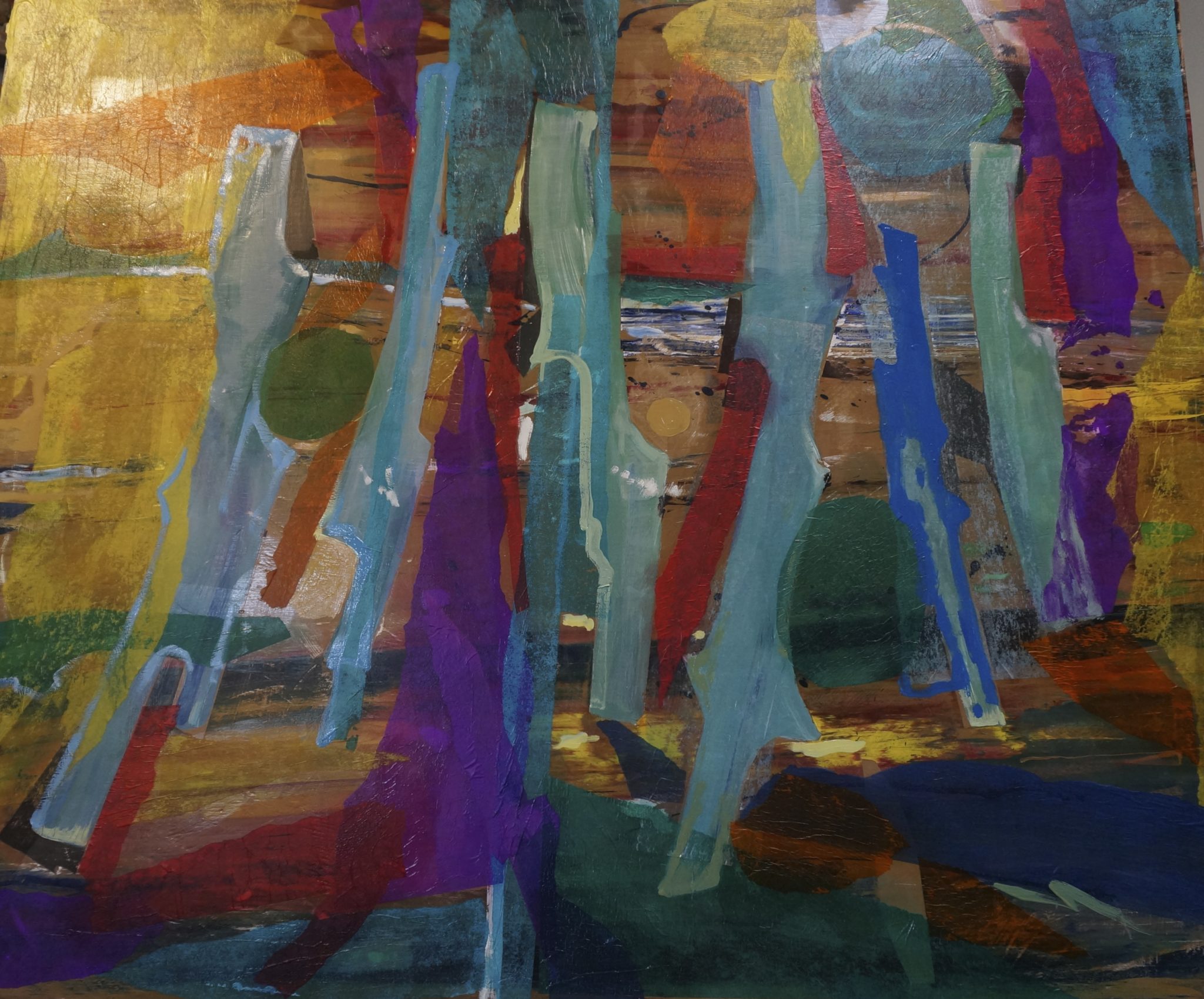
Again, my preference is for board panels which  have been primed and sanded so that the surface is fairly smooth and flat.  This works much better than canvas.  My own preference in working with collage is with tissue paper.  I use colored tissue paper which comes in a remarkable array of colors.  The other key ingredient is water based varnish and a good wide brush.  I also have on hand several small plastic spatulas.  I typically tear the tissue paper into shapes.  This is an abstract so precise cuts and tears are not necessary.  I approximate where the piece will go and then lay on a coat of varnish.  I then apply the tissue paper and brush it out thoroughly with the varnish brush.  If it appears too mottled or wrinkled then use the plastic spatulas to even the paper out.

That is the basic method.  Overlaying one tissue paper color over another creates of course an entirely different color and this kind of translucence is exciting.  Often surprising effects are created.  Tissue paper collage, by nature is vibrant and exciting.  It is not necessary to cover the entire surface area.  I will often add painting effects to the collage.  After the quick drying varnish dries and after the paint dries I suggest studying the piece.  Inevitably you will see the areas that are weak and those that are holding their own.  The beauty of collage is that you can now add layers to the previous work.  Every layer adds seems to add more interest.  This kind of tearing up of tissue paper and pasting it over with clear varnish creates some astonishing effects – sometimes resembling stained glass.

Ultimately as artists,  these several methods of creating abstract art can be tremendously liberating.  Abstract art, after all, affords us an opportunity to create without worrying about or waiting for some grand theme.  We can just begin and let the piece evolve as it will.  We are realizing that there is more, much more inside us than we give credit.  There seems to be an inexhaustible voice within and abstract work such as collage and drag painting  provides the means for our expression.

Posted on Leave a comment

What is Abstract Art

Anyone seriously considering an art purchase has probably asked themselves, ‘What is abstract Art’?  When did the shift occur from realism to abstraction?  Just what is so special about abstract art?DSC02557

Bending realistic images and painting canvases where there is nothing recognizable was of course a major shift in how we view art.  Most agree it essentially began with Cezanne and then truly exploded with the remarkable output of Wasily Kandinsky.  Cezanne experimented with bending and refracting landscapes and still lifes but it was Kandinsky which evolved the painting process to make no reference to anything visually known.  Entirely new material was manifested.  Apparently the art world was ready because he received acceptance and eventually even embraced as a pioneer.

Abstract art takes us away from viewing a specific subject.  We are forced to look at something that takes our attention to color relationships,  obscure forms and completely different interpretations of style, balance and relationship harmonies.  Abstract art begins to feel more like jazz than structured classical ensembles.

Using traditional oil painting techniques abstract artists began to discover the means to express more authentically inner emotions and sub-conscious responses.  The outer world became less exciting.  The inner world began to be explored and then visually manifested.  We now know that the inner world (our essential self) is far more complex and more vast than our limited mental constructs.  New emerging psychologies are helping us to understand our relationship to this inner life which ultimately connects us to each other – to humanity.   Truly authentic abstract art painted with sensitivity and awareness helps us to bridge over into this new awareness.  Connecting us to our inner selves may be abstract arts more endearing qualities.

Posted on 1 Comment

Television and Art

Television and art are not especially co-compatible.  Invariably those periods when I cut out watching television my artistic productivity increases.  This article is geared towards the artists out there who are struggling with creativity, and if you are I suggest laying off the boob tube for a couple weeks and see what happens.DSC02669

As an example have you noticed what kind of thoughts you go to bed with after spending a couple hours surfing channels?  Nothing very inspiring ?   It is difficult for my mind to turn off the images, especially the sordid and violent images which are so prevalent on T.V.  Being creative requires a fairly clear head and much of the gestation occurs during sleep.  I will often plant an idea in my mind, something I am trying to work out for a painting and go to sleep with it.  After several nights I will often wake up with some kind of creative solution.  Turning off the mental pollution seems to help immensely.

I read about a fairly famous woman artist – a minimalist who admitted often staying in bed sometimes until late in the afternoon until the idea she was after became clear enough to start a painting.  The point is that a gestation period is undeniable.  It is impossible to just come home from work and start in.  With abstrast art especially there is a process of thinking through a piece to get a sense of the concept.  A perfectly clear image is not necessary, but a point of departure is critical.  I say gestation but you could call it meditating on an idea or getting in touch with something deep within, or drawing out a feeling.  Whatever you call it the process is fairly unique to the creative process.

Our instant society is not especially patient and as a result we can get frustrated when it takes awhile for a good, worthwhile concept to develop for a painting.  Clicking on the T.V. is more of this just filling in with white noise but we become mentally polluted in the process and block the creative process.  ALone time is necessary.  I think it is a good idea to have a sketch book in the house…just randomly sketching helps the creative process.

Posted on Leave a comment

Buying Original Art

There was a recent show on NPR Radio last week discussing what original art is.  Both the host and the person doing the show took the position of saying that in fact,  all art is essentially ‘derivitive’.  Their contention was that nothing created is truly original.  I assume they mean that nothing is therefore ‘authentic’.04.jpg

This is an important consideration especially when you are in the market for Buying Original Art.  Listening to the program I was in a large, natural setting with beautiful trees and I began to think about this.  Because a tree comes from a seed does that mean it is not an original and authentic tree?  Well, of course not, right?  It is derivitive of course but that does not take away from this particular tree being very uniquely original.

They cited numerous examples of works of theatre, music, dance and paintings drawing from some previous effort and then producing something out of that -a sort of hybrid, but not an original.  The examples were certainly plausible but somehow not convincing.  I thought of small children painting.  I think we could all say whatever it is they are producing seems very original.  Then I thought of something quite basic to our existence, our breathing.  We do nothing to create it but yet we breathe.  The breath itself, each one is completely original.  With a stick we might draw an oblong shape in the sand…is that shape original?  Does it represent something uniquely our own?  I pictured myself breathing and drawing lazy, loose freehand shapes.

Their contention was that even when we think we are drawing something quite unique, we are nevertheless responding to a vast, corporate reservoir of human experience.  They said it is something like a corporate consciousness and we cannot escape from that large pool of influence.   In spite of that argument I kept admiring the beautiful tree that provided me shade while I lunched.  Perhaps it is that our lives are truly much more original and authentic that we might even acknowledge.  If our very breath is original, why not the red slash across the canvas, the way my voice finds a new octave, the way I alter a recipe?  I personally happen to believe, in the process of creating abstract art we often tap into something quite beyond our own limited consciousness, beyond our own confined set of experiences.  I am certainly not alone in this assertion.  It is a discovery.  It is what draws us to create…the opening up of that mystery and that ‘other’ transcendent consciousness.06.jpg

Posted on Leave a comment

What is Abstract Art

What is abstract art is my second article on understanding abstraction.  I was listening to an interview last night of Gerhardt Richter.  Though the interviewer’s questions were remarkably insipid, his replies were insightful.  There was the distinction made between expression and impression in abstract art – two very distinct processes.  The artist is attempting to express something he or she feels internally.  With expression there  is volition required, a physical effort, planning and execution.  Impression implies an imprint such as what a viewer might receive when looking on a painting.   There is no effort, except for the willingness to absorb the message.

Before however the viewer has a look and when the painting is still in the studio there is the active back and forth between expression and impression.  The artist makes a move, creates and applies and then must stand back to get the impression.  Sometimes the question is asked, ‘Is this what I had in mind, or Is this where I want to be going?’  Richter, who does not believe there is a God stated that he uses his art as a means of discovery, of finding truth, of searching out another dimension of consciousness.  The expression and the impression is a constant and active process, back and forth means to develop an abstract painting.

Because the source is not from natural surroundings ( not of what we see around us) DSC02559 the artistic expression comes in large part from the sub-conscious.  It is certainly a co-mingling of the aggregate of our experiences interpreted through our sub-conscious.  This is why we are attracted to abstract interpretations even when there is nothing naturally recognizable.  If we are to understand ‘what is abstract art’, we need to grasp the source.  The source is that vast reservoir which we all have of inner responses, memories and feelings.  These are stored up in our psyche.  An abstract artist over time develops a sensitivity to these inner resources by overcoming or taming exterior or outward impressions – that is, one gains ascendancy over the other.  This opens up enormous opportunities for expression.

Posted on Leave a comment

Abstract Drag Painting Details

In this brief article I shall provide some important details for executing a ‘drag painting’.  Abstract drag painting details will help you get the results you are looking for.  To begin with I would strongly recommend not painting on canvas but using a hard surface such as 1/2 inch plywood.  If you decide to use a larger format, say 36 ” x 42 ” you will need to screw or nail support backers to keep the board nice, straight and flat.01.jpg

Any water base primer will work to prime the plywood or panel surface.  I usually apply at least two coats.  It is necessary to thoroughly sand the surface and then get it clean before starting your drag painting.  You may want to refer to my previous articles but a drag painting is simply applying oil paint with a hard squeege, usually from edge to edge in a slow, steady pull.

Canvas is just too flexible to get a good press with the squeege.  Besides I actually prefer the ply surface because of all the interesting effects that occur when the paint (during drag) gets caught in all the small wood ‘pits’.  There are several good methods of dragging.  One is to press hard and drag.  This leaves a thin skin of paint on the primed surface.  I will usually look for patterns and play with them, dragging back and forth to accentuate those emerging patterns.  Often with this heavy press method the actual grain of the ply will emerge even through the primed surface.  The other method is to apply the paint more thickly and drag that side to side.  Across the board this will create its own affects depending on where you placed your pigment.  I tend to squeeze paint direct from the tube in random placement across the surface.  As the paint is dragged it will pick up and disburse the oil paint.  On the first pass try to go all the way from edge to edge.  You will be surprised at the very interesting accidents created as the pigments mix on the surface.

Look for patterns that have been accidentally created.  Re-drag where you think it will accent these.  Add pigment and drag again in you wish.  Drag paintings often take longer to dry due to the heavy use of oil pigment.  I set my aside for several weeks and then pull them out and study them.  I am looking for strong or weak areas…areas that are not so interesting will require a new application.  By passing over with new pigment over the existing hues even more interesting effects are created – often certain ‘skips’ that are quite intriguing.  Sometimes I will even come back with selective brush work additions.  This can add visual interest and contrast, though use brush sparingly…try not to have them especially obvious.  You don’t want to detract from the free, spontaneous look of the drag painting.

Posted on Leave a comment

Starting an Abstract Painting

03.jpgIt is possible, to some degree to remove the mystery in starting an abstract painting.  There are painters who suggest it is a magical and spontaneous affair,  that it cannot be defined and that the process cannot be understood.  In my own experience I do not find this to be the case.   Kandinsky broke down his own work into several ‘categories’.  When we read how he separated these categories it is clear that he was identifying the process.

In this brief article I will suggest several styles or directions to you.   I think this will be helpful to get you started.  If you already are painting abstracts this might suggest a new direction for you to discover.  The most well-known abstract ‘living’ artist today is Gerhardt Richter.  He is best known for his drag paintings.  This is a method of applying paint to one end of a canvas or board in fairly random gobs and then dragging these across horizontally with a wide, flat squeege.  With his very practiced eye, he produces some wonderful effects.  These effects are part by accident and part by planning.  Not knowing the exact outcome is what makes this process so intriguing.  I have found this to be an excellent way to free oneself from repeating realism.

A second method for abstract painting is what I classify as free form shapes applied by brush.  There are many YouTube videos of this style.  Artists seem to be attracted especially to this means of expression.  Large and small shapes are created in swirling patterns giving the canvas a very free-form, spontaneous effect.  The challenge in this type of painting is having some good fundimentals in color harmony.  However, color can be quite forgiving when one color is juxtaposed adjacent to another.  Often sharp, contrasting lines are added to this type of abstract expression.  This type of art reminds me of good jazz.  There is nothing recognizable, it is definitely spontaneous and relies on sub-conscious responses.  Some artists would say it is an effort to express an inner feeling or a composite of inner feelings. Hans Hoffman was one of the first to paint in this fashion.

A third example of abstract art seems to stem from the cubist movement begun by Braque, Picasso and Juan Gris.  Also the tightly constructed work of Marcel Duchamp.  These are typically more thought out compositions.  They may even have recognizable elements.  Objects, colors and shapes are in defined planes.  Abstract paintings such as these often appear geometric or architectural.  If you have painted realistic scenes of buildings and landscapes and are wanting to express yourself more freely, this type of transitional abstract painting may be an excellent springboard for you.

These are three to consider.  There are of course many.  Starting out with one of these will no doubt help you to define your own vernacular and your own special means of expression.  Emulating another style provides a direction and by studying the abstract artists of the past gives us an opportunity to choose our personal path.

Posted on Leave a comment

Negative Space in Abstract Painting

Negative space in abstract paintingpicasso-three-musicians-1024x922 can be a critical element in the development of your painting.   I had one instructor who especially emphasized the awareness of negative space in both drawing and painting.

Negative space in drawing helps immensely to define and measure the positive image.  In Painting however it creates impact and power by defining typically highlighted elements of a painting – often those important  elements that we want the eye to draw upon.  Negative space tends to recede and of course positive space or (elements) come forward.

It is interesting to discover for yourself how certain colors work towards this negative recessive part.  These colors are often muted and often darker in tone and thus help to thrust an image forward.  Some artists think in terms of contrast which is fine, though heightening awareness of those negative spaces and interweaving them adds a certain vitality to a painting.  Balancing negative and positive spaces should always be considered, even in a free-flowing abstract piece.  It is even true with work by Jackson Pollack.  Studying his work you will see very definite balance of these elements.  This is striking considering the apparent randomness of his so called drip paintings.

One interesting practice is to start with negative forms and let them develop the positive forms rather than the reverse.  By giving these negative forms good shape and by balancing them, the formation of the positive elements will gain even richer, more dramatic force.

Painting example by Picasso.

Article by Michael A. Wilson