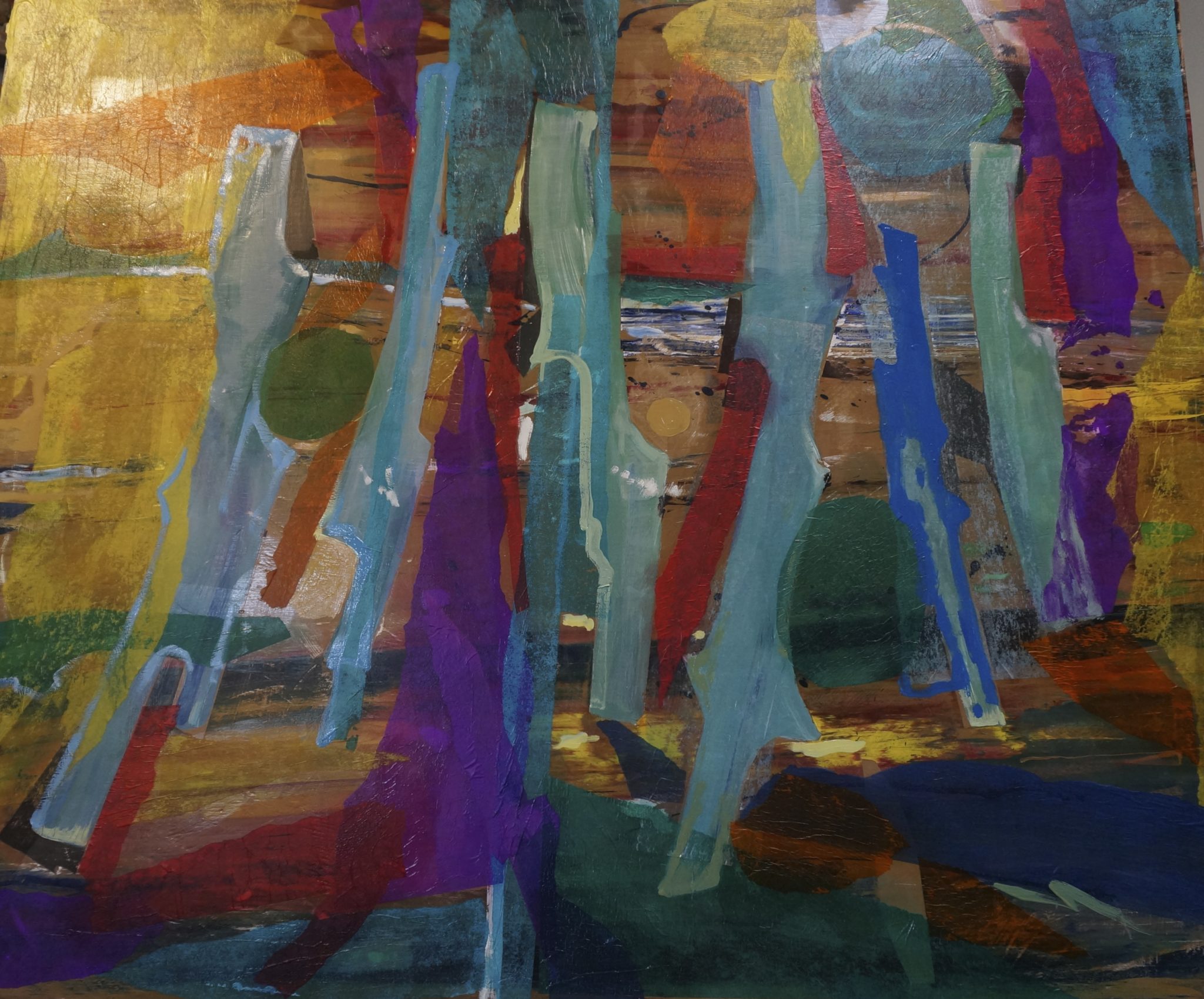
How to break free from the painting of forms? This question is not unlike that which Eckart Tolle poses – the realization that ultimate reality does not lie in form. For the artist even nature itself can prove a distraction because nature as pure as it is, confines us to perceived images. Nature itself is a reflection of form – though often beautiful.
When we as artists are no longer confined to representing nature or even know and familiar objects, when we break free from representation itself, we become in turn more able to express ourselves authentically. This should be the goal- to paint authentically and honestly. 
We live of course in a very complex paradigm. Volatile emotions, reactions and constantly bombarding impressions invade our private selves, our personal space for good or bad. Painting, especially abstract painting provides a means to interpret our responses productively. Just as a poet gropes for understanding in a poem by the use of metaphor, so does an abstract artist grope to discover him or herself by interpreting not what is seen in nature and not what is experienced externally in form, but by responding from a more natural, inner resource.
Abstract expressionist painting becomes a more reliable means of responding to these influences without being constrained to one rigid series of forms – beautiful or plain. For an artist seeking to discover ones’ own authentic and personal response to these constant external impressions, one answer is recognized and that is a turn to the well of internal interpretations. We develop a storehouse of these. We began to create them at a very early age. Art provides the means of expressing these internal responses. The advantage here is that these internal interpretations are wholly our own. We turn them over and over and are constantly juxtaposing them within the matrix of our personal mind and soul to suit our personal
needs. This is an invaluable resource. Surely one of the main purposes of painting in the abstract (even non-objectively) is to discover how to interpret these myriad of personal images by learning to paint more intuitively. It is certainly a process which can be developed – even learned.
There is a certain and distinct volition to this process which propels us to paint. Once it is discovered it is difficult to ignore. I have learned it is important to keep on hand enough canvases to be able to express these discoveries as they well up from within. When gold is discovered you will want to have a pick and shovel handy. These personal impressions which we store come from an unendending well spring. There is great joy in the process, a great joy of expressing something that comes inherently from within. This is why perhaps Kandinsky often painted over three hundred paintings a year- he literally could not keep up. The opportunities far exceeded the means of expressing them.
One interesting study is that of the English painter, Turner. He began as an artist of architecture. His drawings, watercolors and paintings of English City architecture is remarkable. He eventually gravitated to landscape and is now considered historically as one of the greatest landscape artists. His work however became increasingly abstract. In his last works before his death, it seems as if nature was only a mere springboard to express what he was experiencing internally as if his soul bridged across and a synthesis was created between nature and his own vast inner resource. Each of us also has a vast reservoir to tap.
I expect Kandinsky might have been impressed with his discoveries.