Posted on Leave a comment

Creating a Collage Abstract

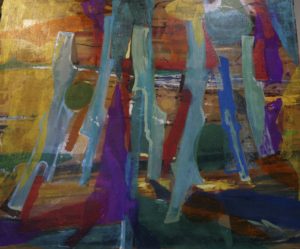
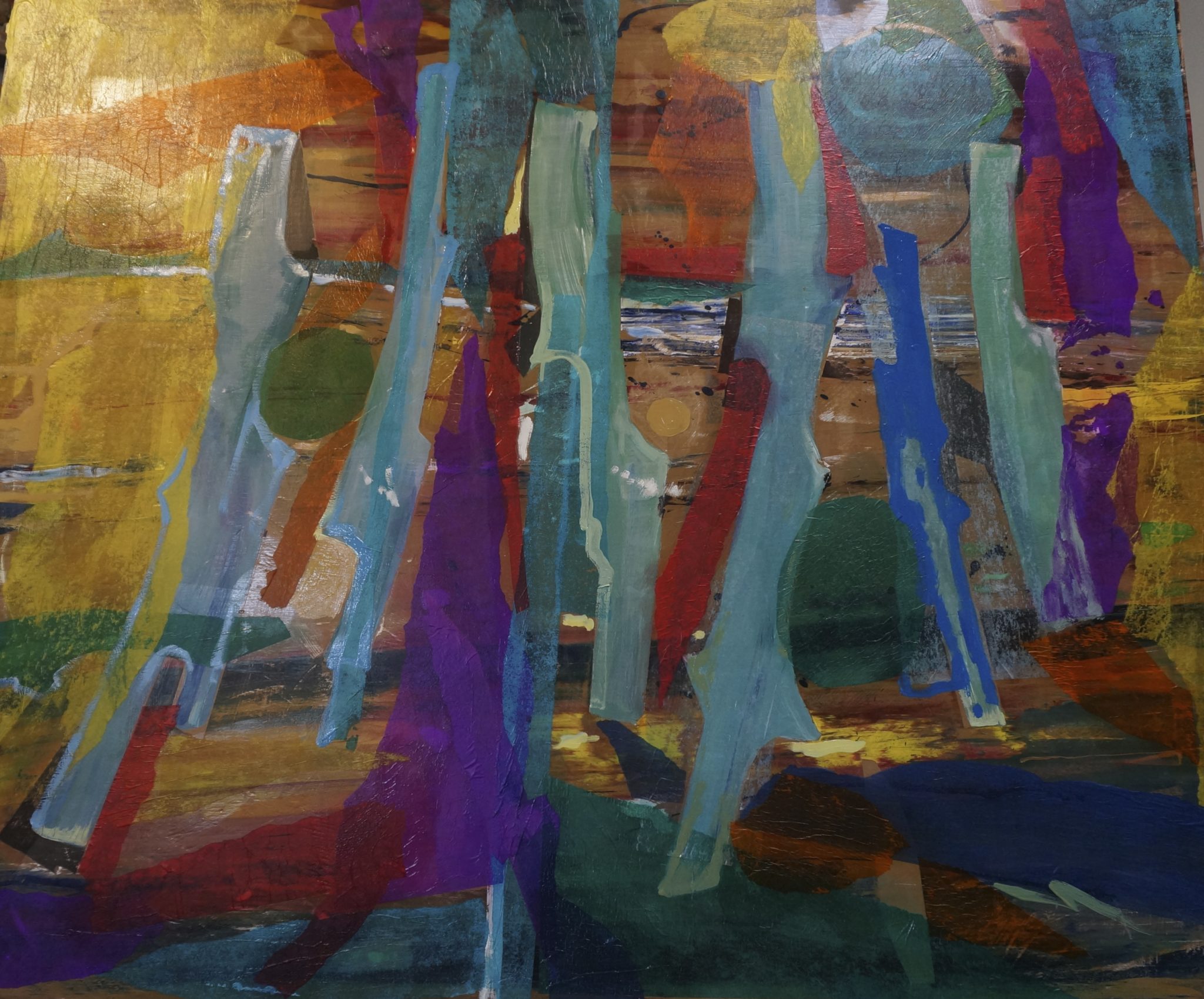
Creating a collage abstract is yet another excellent way to begin expressing yourself.  In previous articles I have talked about how and why to be creative with drag paintings.  Drag paintings can be expressive and fun without getting hung up on representing some known form or trying to duplicate on nature.  Collage has that similar characteristic.DSC02678.jpg
Again, my preference is for board panels which  have been primed and sanded so that the surface is fairly smooth and flat.  This works much better than canvas.  My own preference in working with collage is with tissue paper.  I use colored tissue paper which comes in a remarkable array of colors.  The other key ingredient is water based varnish and a good wide brush.  I also have on hand several small plastic spatulas.  I typically tear the tissue paper into shapes.  This is an abstract so precise cuts and tears are not necessary.  I approximate where the piece will go and then lay on a coat of varnish.  I then apply the tissue paper and brush it out thoroughly with the varnish brush.  If it appears too mottled or wrinkled then use the plastic spatulas to even the paper out.

That is the basic method.  Overlaying one tissue paper color over another creates of course an entirely different color and this kind of translucence is exciting.  Often surprising effects are created.  Tissue paper collage, by nature is vibrant and exciting.  It is not necessary to cover the entire surface area.  I will often add painting effects to the collage.  After the quick drying varnish dries and after the paint dries I suggest studying the piece.  Inevitably you will see the areas that are weak and those that are holding their own.  The beauty of collage is that you can now add layers to the previous work.  Every layer adds seems to add more interest.  This kind of tearing up of tissue paper and pasting it over with clear varnish creates some astonishing effects – sometimes resembling stained glass.

Ultimately as artists,  these several methods of creating abstract art can be tremendously liberating.  Abstract art, after all, affords us an opportunity to create without worrying about or waiting for some grand theme.  We can just begin and let the piece evolve as it will.  We are realizing that there is more, much more inside us than we give credit.  There seems to be an inexhaustible voice within and abstract work such as collage and drag painting  provides the means for our expression.
Posted on Leave a comment

Large Abstract Art for Office Walls

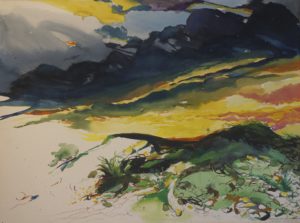
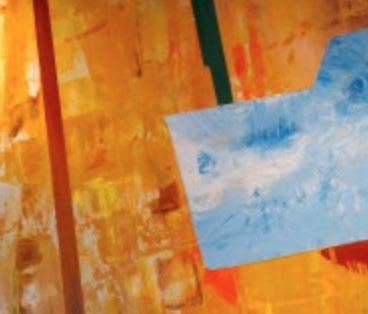
The use of large abstract art for office walls adds character and interest to an otherwise bland interior.  Large abstract art is often placed in foyers or long hallways but also in individual offices.DSC02539.jpg

Here is a quick primer on selecting abstract art for your office environment :  Scale is critical.  Choose a piece of art that has a scale that fits the location…too often a painting is selected which is too small and is dwarfed by the surroundings.  A painting should be about three feet off the ground and two to four feet from the ceiling.  The painting should have an impact on the space.

Abstract paintings typically come with four or five distinct styles.  A first category would be geometric abstracts where hard, sharp lines define the spaces and shapes.  A second would be what I call organic abstracts where all shapes and lines are not straight or linear but softly curved.  A third style uses very dramatic, sweeping segments which may represent nature.  Cubistic abstracts are still very interesting, often denoting city scapes.  Richter made famous the drag paintings and these tend to be very elongated, horizontal impressions which also are quite dramatic adding impact to an interior wall space.

Interior designers can be helpful in choosing a style or genre.  Artists themselves can be consulted, often providing a no cost initial consultation to determine which type of painting would work in a particular environment.  Sometimes where there are many, many walls such as at universities or hospitals a theme will be chosen.  This theme might revolve around a certain color scheme.  By its nature abstract art often translates very well in large scale – something more realistic scenes are unable to accomplish.  Large abstracts come either framed or un-framed and original paintings can be truly stunning – greatly enhancing interior environments.

Posted on Leave a comment

Why Paint Abstract Oils ?

Many emerging artists will eventually ask themselves, why paint abstract oils?  Or even further, why paint non-representational art or art that has no reference whatsoever to known objects?  Painting abstractions of course is mis-leading because it can imply that a vase or a cup or a tree is recognizable but has been bent or elongated through artistic abstraction.   Both non-representational and abstract art expression provides an important vehicle for authentic artistic expression.DSC02678

When the breakthrough painting by Marcel  Duchamp, Nude Descending the Staircase, was presented it shocked the art world.  It is almost a shame that he titled the painting because without a title the viewer needs to look more deeply to discover the painting.  It is indeed a figure or figures descending a stair.  There is great movement, wonderful dynamics and force, even with a limited pallete.  Why did he depart from a realistic image to this abstraction of form?    It might be simply that he was attempting to paint more authentically.  He wanted to paint a certain vital essence.  By concentrating too much on the nature of form he would have neglected the great action.  This effort paved the way for an entirely new way to paint on canvas – one that relied on an inner response and not one that pointed outwards to some exterior form or place or person.

Kandinsky went further by making no reference to any known form.  In Duchamp’s painting if we look carefully, we can see the abstracted cubist form descending.  In Kandinsky’s work shapes and designs stand on their own merit without reference to anything beyond themselves.   This direction in painting can be exhilarating.  It can free up various hang-ups, especially the need to accurately represent something real.  As an artist you might measure yourself with how well you represent a scene or a still life or a face, but this can be limiting and even detrimental to creative growth.  Allowing for freer expression by painting abstractionally can help to discover your own personal style.

Fortunately art (painting)  is evolving just as music, dance and architecture evolves.  We no longer need be tied to reality.  There is a strong inner realm that we can experience which often more directly reflects our own personhood.  By responding to internal feelings rather than external sources we come in contact with something very valuable and also very powerful.  This alone is an excellent reason to paint abstract oils.

Posted on Leave a comment

Buying Modern Art

So, you are interested in buying ‘modern art?’   Christies is celebrating.  Mucho dolares for some new Picassos on the market fetching over $100 million.  Crazy?  Of course it is crazy.  Investors think  he is a safe haven for art investment.  Maybe they are right…who really knows?  We know that modern art is rising.DSC02726

They say his work is still today fresh and relevant.  Maybe it is.  The critics should know, right?  But if you want to buy good modern art there are so many other options out there.  There are wonderful, exciting emerging artists producing also fresh, new, original work.  These can be found in galleries and of course on line.

Don’t be disheartened by the high prices paid for masters such as Picasso and Miro.  Really fantastic work can be purchased for as low as $5,000.  These are originals by emerging, eager new artists from around the world.  The beauty of the internet is that it makes available wonderful work from all around the globe.  Everything can be shipped.  Personally I am taking a brief hiatus from so called ‘modern work’ to pursue some interests in self portraiture and also with the use of glazes.  The masters who painted before Picasso used glazes and varnish intermediate coats extensively.  I have been experimenting with these old methods on some new work.  I will probably be posting them sometime in May.

Art for everyone!

Posted on Leave a comment

Fear and Art

Fear and art is an interesting title, right?  Why should there be any fear in artistic expression?   There is a new art book out.  This one is different.  It is by an artist from Scotland and is a coloring book for adults with elaborate ink drawings of trees, vines and forest animals.  I think this is a great idea, especially when our time is limited and we don’t have the time to invest in coming up with our own ideas but want to paint and color for relaxation.DSC02676

For the more serious artists however…those who have a deep urge to create but are troubled about fear of failure, there are some things I have learned over the years.  This fear or we may call it simply ‘servere self-consciousness’ sets in early.  Pre-adolescence, peer pressure and the great need to fit in, often is the time when we become self-conscious of what we create.  It can even set in much earlier – age eight or ten, which is a shame because art can be a wonderful way to express our feelings.  Children should be encouraged to create and express themselves through the arts.  Fear and art, should not go together.  They should be separated.  Art should be a time when fear melts away, both for children and adults.

Fast forward to when we grow up and we are young adults.  We have a little better handle now on our place in society and our confidence (hopefully) has grown.  We are not as concerned about what others might think.   Sometimes it takes an active ‘pushing out mental process’- that is, pushing out negative thoughts or any thoughts at all.  Just getting in touch with our feelings or appreciating simple, natural things can often be enough to get us started painting or drawing.  It can start small with a private drawing pad.  You don’t need to share it.  Simple drawings, almost like a diary can also be colored.  This basic form of expression can then lead to an art class or buying some supplies and starting to experiment with color mixing and discovering the world of painting.  I suggest starting with acrylics.  You can buy simple canvas boards cheaply.  Have a glass of wine while you are painting – ha.  Just enjoy yourself.  When I was a kid we would tune in to the painting shows on T.V. but now we can find just about anything on YOuTube.  The important thing is to start, just start drawing and this will probably lead quite naturally to painting.

Posted on Leave a comment

What is Abstract Art

Anyone seriously considering an art purchase has probably asked themselves, ‘What is abstract Art’?  When did the shift occur from realism to abstraction?  Just what is so special about abstract art?DSC02557

Bending realistic images and painting canvases where there is nothing recognizable was of course a major shift in how we view art.  Most agree it essentially began with Cezanne and then truly exploded with the remarkable output of Wasily Kandinsky.  Cezanne experimented with bending and refracting landscapes and still lifes but it was Kandinsky which evolved the painting process to make no reference to anything visually known.  Entirely new material was manifested.  Apparently the art world was ready because he received acceptance and eventually even embraced as a pioneer.

Abstract art takes us away from viewing a specific subject.  We are forced to look at something that takes our attention to color relationships,  obscure forms and completely different interpretations of style, balance and relationship harmonies.  Abstract art begins to feel more like jazz than structured classical ensembles.

Using traditional oil painting techniques abstract artists began to discover the means to express more authentically inner emotions and sub-conscious responses.  The outer world became less exciting.  The inner world began to be explored and then visually manifested.  We now know that the inner world (our essential self) is far more complex and more vast than our limited mental constructs.  New emerging psychologies are helping us to understand our relationship to this inner life which ultimately connects us to each other – to humanity.   Truly authentic abstract art painted with sensitivity and awareness helps us to bridge over into this new awareness.  Connecting us to our inner selves may be abstract arts more endearing qualities.

Posted on Leave a comment

Using Glazes in oil painting

Using glazes in oil painting can create a beautiful mood.   Recently I painted an early morning landscape scene.  Upon completion the colors seemed too vivid and too bright for the affect I was after.  I mixed deep dark purple, blue shade with thinners for a glaze.  When the paint was dry I brushed this on the entire painting…finishing with a broad brush and kept brushing out until the dark blue glaze was very even across the board.  DSC02667

Of course the entire painting was muted, the vivid colors were now subdued with an even misty, early morning patina.  This was exactly the affect I was after.  This is a good example of how glazing can be used to excellent advantage.  It seems as if a dark veil was pulled over the entire painting and all the colors were equally muted which is the look of very early morning just before the sun rises.

If you are reluctant to try glazing, try painting several vivid hues on a small canvas and then mix the soupy glaze of some pure tone.  The oil underpainting must be allowed to dry.  Make sure it is thin enough to the point where it is almost running down the canvas.  I cover the entire piece with the wet brush and then come back with a larger, dry brush and spread it all out even until it begins to set up.  Using a small test sample like this will give you confidence for larger, more complex paintings.

The masters would often use multiple glazes.  They would also isolate areas and glaze only certain sections of the painting.  Glazes not only darken and subdue a painting but can also brighten an area depending on the color you select to create the glaze.  Regardless it will be necessary to varnish the entire work upon completion to unify the refractions and to give the final painting a more pleasing finish patina.

Posted on 1 Comment

Television and Art

Television and art are not especially co-compatible.  Invariably those periods when I cut out watching television my artistic productivity increases.  This article is geared towards the artists out there who are struggling with creativity, and if you are I suggest laying off the boob tube for a couple weeks and see what happens.DSC02669

As an example have you noticed what kind of thoughts you go to bed with after spending a couple hours surfing channels?  Nothing very inspiring ?   It is difficult for my mind to turn off the images, especially the sordid and violent images which are so prevalent on T.V.  Being creative requires a fairly clear head and much of the gestation occurs during sleep.  I will often plant an idea in my mind, something I am trying to work out for a painting and go to sleep with it.  After several nights I will often wake up with some kind of creative solution.  Turning off the mental pollution seems to help immensely.

I read about a fairly famous woman artist – a minimalist who admitted often staying in bed sometimes until late in the afternoon until the idea she was after became clear enough to start a painting.  The point is that a gestation period is undeniable.  It is impossible to just come home from work and start in.  With abstrast art especially there is a process of thinking through a piece to get a sense of the concept.  A perfectly clear image is not necessary, but a point of departure is critical.  I say gestation but you could call it meditating on an idea or getting in touch with something deep within, or drawing out a feeling.  Whatever you call it the process is fairly unique to the creative process.

Our instant society is not especially patient and as a result we can get frustrated when it takes awhile for a good, worthwhile concept to develop for a painting.  Clicking on the T.V. is more of this just filling in with white noise but we become mentally polluted in the process and block the creative process.  ALone time is necessary.  I think it is a good idea to have a sketch book in the house…just randomly sketching helps the creative process.

Posted on Leave a comment

Buying Original Art

There was a recent show on NPR Radio last week discussing what original art is.  Both the host and the person doing the show took the position of saying that in fact,  all art is essentially ‘derivitive’.  Their contention was that nothing created is truly original.  I assume they mean that nothing is therefore ‘authentic’.04.jpg

This is an important consideration especially when you are in the market for Buying Original Art.  Listening to the program I was in a large, natural setting with beautiful trees and I began to think about this.  Because a tree comes from a seed does that mean it is not an original and authentic tree?  Well, of course not, right?  It is derivitive of course but that does not take away from this particular tree being very uniquely original.

They cited numerous examples of works of theatre, music, dance and paintings drawing from some previous effort and then producing something out of that -a sort of hybrid, but not an original.  The examples were certainly plausible but somehow not convincing.  I thought of small children painting.  I think we could all say whatever it is they are producing seems very original.  Then I thought of something quite basic to our existence, our breathing.  We do nothing to create it but yet we breathe.  The breath itself, each one is completely original.  With a stick we might draw an oblong shape in the sand…is that shape original?  Does it represent something uniquely our own?  I pictured myself breathing and drawing lazy, loose freehand shapes.

Their contention was that even when we think we are drawing something quite unique, we are nevertheless responding to a vast, corporate reservoir of human experience.  They said it is something like a corporate consciousness and we cannot escape from that large pool of influence.   In spite of that argument I kept admiring the beautiful tree that provided me shade while I lunched.  Perhaps it is that our lives are truly much more original and authentic that we might even acknowledge.  If our very breath is original, why not the red slash across the canvas, the way my voice finds a new octave, the way I alter a recipe?  I personally happen to believe, in the process of creating abstract art we often tap into something quite beyond our own limited consciousness, beyond our own confined set of experiences.  I am certainly not alone in this assertion.  It is a discovery.  It is what draws us to create…the opening up of that mystery and that ‘other’ transcendent consciousness.06.jpg