Posted on Leave a comment

Techniques in oil painting

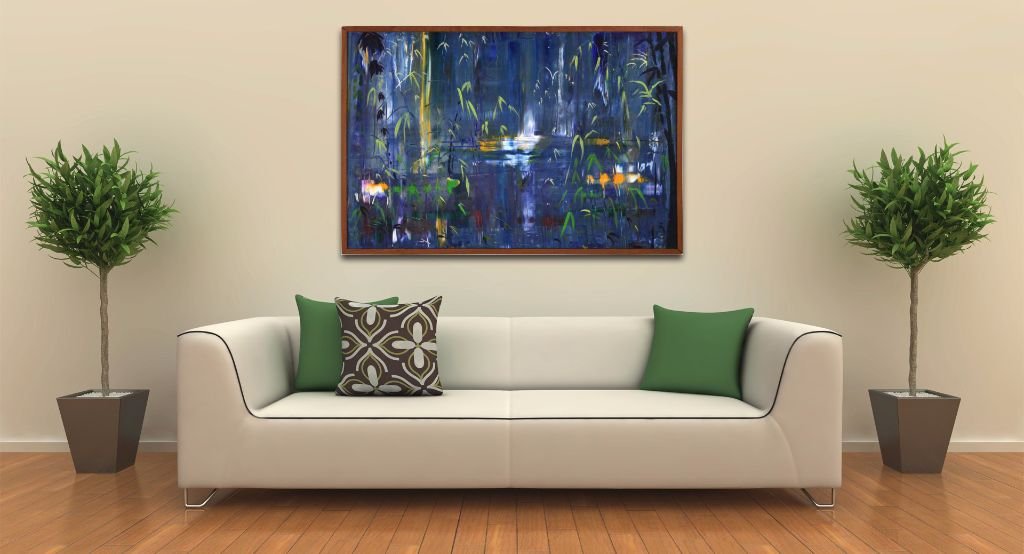
This is my fourth article on techniques in oil painting and will describe the very early conceptual stage vital to a successful painting.  My reference is of course painting abstracts so my process requires more careful explanation.  I hope you as a beginning painter will find this helpful.  DSC02672
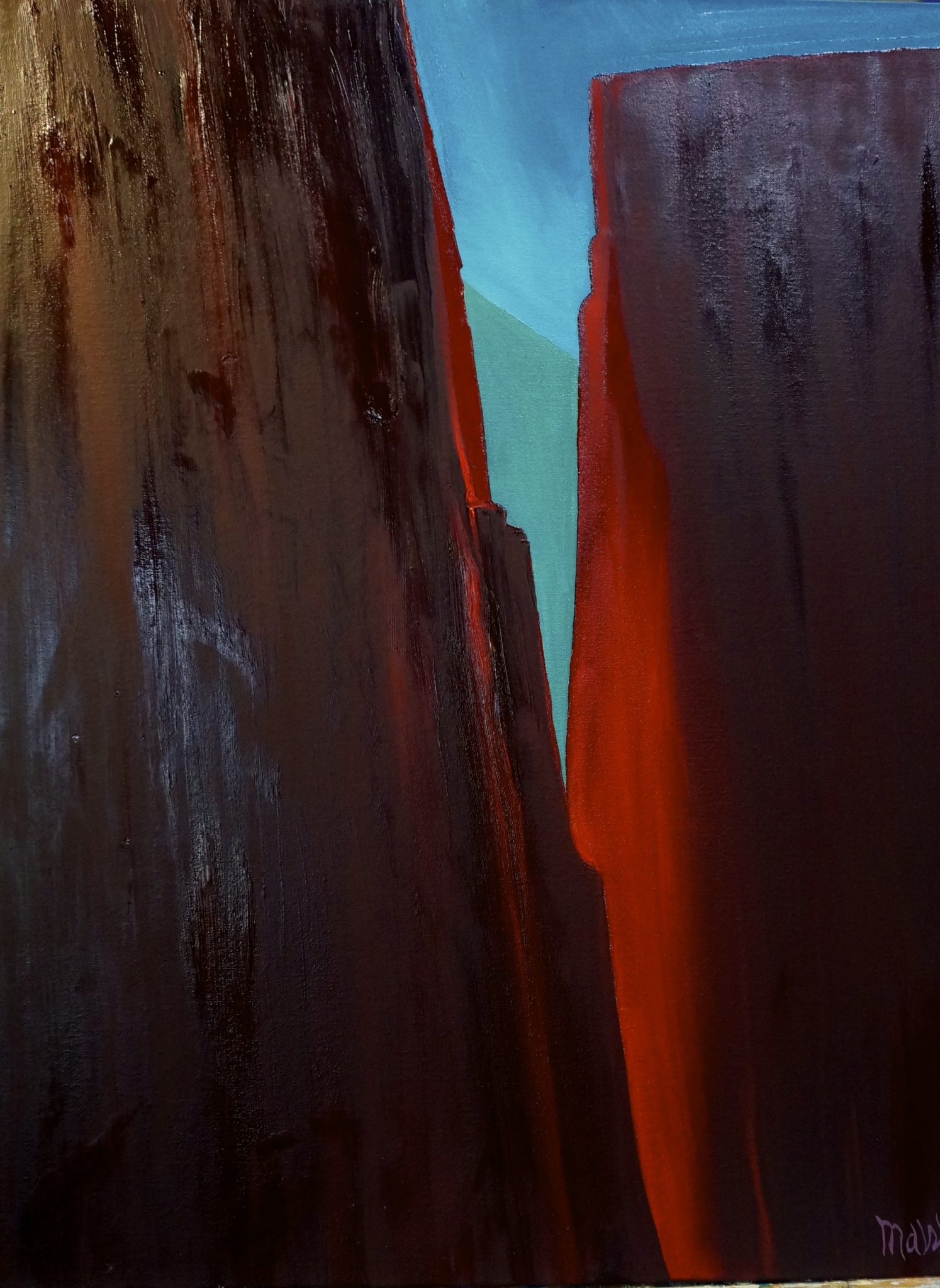
I do keep art books around and look at them.  My purpose in perusing art books is not to get an idea but to stimulate myself visually and to understand more carefully what stimulates me personally.  It might be something as simple as a certain hue that Picasso used in a background, or an interesting contrast of shapes that Kandinsky used in a painting.  Watching television, excessive telephone use or Ipad connectivity is a distraction.  I am attempting to ‘clear the slate’ to allow for something new and fresh and authentic for myself.  We live in a world of distractions and it takes effort to distill what is important to us personally.  I call this a gestation period.

When I am wanting to start a new painting I will often go to bed early and then in waking wait awhile to get up.  I try to open myself up with the purpose of starting a painting.  I don’t necessarily ‘picture’ the blank white canvas nor am I trying to conceive of a theme.  This is a good time to practice control of distracting thoughts.  Keep bringing your mind back to the purpose of locking in on a feeling or color or image that begins to resonate.   I have come to call this Initial Subject Impression.  Initial because it is the very first germ of the idea – the formulation.  Subject because we need a physical form, an anchor to start with, even if it is just a rudimentary simple form.   Impression because ultimately we are mentally and emotionally locking in on an impression – a form, a color, an emotion is making an imprint on our personal psyche.

This process might come about spontaneously but often I find it is a process of searching inwardly for a particular essence.  It is not unlike a meditation.  Of course you can by-pass this process but typically the result will lack power, force and vitality.  Give yourself some time and learn to embrace this all important period of gestation. The Initial Subject Impression  is for me like finding a valuable pearl in the barren field.  Of course sometimes the impression has more force and vitality than at other times but especially with an abstract work, this is critical to the conception and eventual physical process of painting.

As I have said many times before in previous articles, fortunately the initial thrust of the painting does not require a total theme.  Once begun a painting has a remarkable way of taking on its own life.  It begins to form itself once the impetus has been provided.  It is almost as if we are, as the painter a facilitator of a larger design and a more universal concept.  We are expressing a small passage of a greater design and this can be tremendously exhilarating.

In summary remember to reduce the bombardment of distractions by getting off by yourself…turn off the T.V. and take some walks.  Go to bed early and settle down, try to get in touch with your inner self, get control of your own thinking by focusing on what you are trying to accomplish.  Visually stimulate your mind by looking at good art and ascertain what resonates particularly with your own psyche.  Don’t worry about a grand theme, but be satisfied when you get a decent fix on an emotion or simple image that moves you or even a particular color that you want to express…Most abstract paintings begin with the smallest of concepts.  One of my more successful paintings came to me in a remarkable way –  for several weeks I had been formulating the third painting of a triptych series.  It was to be a large piece and the canvas had already been set out in the studio.  Mentally I kept mulling it over, making sketches, developing the concept – the gestation process as mentioned above.  When I went to bed I knew I would be getting up the next day to start the painting – a Saturday.  However when I woke up I was astonished to have in my mind a remarkably clear image of what I wanted to paint and it was nothing like what I had been formulating for the past several weeks.  I went immediately out to the studio and painted…five hours later it was completed and I felt I had put it down fairly accurately to what I had envisioned.  Now that was unusual but in retrospect, without those several weeks of gestation I would not have arrived at the ‘new image’ which came to me so suddenly and so clearly.  It was an example of the Initial Subject Impression being unusually clear, strong and powerful.  This however is not the typical process and I certainly would not condone waiting for this kind of initial starting impression.  Better to implement the process I have described above as a means to creating consistent abstract work by beginning with a fix on a simple and reduced image.  This will inevitably expand on its own once it has begun.
Posted on 1 Comment

Starting a drag painting in oil


STARTING A DRAG PAINTING IN OIL

From previous articles I have tried to describe the process of starting a drag painting.  Without some motivation, some method even – a painting will sit dormant within one’s psyche, unmanifested.  I have also mentioned in the past that there is no need for some grand theme, some profound thought or something that resembles symbolism.  These certainly will come, for example we can see symbolism in so many things.  Today at the stop light the young man behind me took out and lit a cigarette while we waited in traffic.  There was an edge to him, a certain nervousness as he tapped and popped out a cig., then lit.  There was a furtive look in his eyes as if he was not quite sure how this day would turn out – for the better or for the worse.  When the light turned green I pulled forward to make the first left as he drove by to the side in his black, noisy’ guys truck’ – vroom.  Right there is a lot of symbolism that I might interpret…all kinds of layers having to do with ‘if there is true peace in our lives and what might be the right path?..’  Or just the eagerness of youth, the searching and even the bravery of becoming a man or woman – expressing themselves, discovering their own unique motivations. All kinds of imagery and symbolism.02

But that is not the stuff paintings should be made of.  It tends to appear false, plastic and disassociated.  It is the kind of intention that stops too many artists from actually painting.  I think too often we are straining to paint something significant.  IF we do not paint then we are not truly artists.  The process must be much more intuitive and inspired  not from external influences but by internal responses.  These responses come often in the most slight bits of information, small visual ticks, short, brief hints that sometimes appear only as feelings or sentiments but portend much larger contexts.  We need to respond to these as authentically as we can.  It may only begin with just a very small brushstroke.  The thing that fascinates me about drag painting is that the brushstroke is then dragged off by a small plastic squeege.  The plywood then shows through and there is a distinct accidental quality to the two processes – first the brush applying the pigment and then the squeege dragging most of it off, indenting into the pores of the wood.

Inevitably, if you will just get it started, the motivation to work more will tend to rise up if we can keep from being distracted.  A very large part of being an artist resides in his or her ability to block out distractions – both mental and outside of us.  It might be like playing in a concert as a musician.  The same concentration is required and more so because something is being created that is completely reliant on an organic response and then transmuted to a physical response by the artist’s hand.  We are indebted first to the impressionists who declared that what was before them, without contrivance was quite adequately beautiful.  They created their beautifully intuitive paintings with honesty, trying to be authentic to the impression.   In a similar way, so do abstract artists, only they are transmuting something honestly from an inner source.  THese inner sources often just unfold in small windows.  We open one and then discover another, and then another.  It is a fairly natural process which sometimes feels quite magical.  The key is allowing yourself time to open that very first window – that small dab of impression as when a child makes an arc in the wet sand.    Because of its inherent accidental qualities, drag painting  is an excellent way to begin to paint abstractly.  By starting a drag painting in oil you will be surprised at the good results.

Posted on 1 Comment

What is an art studio

Photo of artist in front of painting

There is a very distinct difference between the education system that I came out of and the experience of the art studio.  It lies fundamentally in the fact that by and large our education system does not deal in problem formulation but only in problem solving – the answer of course is always at the back of the book.  We are solving problems which have already been thought through…there is already an answer.  Our job as students is to discover through study that one answer.DSC02725

The experience in an art studio – at least mine,  is the very first thing is to formulate the problem to solve, which is vastly more complex that solving a prescribed problem.  What does that mean to formulate the problem to solve?  In my view it goes very deeply into the existential question of discovering one’s own self and because each of us is unique and individual we must do the hard work of creating our own particular formula – our own blueprint to follow, our own map to chart.  This is after all at the core of the creative process.  In the purest sense the art studio is where we discover our own personal inner selves, our own essence and our own unique experience.  Even if the studio is only a corner of a closet with a small desk lamp, this must be the place where form is expressed from an inner awareness, an inner discovery.  Art is manifestation but only after the artist first lays out a course of formulation.

The so called artistic formula however is in my experience constantly in flux.  Every small increment of growth, every artistic expression that becomes manifested opens an even new portal and so our old formula is outdated right away.  We find ourselves searching yet again, like peeling off the petals of a rose we discover the need for yet another formula relying, by the way, on intuition and a certain sensitivity to inner impressions.  The much heralded artist Francis Bacon created a decent enough formula for his own personal discovery but then froze it in time.  He shut himself off from any future portals.  He just keeps re-examining and re-hashing an old formula for personal growth and very quickly got himself caught in an eddy.  This is my view.

An art studio to have any real purpose and any real vitality must strive to be authentic.  I believe fervently that authenticity must be immensely sensitive to each and every small inspiration and then, once discovered must begin again from that new vantage point.  This is artistic advancement, this is artistic growth – but it is also and no less important, personal inner growth.  I expect the word formulate must be related to the term fermentation which we all know is that chemical response that causes vapors to create spirits.  This is so vitally important to an artist – this process of allowing ourselves to discover our own personal images.  There is meditation involved.  There is effort here to get a ‘fix’ on something and this is what I mean by formulation and then, with that fix (even if initially vague) begin the creative process. We are not artists if we are not expressing – we cross over from being formulaters and become artists.  The formulation of the problem which is our own personal interpretation of our ‘condition’ should be conscientiously sought after before the work commences.  This is what gives life to a painting and its relative force.

Fortunately for the artist, again in my experience, we can definitely begin with just a kernel of conception.  Our own personal formulation might be disturbingly illusive and so, we need courage to begin the process of manifestation.  Very small beginnings will often open up incredible new vistas of expression – one movement of the brush seems to trigger another slightly different movement, one hue seems to inspire an adjacent and contrasting hue.  A certain vibration that was just hinted at in early formulations begins to take on a truly resonate tone, a vibrant tone.  This is when a painting truly begins to develop its own energy and force.  This is why abstract art can be such an invigorating way to discover oneself as an artist.  This is the kind of thing that should be occurring in the art studio.

Posted on Leave a comment

Techniques in oil painting abstracts

This would be my third article in describing specifically the technique of ‘drag’ painting.  This is essentially the same technique that Gerhard Richter explored though on a much larger scale.  Techniques in oil painting abstracts vary considerably.DSC02979

As I have mentioned before I find that canvas is not suitable…my own process uses 1/2″ plyboard which I prime and sand at least twice and sometimes three times to create a very smooth surface.  Even with all that priming the patterns of the ply still show through which I incorporate and use in the painting to good effect.  The attraction in the drag painting process is the allowance for accidental effects – when the pigment is placed on one side and then dragged with pressure all across the length of the board, it is impossible to know what will actually occur.  Other pigments which are also dragged above and below mix and co-mingle with the others and these create even new colorations.

In more recent works I have begun to use a smaller squeege and in sections completely drag through to the patterned ply to reveal the grain.  The resultant color leaves an interesting ‘stained’ effect and by doing this all over the board an overall design is created.  The intention is to create a harmony of pattern across the entire piece.

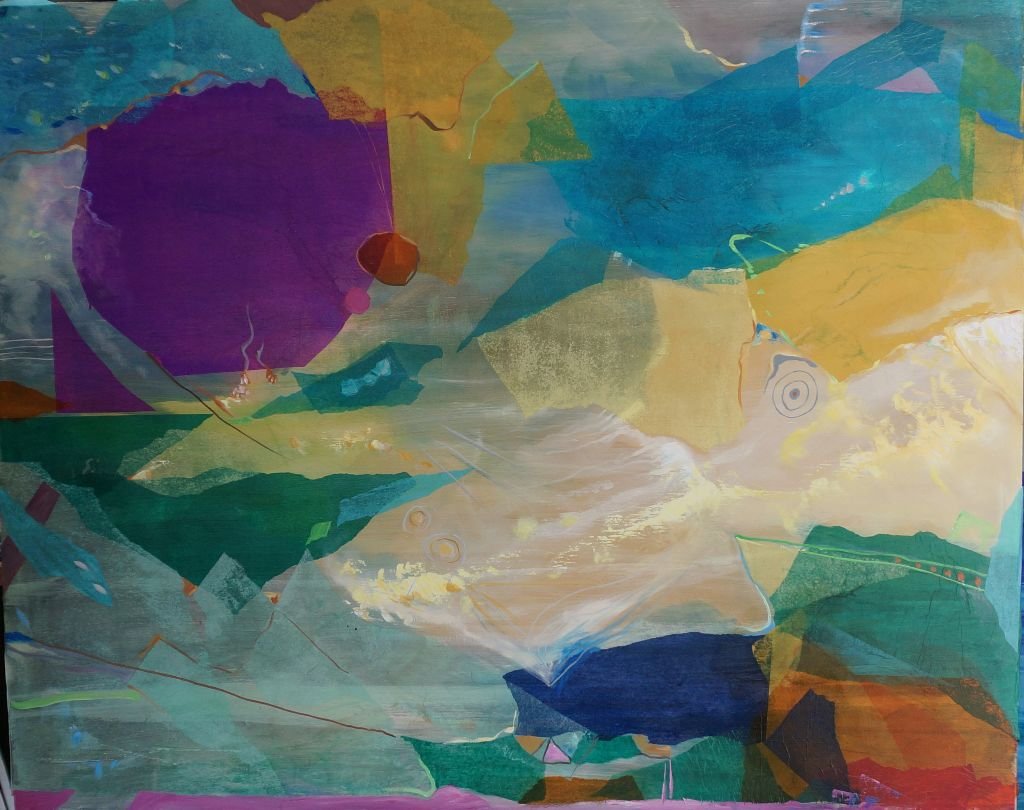
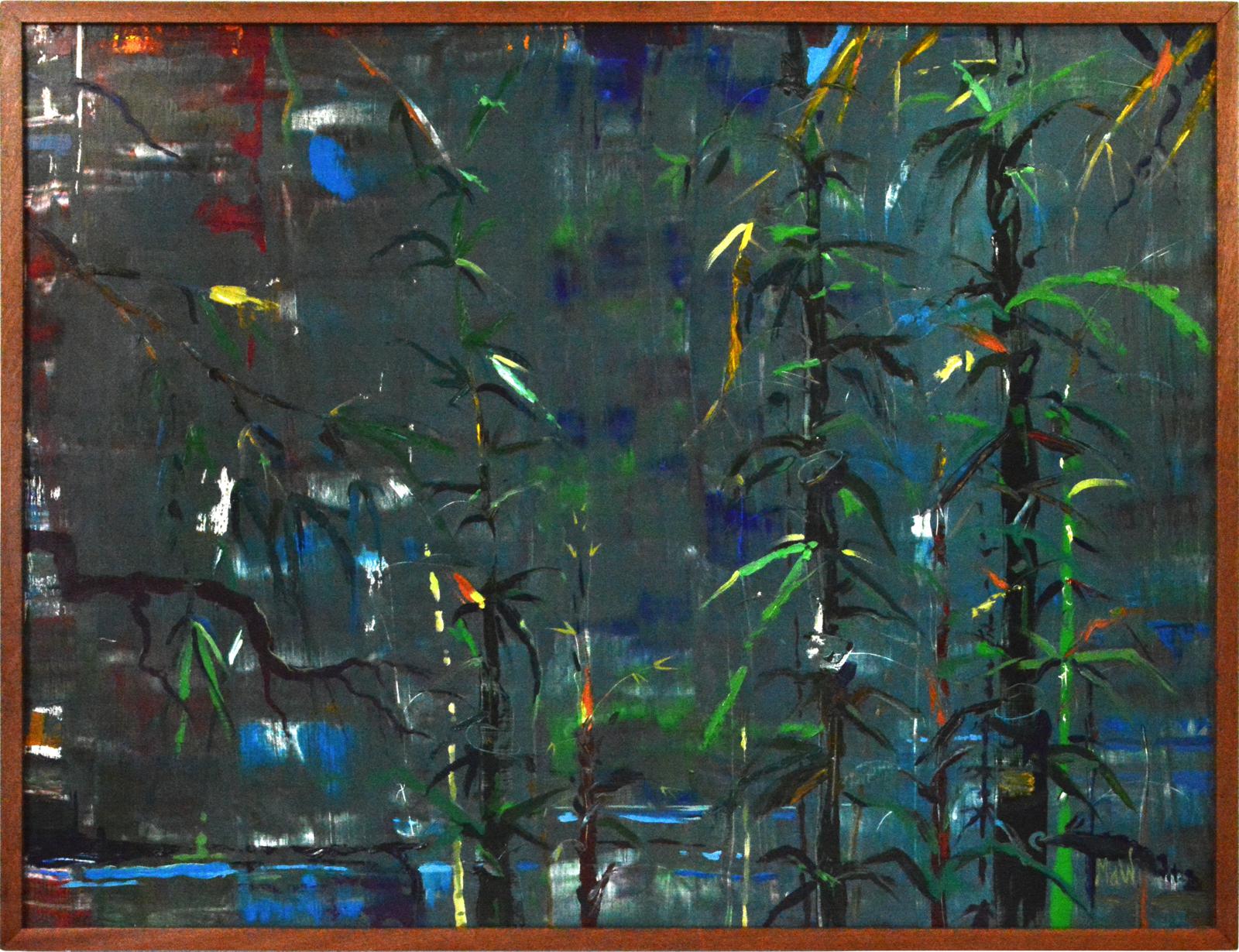
Also more recently,  after the drag painting is complete I will come back and study the work to ascertain just what patterns and what feelings seem to be emerging.  Then I will add by brush or again by squeege in more subtle strokes certain accents that play up those patterns and feelings.  There is the necessity of being sensitive to the painting, discovering what is trying to come out and be manifested.  Sometimes only light touches are required and sometimes more bold accents are added.  I have even begun to experiment with applying tissue paper by tearing and cutting strips and then varnishing them selectively in sections.  This creates in areas translucent and special reflective colorization.  For example a bright yellow tissue paper over a dark blue will create a striking green.  This kind of semi-accidental effect plays well with the underlying drag painting.  The painting in the example is done this way.

Posted on 1 Comment

Oil paintings for Sale

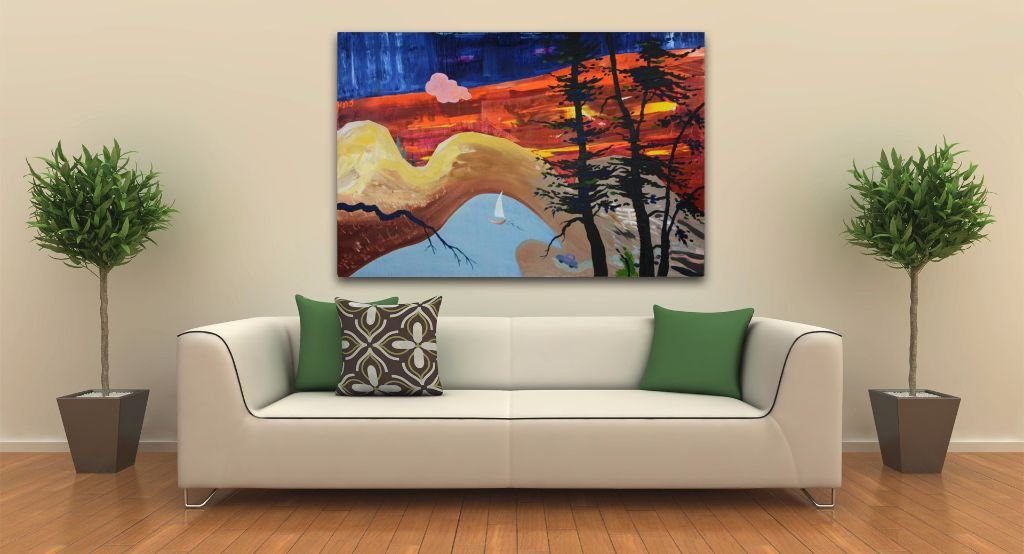
Where do you find truly accomplished oil paintings for sale?  There are essentially four good arenas to buy excellent paintings.  I would recommend first to look for local galleries.   Most galleries are on the prowl for up and coming artists so it is very possible to find quality work, often at reasonable prices.  The larger the City the better the art, as a rule but the prices will of course go up.  Remember that a gallery skims 30 – 60% off the sale for commission.  This is why the internet can be a good second alternative – even sites like Etsy where you will truly find bargain pricing.  Caution is needed here because many ’emerging’ artists are not yet established, their style of painting is not yet grounded and it is likely you will be buying art that may not increase much in value (unless you get lucky).  However you are probably looking for something that appeals to you personally – increasing value is not the priority.06

Third are web sites where artists are displaying their own work.  This is an interesting niche because artists who have taken the time to create their own website are usually serious about their work.  These are artists who are typically established and instead of handing over a large commission to a gallery, choose to market their paintings direct.  It is relatively easy to search the internet until you find an artist you like just by typing in the ‘search bar’.   There is a new fourth way to purchase art because the large, successful art auction houses are now making sales on line.  If you are a serious art investor this is a new and convenient breakthrough to bid on art from the masters.  These kinds of purchases are truly investments  – much like buying valuable real estate.

Whatever art you purchase, remember a painting requires professional lighting when it is hung in your home or office.  Proper lighting will enhance your purchase, revealing all of the subtle nuances the artist has intended to portray.  Also scale is a consideration – insure that your painting is in proper scale to the wall and room.  A large wall will dwarf a small painting.

Posted on Leave a comment

Artistic expression

Our lives tend to be fairly linear following an ingrained and patterned series of actions.  School tends to reinforce these patterns.  When we declare our major it is assumed we are finally charting our own, personal course.  We know however that  societal ‘grooves’ are hard to deviate from.  Soon even our chosen vocation itself becomes a highly patterned and linear way of living.  04

It is only with great effort do we discover our true passions that give our personal lives meaning and value and purpose.  Life no longer is no longer along a straight line but our experiences begin to waver up and down from typical linear patterns.  We continue on with our jobs and our vocations and in one sense everything is the same, we are following the same patterns.  But there is now an inner spark and an inner purpose that begins to gain precedence.  We begin to make choices and decisions out of a personal relationship with this new personal precedence.  We feel alive.

For some the choice is artistic expression and it takes many forms.  Dance, music, painting, writing, sports and horticulture are some of the more commonly known means of artistic expression.  These activities begin to grow and expand as we get older providing our senior years with a degree of fullness and satisfaction.  Authentic artistic expression is when we are expressing ourselves most honestly – when we are not just copying established forms.  It could even be said that artistic evolution for ourselves as persons is very much about learning to be authentic.

We admire artists of the past such as Van Gogh, Cezanne, Picasso and Kandinsky because they seemed to be painting (for the most part) honestly and authentically.  This is not always easy to accomplish but ultimately brings the most joy and a sense of accomplishment.  As I have often said in these series of articles, Abstract art which comes from an inner resource is an important medium for expressing our personal selves.  By painting abstractly we can very effectively break free from those ingrained social patterns and begin to express our emotions and responses in ways that are in harmony with our own inner perceptions.  It is this ‘fine-tuning’ of our perceptions that will lead to an enhanced artistic experience and even to great art.

Posted on Leave a comment

Elements of color

We are a society consumed with form.  Randomness is not acceptable, so we cling to it and in fact almost embrace it.  Artists are no less vulnerable and you see them everywhere trying to interpret the forms they see about them.  Sometimes they do it well and sometimes the product is a disaster.  DSC02979

Ekhardt Tolle talks about how we must associate with form to make mental constructs that give us a false sense of security, of wholeness but it merely feeds the ego.  The entire effort is fruitless and it does not lead to happiness.  It is an identification with something outside us.  It prevents us from looking inside – the essence within us that links us to something very vast and very wonderful.

It us curious then that so many artists fall prey to the same beguiling enchantments perhaps because they are not trying hard enough or maybe someone just has not turned the light on for them.  When we take art down from its pedestal and we are staring at a blank canvas, can we put aside identification with form for just one painting?  Can we re-discover color for colors sake?  Try mixing a tone that pleases you and place it on the white canvas.  Study it.  What would go nicely next to it?  What would blend it nicely?  Curiously some colors tend to even express a certain shape (elicit a certain shape) and so now there are colors being placed with a certain shape and even rhythm.  This is a wonderful experience.

What is going on with this practice?  It is simply allowing yourself to experience pure color – the joy of color.  There are multiple variations to explore.  Free yourself of form, some grand theme and experiment with the application of color.  Try to do on a fairly large platform – not too small.  This is the beginning of abstract painting.  It is what you used to do as a child so you will find yourself coming full around.

Posted on Leave a comment

Authentic expression in painting

How to break free from the painting of forms? This question is not unlike that which Eckart Tolle poses – the realization that ultimate reality does not lie in form. For the artist even nature itself can prove a distraction because nature as pure as it is, confines us to perceived images. Nature itself is a reflection of form – though often beautiful.
When we as artists are no longer confined to representing nature or even know and familiar objects, when we break free from representation itself, we become in turn more able to express ourselves authentically. This should be the goal- to paint authentically and honestly. DSC02978
We live of course in a very complex paradigm. Volatile emotions, reactions and constantly bombarding impressions invade our private selves, our personal space for good or bad. Painting, especially abstract painting provides a means to interpret our responses productively. Just as a poet gropes for understanding in a poem by the use of metaphor, so does an abstract artist grope to discover him or herself by interpreting not what is seen in nature and not what is experienced externally in form, but by responding from a more natural, inner resource.
Abstract expressionist painting becomes a more reliable means of responding to these influences without being constrained to one rigid series of forms – beautiful or plain. For an artist seeking to discover ones’ own authentic and personal response to these constant external impressions, one answer is recognized and that is a turn to the well of internal interpretations. We develop a storehouse of these. We began to create them at a very early age. Art provides the means of expressing these internal responses. The advantage here is that these internal interpretations are wholly our own. We turn them over and over and are constantly juxtaposing them within the matrix of our personal mind and soul to suit our personal
needs. This is an invaluable resource. Surely one of the main purposes of painting in the abstract (even non-objectively) is to discover how to interpret these myriad of personal images by learning to paint more intuitively. It is certainly a process which can be developed – even learned.
There is a certain and distinct volition to this process which propels us to paint. Once it is discovered it is difficult to ignore. I have learned it is important to keep on hand enough canvases to be able to express these discoveries as they well up from within. When gold is discovered you will want to have a pick and shovel handy. These personal impressions which we store come from an unendending well spring. There is great joy in the process, a great joy of expressing something that comes inherently from within. This is why perhaps Kandinsky often painted over three hundred paintings a year- he literally could not keep up. The opportunities far exceeded the means of expressing them.
One interesting study is that of the English painter, Turner. He began as an artist of architecture. His drawings, watercolors and paintings of English City architecture is remarkable. He eventually gravitated to landscape and is now considered historically as one of the greatest landscape artists. His work however became increasingly abstract. In his last works before his death, it seems as if nature was only a mere springboard to express what he was experiencing internally as if his soul bridged across and a synthesis was created between nature and his own vast inner resource. Each of us also has a vast reservoir to tap.
I expect Kandinsky might have been impressed with his discoveries.

Posted on Leave a comment

Identity Theft

There is not a gentle way to find one’s own identity in painting. There is a certain thievery involved – a wrenching, almost violent extraction. This is not necessary for some, but others who are searching, this becomes a vital part of the process.Couch10
I began drawing and painting as early as four and I am sixty-six now and yes, I am still in the process of discovering my own identity. By painting I think I understand my own personal dimensions more than the average man my age. It is important to me. My painting helps me to discover myself and sometimes it is, frankly slightly painful. It feels like an extraction. At other times it feels like I am drawing up a heavy bucket of water from a deep, dark well. I pull hand over hand and it is hard work. It does not come easy. I concentrate and I pay attention.
So what am I stealing? There is something hidden away in all of us and we go around the edges like we are circling a lake, a little afraid to go in. Maybe it will be too deep. Abstract painting is like that – identity theft. We are stealing something from inside and we are allowing it to manifest itself. They say when you open a good bottle of wine, you have to let it breathe. Abstract painting is like that…you are allowing yourself to open up and experience what is inside.
There is some honesty involved and bravery. You must be prepared to honestly put down the experience. This is part of stealing of the treasure, pulling up whats inside and manifesting it. There is no form that needs to be represented – this kind of painting creates its own form, its own colors, its own patterns and rythm and style. So in some sense this kind of painting is more difficult because you are interpreting images that are just now coming up from within. There are no forms to go by, bottles or trees or basket of fruit or shimmering lake or sweep of road or animal, plant or human visage. No, this kind of abstract painting is a very visceral thing and often expressive. There is very much to gain in the process – what can be more precious to discover than ones own emerging expression, ones own identity?
In a society that has lost much of its art, it has lost its humanity as well and by that I mean its own identity. We are floundering and confused. Painting abstracts can be a means to discover ones own identity (personal stamp), piece by little piece. THis kind of personal discovery also serves the greater humanity – pointing the way.

Posted on Leave a comment

Passages in oil painting abstracts

It helps me and it may help you to consider your painting in progress, not as a whole but in terms of co-joined areas.  I prefer to call them passages.  These so-called passages in oil painting abstracts are important as individual units and when these units are reasonably intact then they can contribute to the whole more effectively.  I am sure there are parallels in the other arts.   I know music refers to passages of a piece of music which ends and flows into another part or passage of symphony.DSC02543.JPG

Especially in large paintings it is easy to become a little lost.  I have found that going back and working carefully on getting one section properly in balance then it allows progress to another section.  It is better to do this than to have an entire painting which is only partially rendered.  I will often develop these passages somewhat at the same time – that is dabble with one and then dabble with another to bring them along at roughly the same pace.  In this way the painting begins to take shape and the whole begins to be recognized.

It is important to study a painting and determine strong or weak areas (passages).  Inevitably you will find some passages as you go along are quite fine and are standing on their own and they have even successfully integrated with the rest of the painting.  When all the components are integrated then the painting is of course, nearing completion.  By thinking in terms of passages or sections you can visually breakdown a painting and concentrate on getting that one section correct or at least develop it further to bring it up to the level of the rest of the painting.