Posted on Leave a comment

One Thing Right

Wouldn’t it be wonderful if we could attain all of our objectives in a painting?  This of course is unrealistic thinking.  If we are to enjoy the process and to keep from constant frustration we have to temper our expectations…right?  Babe Ruth only hit four out of every ten ‘at bats’, which is probably not a perfect analogy but you get the idea.DSC02983
There are three essential ingredients to an oil painting :  Structure or design which would represent the bones of the piece – the architectural framework.  Secondly the placement of tone or color which encompasses a broad range of disciplines such as harmony, contrast and accent.  Third is the execution which speaks to how technically proficient you are as a painter.  For example you may have a poor composition, a poor design but the brushwork is wonderful.  Well, then you have accomplished much.  You have developed your skills enough so that you can do very good things with the brush.  You’ve learned just how much thinner or medium to use, how to brush color next to color, how to draw precise lines, how to blend.  Now add to that the elements of good design…study the masters.  Find out about balance and counter weight, the ‘magical triangle’.

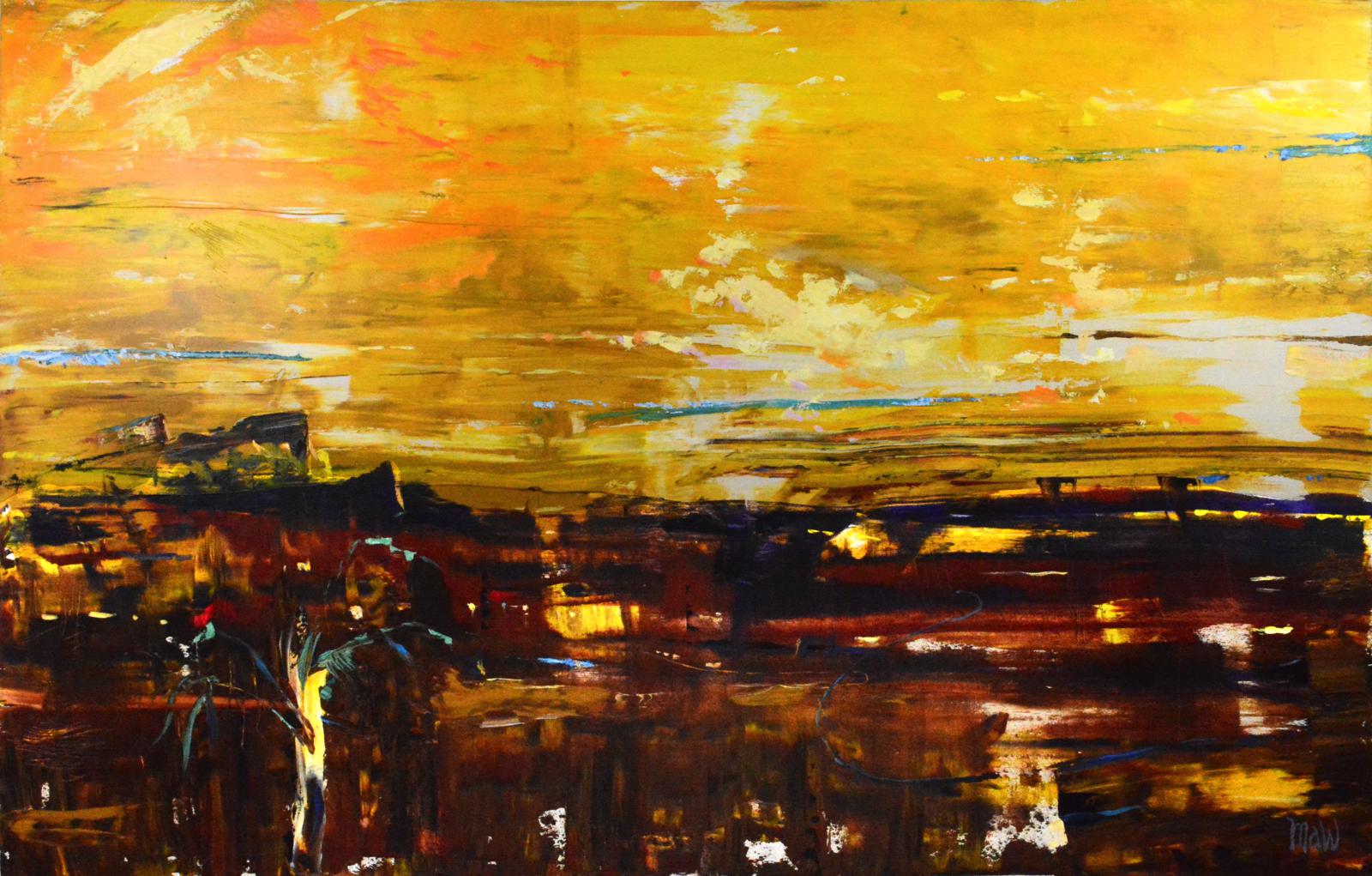
The point I am making is to strive for getting ‘One Thing Right’.  Very often I am working on a painting and there develops an exceptional area or passage.  It especially stands out, it is especially successful in all three aspects of good design, good color choices and strong, confident execution.  So I have to be happy about that area even if the rest of the painting does not quite stand up to that one area.  Sometimes that one area can ‘carry’ the painting.

This is how we progress as artists.  We keep building on not only mistakes but also on our small successes.   Go easy on yourself.  I remember when I was a young student and the instructor, Nicholaides came and stood behind me for a few minutes.  Then he reached in and with his finger traced the left leg I had drawn of the model.  That’s the right line, the right shape exactly, he said.  I kept working on the drawing but I never got the rest of the model drawn properly, but the left leg was good.  I was happy that at least I saw that properly.  Sometimes I think we are able to focus better at some times than others – we are less distracted and our concentration is more pure.  We can’t be too hard on ourselves when this is not sustainable.  In time however, through practice we are in fact to sustain this level of concentration for longer periods.  We can do more well, in a shorter amount of time.

Posted on Leave a comment

BEGINNING ABSTRACT OIL PAINTINGS

For over four centuries all of art representation was figurative and scenic.  It was highly formulaic and it was not considered ‘good’ art if brush strokes were detected.  All of this thankfully changed during the French Impressionist period.  The range of subject matter increased dramatically and now brush strokes became not only visible but seemed to show the vigor and intensity of the painting.  Of course the public was slow to appreciate this dramatic departure from the careful studio paintings of the past.DSC02551

The impressionists paved the way for Miro, Matisse, Braque and of course Picasso.  Then Kandinsky came on the scene, which brings me to my subject of Beginning abstract oil paintings.  He was not originally a painter but once he began to paint the process consumed him.  At his height of production he was producing over two hundred paintings a year.  Because of the war years he was compelled to always be moving his studio locations and yet he continued to explore and discover breakthrough methods of painting.  His work should be studied by anyone interested in seriously painting abstracts.

When you do study his work it will by degrees come over you just how technically perfect are his paintings.  The patterns, the balance, the colors are all very carefully thought out.  If one can successfully compose a painting will not succeed as a whole unless it is painted with technical skill and Kandinsky’s skill was unmatched.  His use of the brush and his great skill with the brush is clearly demonstrated in every painting.  This virtuosity came as a result of painting often and much.   The beginner painter and even more advanced students must realize and face the harsh truth that only with copious practice can these kinds of results be achieved.  In my view he was more skilled than, say Picasso in terms of sheer ability with the brush.

It is not unlike the young violinist who must practice a piece over and over until the music is mastered.  There is however great joy in the mastering.  It is the same with painting.  As one develops the technical skills, a steady hand and mastery of the brush – a distinct pleasure will arise at being able to execute what the heart and mind envision.

Posted on Leave a comment

Now is the time to paint!

I am about to go on a vacation for a week or so.  I thought, ‘what would I write if this might become my final article on abstract painting’?  Knowing that beginners as well as more advanced artists read these, I would say to both, ‘Now is the time to paint!’  If you are an artist then paint.  I have said that often.  Don’t wait for inspiration. You have a canvas or board before you, brushes, thinner, a pallete and pigments….paint a square and then next to it paint another square and then relate them to one another.  There, you have made a start. See where it takes you.  How good are you at painting circles within a circle?  Paint one.  See where that goes.03

What is important here after all?  The arts, your own progression, you expressing yourself, your experiencing inner feelings, the manifestations of those feelings!  Now more than ever as our civilization becomes more and more mechanized, more absorbed in the vast internet we can easily lose our own development and our own inner fruition.  Art is there to serve that great hunger and that great need.   Art is personal expression and personal interpretation.  Much in the way that dreams are to reflect back our feelings and experiences unconsiously,  art serves to do the same only consciously and deliberately.  The curious thing is when the ‘border’ is reached between the un-conscious and the conscious, between form and spiritual or…when we are able to manifest (bring forth) what we are trying to understand internally.  Art is intuitively a form of discovery.  That is its supreme purpose.

Now is the time to paint….now is the time to discover.  Great themes, perfect diagrams, wonderful effects are irrelevant and even stand as blockades.  Don’t foolishly wait for weeks for them to come.  By painting you will inevitably become better with your brushstrokes.  You will learn more about mixing colors, about balance, about transforming shapes but most importantly, you will discover yourself.   Like peeling an onion you will discover what is vital for you and even what is essential for you as a progressing human being.  Abstract painting is the perfect vehicle.

Posted on Leave a comment

The one painted Thing

It is not uncommon for artists, especially abstract artists to discover ‘The One Painted Thing’ that the painting is about.  The entire structure however large seems to exist just for that one ‘thing’ to become manifest.  I have found this often to be the case.  It is interesting when someone looks at the painting and discovers it also.

Rarely have I preconceived that ‘One Thing’ because it develops out of the sub-conscious in the process of painting.  It is not so much a theme as a singular statement.  It often is seen as a coalesence of the other forms and images or to say it more perfectly, the fullest expression of all the other forms.  It is the pinnacle, though curiously it may often appear cloaked or partly hidden.  It resides supreme in part because of a perfect shade, or shape.

That one special ‘Painted Thing’ even in its subtlety is like a magnet, a sun which all the other forms, all the other shades seem to revolve around.  It might even be said that one of the purposes of abstract painting is to discover that One Thing, that essence of the painting that seeks to become exposed and discovered.

When a painting has excellent balance, when it is purely painted, when there is an inherent energy and then when a core genesis is discovered within the context of the entire painting something very special has happened.  The painting develops and then the artist begins to realize what needs to be manifest.  It is a distillation process.  Then the One Thing is painted and sometimes quite by accident.  The artist stands back, almost astonished.  He realizes what has been achieved…as if beyond his own understanding.  That ‘One Painted Thing’, that image irrevocably DSC02978 resonates.  It speaks back to him.  It is as if the artists has discovered a valuable part of himself.  His psyche has been opened up.

Posted on Leave a comment

HOW TO STOP PAINTING

Now there’s a catchy title for an Article, ‘How to stop painting’.  We have all seen those 18″ x 24″ paintings so completely overworked that the very life has been drubbed out of the piece.  There is no vitality because the artist had no conception of when to stop but just kept daubing on.  Knowing when to walk away is vital.  Fortunately I have a garden out back and I will retreat to weeding when I begin to sense that I am mindlessly daubing.picasso-girl-with-boat

It is imperative to study your work and make some critical determinations along the way, especially when you feel that the painting is nearing completion.  One excellent way to do this is by dividing up your work into quarters.  If the painting is especially large and elongated you can divide it by thirds across the top and then by thirds across the bottom for six equal panels.  Assuming that your work is sufficiently dry, take the smallest width blue painters tape and divide up the canvas…press the tape on lightly.

This will be an invaluable aide to study the painting by sections though I prefer to call them passages.  Does the panel have its own inherent interest?  Do the applied colors work well with each other?  Is there vitality or a sense of energy in each panel ?  I am of course primarily talking about abstract work here.  Then ask yourself if the panels or passages are relating to its neighbor?  Is there an implied tension between the parts?  Always look to see if the principle of balance is working in each panel, and then in relation to the other panels.

Eventually as you mature as a painter it will be unnecessary to use the tape because the eye will be able to divide up the canvas by experience.  You will learn to make every passage ‘work’, first within itself and then in relation to the whole.  I learned from Kandinsky how to make my backgrounds (those massed areas of color behind defined forms) more interesting, more energetic and more related to the entire piece.

There is always an impetus to any abstract painting, often short-lived.  It is therefore imperative to keep the painting fresh and responsive to that initial impetus…even days later.  This is why we find those photos of Picasso standing for an hour before applying a critical brush of color – especially as the painting is nearing completion.  I read of Sargent who would get a painting 98% and then go out to his studio for one last application of certain, final highlights that would make the final painting zing.  Then he would put the brush down.

Posted on Leave a comment

Oil Painting wet on wet

Oil painting wet on wet provides opportunities that fast drying acrylic cannot serve.  Even when dividing up a painting into sections or passages it is rare that an area can be completed.  So it is necessary to work one edge against another.  This requires some finesse with your brushwork – don’t skimp on brush quality.  You will want to drag a good line against an existing field of paint.  A good brush with long enough bristles will help to get a clean line flowing along the edge.  Thin the paint to the point where it is flowing but the pigment is not diluted to be transparent.  The hue and color should be intact but it should flow nicely off the edge of the brush.  Regular paint thinner or linseed oil thinned with paint thinner works though I now prefer Gamblin’s Galkyd SLow Dry.  Turpentine works as well.15

About a 1/2 inch away bring your loaded brush up close to the adjacent field of paint previously painted and carefully begin to drag a bead along that edge.  It will take some practice to load up the brush just enough to cut a line and not leave a bead of paint along the edge.  If done this way the two colors will not intermix and you will have a good line between the two colors.  An entire painting can be processed this way.  You don’t have to wait for one field to dry before painting other adjacent areas.

Painting wet on wet, or wet against wet (to be more accurate) allows you to keep painting while the inspiration is still there.  I paint very free abstracts but also some tight geometrics where precise color hue is placed against its neighbor.  This method of loading the brush so that it flows with a medium but still retains its hue allows me to keep painting for a longer period.  The next day it is still pliable to continue working.  It is always adviseable for beginners to have a spare canvas handy and try dragging the brush to see how sharp a line you can cut before going to your actual piece.  One last tip – if you happen to sneeze and you pigment goes over into the adjacent color, you can always later go back to your pallete, find that color and straighten it out from the other side.  By the way it is standard practice to balance your stroke by resting the small finger against the canvas.  This will help keep your line steady,

Posted on Leave a comment

PAINTING FOR COLOR AND HUE

Painting for color and hue is certainly a very valid purpose and reason to paint.  Certainly musicians like Bach and Beethoven had to understand the characteristics and values of notes in order to compose.  When we paint to understand more fully the many and multitude characteristics of color and hue we are definitely doing something that advances our abilities as artists.  Is a theme required?  No!    One can begin to explore color theory right on the canvas without a subject or theme.  The time will not be wasted.  DSC02978

Yes of course it is helpful to understand basic color theory but this can be found in all the art book primers.  I know artists that have memorized all of the many formulas.  Nothing however replaces actual working with pigments and placing them side by side.  We know for example that the word tint refers to adding white to a pure color.  The question of course is how much white to add?  Painting side by side along another color you will discover for yourself how much white to add, if any at all.  What vibrates…what is more beautiful?

Pink next to green for example does not sound pleasing, yet with the right amount of white added to each, the relationship next to one another can create some wonderful sensations and can in fact bring a painting to life.  Cerulean with white added next to a dark umber can be striking.  But how would you know without experimenting.  I tend to paint smaller canvases just to discover how pigments work together, placed side by side.  I might do several smaller canvases before I am comfortable to moving to larger, more mature works.  This is the learning process.  Little by little you become familiar with all the hues and why Ultramarine is so unique to Cerulean and why those two blues do such different things on a canvas – Ultramarine is always so much better in shadows.

Posted on 1 Comment

The Universality of Abstract Painting

Universality of Abstract Painting refers more to its broad range of source than its’ general appeal.   An artist who is attempting to paint in the abstract or more exactly, non-objectively does well to understand the source for inspiration.  This source is a curious, visceral and energetic mix of both the sub-conscious and the conscious.  The two co-mingle to create a visual form on canvas.07

Carl Jung was the first to really probe and define the impact of our sub-conscious on our conscious selves.  He discovered how vast and inter-connected our sub-conscious truly is, affecting our personal psyche and the many ‘choices’ we make as individuals.  His extensive research discovered that it is our sub-conscious that primarily dictates our responses.  Therefore by understanding and nurturing  an awareness of our inner selves (our sub-conscious) we become more complete and more balanced individuals.  More recent teachers such as Eckhardt Tolle have given us good tools to more directly be in touch with this inner development.  He represents this evolution as a more correct means to view our lives – that of emphasizing our inner development over reliance on exterior form.

It is helpful for a painter of abstract work such as myself to understand these concepts because it provides an important road map to artistic progress.  Universality in this context refers then to the broad range and depth that we can utilize within our own personal psyche.  This association is similar to a meditation.  It is getting in touch with our own inner selves but as Tolle points out, also connects us to a much broader and far reaching spiritual connection.  This broader and deeper connection takes on a Universal characteristic.  We become, by increments part of a larger whole, part of a greater understanding and part of a more Universal sense of those elements that are important and meaningful.  Abstract painting then becomes a very direct way of manifesting important Universal concepts and developing feelings.  This is one paramount reason why I am attracted to painting in abstracts and even non-objectively instead of painting known visual form.  Painting non-objectively provides a platform for distilling these sub-conscious responses…the sub-conscious becomes manifested through paint and design.  This characteristic then, the Universality of abstract painting becomes an important platform for the artist to work from.

Posted on 4 Comments

Gestation in Abstract Art

We have all seen humorous cartoons of artists lazily sitting around waiting for inspiration to strike.  The wife or girlfriend is stirring a pot of beans, waiting as well,  but for money to buy groceries and essentials.  The article topic, Gestation in abstract art is something I have been thinking about for some time.  Gestation of course refers usually to the period of time a baby is in the womb, prior to birth.  However the term can be aptly applied to bringing forth an abstract work of art.04

Because abstract art finds its source and inspiration from something other than nature, an entirely different set of constructions needs to occur.  These partially reside in our sub-conscious and come from a source that is not seen.  One can’t go out into the hills, set up the easel and begin to paint.  Abstract art heralds a different form that must first come from an inner resource.   I have learned to develop or allow to develop this important first step and I think it could be aptly called the ‘creative period of gestation’.  There is something stirring, an emotion or a feeling or a hint of some abstract form and this needs to develop internally.  Exterior references do not seem to help.

Earlier in my career I spent time designing homes.  There was always considerable time just thinking about the design before anything could be drawn.  Fortunately I was fairly good at visualization.  The process for painting, especially for painting abstracts is not too different.  Sometimes there is just a very brief glimpse or hint or direction or feeling.   If we can be very still we can internalize this and develop the image.  It is however impossible to develop the work completely, or even partially but it is possible to get a good ‘lock’ on an impression.  That impression or shape or form or feeling begins to go through this gestation process before it is eventually given birth or in artistic terms, manifested on canvas.

The  beauty and wonder of abstract painting is that once we provide the impetus to a painting,  a certain magic comes about and the painting begins to develop its’ own force and identity.  Sometimes there is a feeling that I am just the facilitator and that the painting begins to dictate which direction to go and which hues to incorporate.  This is a fantastic experience.  I suppose not unlike the process of seeing good jazz develop.04

Posted on 4 Comments

The Joy of Painting


This is a brief  article on the Joy of Painting.    My younger brother is a classical pianist, but plays all kinds of music and has a vast repetoire.  He has reminded me that a passage must often be played hundreds and thousands of times to ‘get it smooth’.  I imagine what he means is that a piece will have many subtle variations of tonality, crescendos and transitions.  These are written of course in the music but I expect that by playing one becomes gradually aware of the deeper inferences written in the bars.DSC02551

In oil painting we have no scores, no bars to guide us.  We do have  however certain established relationships of tonality, of hue and of contrast to name a few.  If you are a painter serious in becoming truly adept you will need to practice often to learn these rules and relationships.  There is also the need to develop the required dexterity in using the brush.  Much of my work is wet on wet – that is,  I paint along side applied paint, cutting a line defining one to the other or, I choose to blend them.  There are multiple ways to accomplish those tasks and those effects.  The Joy of Painting resides in these practice sessions.  The only way to get ‘good’ is to practice these effects.

If you are waiting for some grand theme, some great inspiration you will eventually find yourself bankrupt.  Far better to experience the simple joy of painting by application.  Place one hue on the canvas that pleases you and then another beside it and then mix another.  Determine how much white to add.  The shapes you choose are irrelevant…just become expert in your brushwork, and learn to paint wet on wet.  If you want,  paint on small canvases.  The beauty of abstract art allows you all manner of freedom – learn to trust your intuition.  Don’t rush and learn to develop a steady hand.  Study each effort and pause before mixing subsequent hues.  Work in small passages until they are visually effective.  Ask yourself, ‘does this area, this passage resonate with me?’  Eventually you will learn how to integrate all of the passages into a whole painting, but that comes later.   The thing to do is to practice painting…you must paint often.