Posted on Leave a comment

Why buy Abstract Art

When it comes time to decorate your home or office, the question will inevitably come up – why buy abstract art? Millennials especially are looking for more adventurous art, bold forms and larger art that enlivens an interior. Prosaic landscapes and still life paintings, though charming lack the dynamism that an abstract piece carries.
There are so many good, contemporary abstract artists today. They are also easy to find on the internet. Purchases are easier and the paintings can often be purchased framed and ready to hang. Paintings found on the internet will usually note the size so you can make sure the wall you have in mind will accomodate the piece nicely. The beauty of a painting is appreciated when there is adequate lighting – especially at night. Consider hiring an electrician to install perfect spot lighting for your new purchase.
If you are asking yourself, why buy abstract art – consider how the right painting can truly enhance an interior environment. Many abstract paintings contain a certain mystery or metaphor that is intriguing. Mature, good abstract paintings still employ the fundamentals of good classical painting – those of balance, movement, harmony of form. A purchase of a quality abstract painting will retain its value, however always purchase a painting that resonates for you personally.
The price of a quality abstract painting, especially by a contemporary artist is usually very reasonable. There is of course something very special in buying a signed original painting. There really is no comparison to a flat image print – even when the print is by a known master. Prepare to pay an inflated price when buying from a gallery, though admittedly a gallery will often host excellent work by new, emerging abstract artists.

Posted on Leave a comment

The Accident in Abstract Painting

There was a period in my own painting where I felt stymied for lack of a particular theme in my work.  I felt I needed a very clear idea to begin, good preparatory drawings and a distinct theme that would pervade the painting.   Consequently the canvas glared back white and cold on the easel.   A grand theme, a poignant idea was typically beyond my grasp.  Meanwhile I wanted to get on with the process of painting – I became willing to allow the accident in abstract painting.

The accident in abstract painting, was fortunately discovered for me at the age of 58.  It is an essential element discussed by abstract artists such as Gerhardt Richter  in his book – the need to balance un-planned accidental events with an over-arching purpose.  He admits to relying too heavily on the accidental effects.   When I began to move from thematic, representational figurative art  to abstract art I experienced a new-found thrill of creativity.  This thrill of painting, this joy has not abated.  I have a new and heightened sense for pure color.   Curiously all the formal applications I learned at school and by personal instructors still proved helpful – those of balance in a painting, of movement, of the placement of forms and even primary, basic color theory.

I began to understand why Richter experienced a degree of  reliance on the accidental.  For me it serves as a starting point in a painting.  There is a feeling I want to express.  It is undefined so I start by applying pigment to the surface.  It is an intuitive process – a process which Jackson Pollack made famous.  It is not tightly conceived and meticulously drawn out like an Andrew Wyeth painting.  Abstract painting is about expression of color and form.  Color and how color defines form takes precedence over any particular concept or theme.  Remarkably patterns begin to emerge, inner emotions are discovered and we discover how potent color can be when we are sensitive to what is emerging on the canvas.  For the artist, this is a meditation.  A balance begins to emerge between those accidental displays of color and form and between my own personal judgement of how they should be placed.  There is a dance between those two dichotomies, an energy that turns an accidental effect in to a dynamic composition.   Kandinsky often called his paintings simply Composition 20 or 22 and so on because ultimately we are taking the initial thrust, those wonderful accidents and then consciously creating a composition that best defines the direction we are wanting to express. That direction might never have been discovered had it not been for the initial thrust of the exerted accidental effect.

Posted on Leave a comment

Trust your eye and not the critics when buy art

It is always best to trust your eye and not the critics when buying art.  This is especially true when buying abstract art.  Critics might suggest there are few reference points in abstract art – that there are no guidelines to follow.  This of course opens the door for their own personal evaluation regardless of the validity of a critique.   Ultimately,  the published art critics today when evaluating abstract art,  typically come up short both in experience and true perception.   Trusting your own impression – your own eye is often the most reliable means to determine a purchase that suits your taste.

Actually good abstract art (specifically the masters) employed tried and true art fundementals in their work.  As some critics suggest, they did not abandon established art theory.  Elements such as balance and rhythm are essential elements used consistently by the masters such as Kandinsky.   I have studied many of the modern masters and have found this to be true.   There is a force and dynamic in his paintings that captures the eye and holds our attention.   This dynamic is not halfhazard and it is certainly not by chance.  Kandinsky was a student of music as well and had already learned the mathematical sequences provided by music composition.   It is clear in his writings on art just how carefully he employed art theory – eventually expanding the essential components of line and form in abstract art.   Contemporary artists such as Gerhardt Richter have benefited from his studies.  Jackson Pollack’s work seems completely random yet contains remarkable cohesion and force.

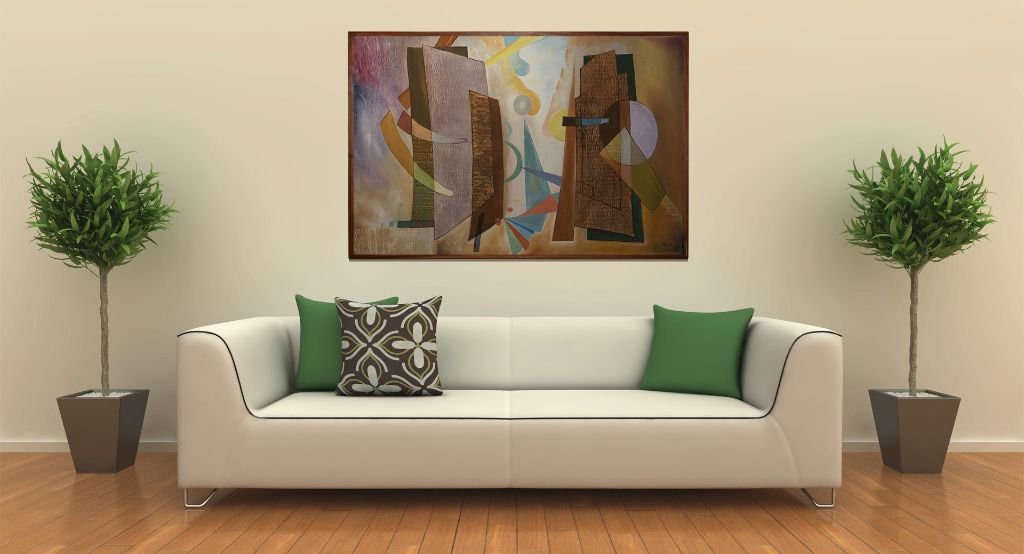
In the example in this article (a painting called Elsie, painted by myself) there are two opposing forces left and right.  THough they are very different forms in composition they each balance the other out.  They create a tension that works towards the center, that pushes against the center so that the painting seems to have an inherent energy.  I learned from Kandinsky just how important the background is – that it too must generate force and interest and that it must support the forms which are forward.  There must be an interplay between the back drop and the forms which are more forward.  Without this balance, without a sense of rhythm it is almost impossible to create a painting that has a dynamic, inherent force.

Posted on Leave a comment

Buying Abstract Art

There are four main choices in buying abstract art.  The costs between these can vary dramatically.  Following is a brief guide to help you navigate through these options.   One very safe and obvious option is to buy a print of a known and famous abstract artist such as Kandinsky or Klee or Miro or Pollack.   Prints are inexpensive so I recommend spending money for a high quality frame.  You will need to find a true, custom frame shop for this.  Try to insure that the print you buy is large enough to suit the intended wall location.  Sometimes an interior designer is needed to scale the work correctly because if the the painting is too small it will not look appropriate on the wall.   Always measure before you order to insure the scale is right for the wall.

When buying abstract art keep in mind there are many, many very good abstract artists at work today.  A few are quite well known and there are many more who are producing good art but are not yet on the critic’s radar.  It is very possible to buy an excellent abstract painting by a contemporary artist for less than $5,000.   These are usually shipped without a frame.  These can be easily found by searching the internet.   Again, make sure of the scale and size of the painting.   It is impossible to determine if the artist you buy from will ever gain any degree of fame and if the art you acquire will gain in value.  Buy it because you really like the piece.   A good frame shop can determine the best frame for your new acquisition.  Especially in the past five years a number of excellent art sites have become sources on the internet.   They host a number of different artists and charge a percentage of every sale.   You will find a wide variety to choose from.

Private galleries and showings is another choice.  This will take more time but the effort can be most rewarding.  Seeing an original hanging with good light represents an excellent way to decide what kind of abstract art you prefer.   In most gallery showings there will be a number of pieces by one artist which gives you more choices.  Cities will often host outdoor shows and for a fee an artist can set up a booth to show his or her work.  You might be amazed to see just how good some of these paintings can be.  In the trade we call these ’emerging artists’.   Paintings hanging in galleries will always reflect a  spike in pricing, especially over art that is sold in ‘open, City sponsored’ shows.


Posted on Leave a comment

Advantages of painting on hardboard

Serious painters today, especially those who use the medium of oils have several surface choices.  Canvas, either store bought or stretched by the artist is the most common.   I have painted many paintings with canvas and on linen.  The linen of course is a tighter weave and more suited to portraits.   When I began to paint abstracts switching to hardboard became the obvious better choice for me.  

The abstracts that I paint require multiple approaches to medium.  These include brush and appliques and collage and tissue paper varnished on, but also the use of hard squeege to drag across the pigments.  I often press quite hard.  This pushes the paint into the primed board and drags off any excess pigment.  This effect can create some stunning effects.  It can be used selectively or across the entire surface.  All of these effects and methods of creating a painting could not be done on canvas.  The visual result of painting on hardboard is dramatically different.  The smooth surface allows for this dragging of press squeeges but also for very distinct fine lines.

An extra bonus in using the primed panels is that a piece that does not meet muster (falls short of the intentions) can be simply sanded back to the original surface and then re-primed.  I will often pull out a painting a month or two after completion and make an analysis if I accomplished what I had intended.  If not the entire panel can be re-cycled.  This cannot be done so well with canvas – the heavy brush marks inevitably remain.

Buy the panels, cutting them (I use a good grade of 1/2 inch plywood) then attaching them to stripping to keep them from warping, then priming, then sanding and then priming again is a tedious and time- consuming process.  I try to do four to six at one time or about a day and half of effort.  It is worth it but it is the only real surface that can accomodate the multiple applications which I utilize.

Posted on Leave a comment

HOW TO START A PAINTING

I occasionally talk with beginner painters, some students who cannot seem to start a painting.  How to start a painting is in my view an actual process.  There is the inevitable fear of getting a good start which some students cannot deny.   It may also be the lack of legitimate idea or concept.  Following a particular process can be very helpful.

In almost every case I first prepare the canvas or panel before there is even an idea in mind.  Because I used primed panel this is a fairly tedious process of buying, cutting, priming and then installing struts but regardless of the material, prepare your surface.  Have it fully ready.  This would include your brushes, the oil paints, the thinner or medium, rags, the pallette.   Have it mounted on an easel.  In other words, be completely ready.  This is the first step in the process.

As they say, ‘sleep on it’.   Think about that white canvas and imagine what might be painted.  It is not unusual to dream about the painting.  One time I had a painting in mind and I had it fairly worked in conceptually.  I even had made some drawings.  I was going to start it the very next morning.  That night I had a dream and woke up with a completely different idea.  While it was still fresh in my mind I went immediately out to the studio and began to paint from my memory of the dream’s image.  I painted solid for six hours to get it down accurately.  If the panel or canvas had not been prepared I would have missed the opportunity – that spontaneous burst of insight which artists so desire to experience.

Once the panel or canvas is ready, when all the mateials are ready I often suggest preliminary sketches.  The beauty of sketches on paper is that they are only sketches – you are not locked in.  Keep sketching until something really resonates for you.  When it does I will often transfer this loosely on the canvas with graphite pencil or even with a small brush dipped in thinned umber.  It is remarkable how drawing with a small brush can bring the idea alive on the canvas.  Keep looking at it.  Come back to it the next day…keep studying it and eventually the moment to begin painting will arrive.

Posted on Leave a comment

Buying Original abstract art

Well conceived abstract art – specifically paintings,  can truly be an inspiration in a home.  Because abstract art provides for multiple interpretations, different persons can receive different impressions.  These personal impressions can often reinforce a decision or direction or give perspective to life situation.  Good abstract art should be inspirational.  A painting should have a positive effect upon our psyche.  Buying original abstract art is easier today than ever.

Fortunately we need not feel limited when we can’t afford a Picasso, Miro, Kandinsky, Braque, Matisse, Pollack or Jasper Johns.  Why settle for a flat, static print when there are so many good, contemporary abstract artists producing today.  Serious artists have studied the past masters and have developed new, important genres and styles.  These new styles and interpretations reflect our own contemporary settings.  The internet is an excellent source to discover these new artists, often before the pieces become expensive.  For the buyer, not having to wait for a gallery showing is a tremendous bonus.  By going direct to the artist, inherent value is increased.

Posted on Leave a comment

How to Complete a Painting

Aside from the difficult process of actually commencing a painting, ‘how to complete a painting’ stands as the final challenge.  The great, initial thrust of the work holds the important germ, the first burst of force and perhaps even encompasses a theme.  From there the work progresses and develops.  As artists we are in awe how our efforts and design is often augmented by the mystery of the ‘Muse’ herself – how our work is often enhanced by a creative force that seems beyond our understanding.  However it comes about,  the painting moves along, sometimes over a few days, sometimes over several weeks but finally we reach a point where it is essentially complete.  It seems to say in the greater part, what we had intended.

To be sure, there have been times when a painting was completed and I never went back to it.  Even after studying it months later, there was clearly nothing I could add that would enhance it or to give it any more substance or intensity.   All the components worked together and they were complete separately and they were complete as they related to the whole.

Some artists have a great superstition that going back to a painting for further work, once completed, will destroy the character and dynamism of the original impetus.   There are paintings however that  can certainly benefit from additional emphasis.  Sometimes the effort to get down a large painting is so great, there is not time to define to completion the individual parts.   Paintings such as these should be brought back to the easel for study.  Look for the intent of the painting.  Get a good ‘read’ on the piece.  Try to discover what the essential nature of the painting is – what it is saying.   When there is a deeper understanding of the piece, then one begins to see just what needs to be added.  Perhaps an edge needs to be highlighted or softened.  Perhaps one hue needs to be enhanced or receeded…a line made more intentional.  There are points of emphasis in every painting so look for those.  Are they functioning as they were intended?  If we are sensitive to the piece and if we are careful a painting can be brought out many months later, reviewed and enhanced – then it is truly completed.

Posted on Leave a comment

Symbols in abstract art

Shapes will often take on the aspect of symbols in abstract art.  Even without conscious effort or design, certain shapes will naturally morph themselves in to often meaningful symbols.

I have often felt in Kandinsky’s work that the triangle often meant the ‘man-made’ whereas the circle related more to the universal and the organic.  The various squared shapes he used seemed to imply defined composition.  These however are my personal impressions.  Certain images become more clear than others – for example when we see the point of a triangle reaching up and touching a defined circle then we feel like the ‘man-made’ is invading the organic and universal.  When shapes over-lap we sense that they are merging, that they are symbolically merging.

The beauty of abstract art is that each person will often see something entirely different.  Impressions are received quite differently.  Some psychologists feel this is basically due to our backgrounds and historical perspective.  When a painting is composed almost entirely of circular shapes it is almost impossible to imagine anything other than a certain cosmology, a sense of the universe and not something man-made.   As we live on Earth or Urantia (whichever term you prefer) we relate to images that we see, even while we might imagine a certain life beyond.  These two apparent disparate cultures can often be represented in an abstract painting.   Sometimes they appear as almost parallel universes.  A wonderful tension and force is created when they are represented on the same visual plane.

Sometimes an artist will be partially successful in pre-determining how to interpret symbols.   This takes a certain amount of understanding and planning.  Exploring how shapes can invigorate and define the selected symbols is an exciting process.  As I have often said in previous articles, the important thing is to paint.  Painting beautiful images, painting shapes and forms well is the first step.  Integrating them to themselves is the next.  It is certainly not necessary to ‘pre-establish’ any sense of symbology.  Often shapes and images will just exist in a playful mode – floating quite nicely on their own.   We paint them thus because we are delighted in them.

Posted on Leave a comment

painting without a brush

For myself and I expect for many other artists painting without a brush or imagining a painting is often the first step in developing a new work.   Artists typically have the ability to visualize a work prior to actual painting.   This is not done casually such as in random day-dreaming but is an actual process itself.  It might be considered a type of visual meditation when a painting is worked out mentally, in brief and abbreviated pictures.  It is rare to imagine an entire piece .DSC03308

This requires some alone time which we might call imagination.  For me it is helpful to be in the studio and seeing the blank canvas or panel.  This is however not necessary.  One could be at the beach, or sitting under a shade tree or having lunch and even driving.  It is helpful of course to block out other thoughts which come in as distractions.  This is perhaps why I find Tolle’s insights especially helpful.  It is necessary to focus ones’ thoughts on the painting at hand and to keep working it out mentally.  I might have a cerulean blue coming down top to bottom in a ragged pattern, then days later imagine that same pattern in pale burnt sienna.   Figures, shapes can be placed about mentally.  There is a certain mental construct that can occur not unlike an architect who is trying to mentally design a facade.  There are many things that can be worked out before a pencil or brush is applied.   Distinct benefits can come from this exercise, but clearly the most obvious is less wasting of time and going about a painting with more clarity and definition.

As an abstract painting it is always necessary to allow a painting to maturate quite on its own, and it will always do so if we allow it.   We might call this the second process, where the first is the original, mental and visualized painting which was partially established before any pigment was applied.  Sometimes I only begin with a slight emphasis, a certain shape and sometimes with only a sense or feeling.  Even with effort, with dedicated time for meditation it is common to hold only a very partial image.  But though slight and ellusive this represents the important first kernel of a painting, and as such should be monitored.  I try to keep a sketch book handy to capture these fleeting images as they serve as reminders of that visual experience.