Posted on Leave a comment

Trust your eye and not the critics when buy art

It is always best to trust your eye and not the critics when buying art.  This is especially true when buying abstract art.  Critics might suggest there are few reference points in abstract art – that there are no guidelines to follow.  This of course opens the door for their own personal evaluation regardless of the validity of a critique.   Ultimately,  the published art critics today when evaluating abstract art,  typically come up short both in experience and true perception.   Trusting your own impression – your own eye is often the most reliable means to determine a purchase that suits your taste.

Actually good abstract art (specifically the masters) employed tried and true art fundementals in their work.  As some critics suggest, they did not abandon established art theory.  Elements such as balance and rhythm are essential elements used consistently by the masters such as Kandinsky.   I have studied many of the modern masters and have found this to be true.   There is a force and dynamic in his paintings that captures the eye and holds our attention.   This dynamic is not halfhazard and it is certainly not by chance.  Kandinsky was a student of music as well and had already learned the mathematical sequences provided by music composition.   It is clear in his writings on art just how carefully he employed art theory – eventually expanding the essential components of line and form in abstract art.   Contemporary artists such as Gerhardt Richter have benefited from his studies.  Jackson Pollack’s work seems completely random yet contains remarkable cohesion and force.

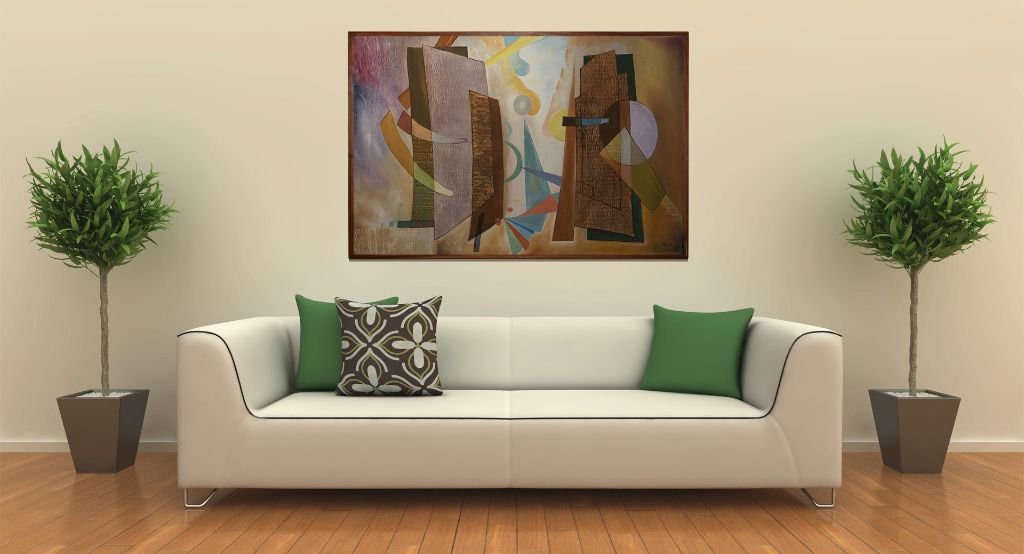
In the example in this article (a painting called Elsie, painted by myself) there are two opposing forces left and right.  THough they are very different forms in composition they each balance the other out.  They create a tension that works towards the center, that pushes against the center so that the painting seems to have an inherent energy.  I learned from Kandinsky just how important the background is – that it too must generate force and interest and that it must support the forms which are forward.  There must be an interplay between the back drop and the forms which are more forward.  Without this balance, without a sense of rhythm it is almost impossible to create a painting that has a dynamic, inherent force.

Posted on Leave a comment

BUYING VALUABLE ABSTRACT ART

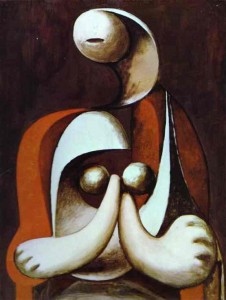
There are three reasons in buying art.  The first is of course buying a piece of art because of its inherent beauty and that it appeals to you personally.  It strikes a deep inner chord for you, so much that you want to put it on a prominent wall.  It becomes like a reminder for you of beauty, of a deeper spiritual world.  The painting gives you visual pleasure.picasso-nude-in-armchair

The second reason is that you discover an emerging artist.  You find an artist who is painting with authenticity and there seems to be an inherent power in the work.  As a buyer of art you are looking for something you like but also for investment, banking on the piece increasing in value as the artist becomes more notable.  You buy low with the anticipation of the value increasing.  Meanwhile you enjoy the work of art in your home.  The art history books are full of intriguing stories of artists selling to a buyer interested in the art piece itself but also for its potential and future value.  Often, a very good relationship is established between the artist and the art buyer – a symbiotic relationship.

Buying valuable abstract art however is unfortunately attained only by the wealthy.  Too often they are purchasing just for the supposed market value.  The artist is already famous, the price is high not only because of its inherent value to the world of abstract art but because it somehow has risen to the top, demanding top dollar.  Where does the value  come from?  From the piece itself, the raw impression or from how society has transformed it into something monetarily valuable?

Buying valuable abstract art for primarily monetary reasons is a concept I have yet to understand.  Some critics and investors contend that buying art from well established artists is the best monetary investment possible.   I often ask myself if this breeds only more banal abstract art, pointless and unauthentic expression?   How often have the art critics and the auction houses literally fooled the public by selling inarticulate paintings that lack force and poignancy for hugely inflated prices?  Then when they are sold, we strain to see the value in them – the visual force they are supposed to represent.  We are told they are ‘landmark works’ but even the common man can see when in fact the King has no clothes on.

Posted on Leave a comment

Oil Paintings for Sale

There are many places to find oil paintings for sale.  I live in San Diego where the weather is excellent for street faires almost year round.  Artists display their art at parks, boulevards and outdoor venues.  It is remarkable how often you can find very good, original art at these casual display booths.  Prices are usually low and you are buying original art!  A notch above this are the juried shows.  These are often still outdoor venues but the class of artists is of a higher quality.  They have had to submit their work for approval and entrance into the show.DSC02667

Most Cities and towns have abundant galleries to visit.  These are not museums but privately owned galleries.  The gallery owner finds ’emerging artists’ who are willing to allow substantial cuts to the gallery owner, sometimes as much as 50%.  So, of course be prepared to spend considerably more.  These relatively small, private galleries are business ventures who are quite discriminating with what kind and type of paintings they will display.  They are usually looking for an artist who generates a consistent style or theme.  It is dissapointing to find art work that appear as spin-offs of tried and true, often nostalgic themes.  Kinkaid (the painter of light), was very successful selling these bucolic, nostalgic paintings.  There were many people who were satisfied with a decent print (a giclee) when the gallery prices for an original began to be in the $20,000 – $40,000 range.

There are many art lovers today who appreciate good oil painting but want to search on-line.  You will be surprised at how many options there are through Google.  Some web sites are poorly arranged and difficult to navigate, but there is usually a phone number to call.  Many emerging and even mature, seasoned artists have elected to let other established sites carry their work rather than develop their own.  These kind of sites are often professionally set up and easy to navigate.  You can arrange for delivery and make payments through portals such as PayPal.  The actual oil painting, once delivered will always be more stunning, more alive and more dynamic than what you view on line.