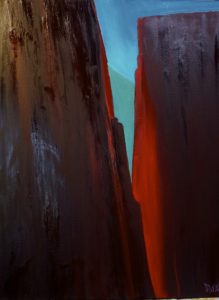
Posted on 1 Comment

What is an art studio

Photo of artist in front of painting

There is a very distinct difference between the education system that I came out of and the experience of the art studio.  It lies fundamentally in the fact that by and large our education system does not deal in problem formulation but only in problem solving – the answer of course is always at the back of the book.  We are solving problems which have already been thought through…there is already an answer.  Our job as students is to discover through study that one answer.DSC02725

The experience in an art studio – at least mine,  is the very first thing is to formulate the problem to solve, which is vastly more complex that solving a prescribed problem.  What does that mean to formulate the problem to solve?  In my view it goes very deeply into the existential question of discovering one’s own self and because each of us is unique and individual we must do the hard work of creating our own particular formula – our own blueprint to follow, our own map to chart.  This is after all at the core of the creative process.  In the purest sense the art studio is where we discover our own personal inner selves, our own essence and our own unique experience.  Even if the studio is only a corner of a closet with a small desk lamp, this must be the place where form is expressed from an inner awareness, an inner discovery.  Art is manifestation but only after the artist first lays out a course of formulation.

The so called artistic formula however is in my experience constantly in flux.  Every small increment of growth, every artistic expression that becomes manifested opens an even new portal and so our old formula is outdated right away.  We find ourselves searching yet again, like peeling off the petals of a rose we discover the need for yet another formula relying, by the way, on intuition and a certain sensitivity to inner impressions.  The much heralded artist Francis Bacon created a decent enough formula for his own personal discovery but then froze it in time.  He shut himself off from any future portals.  He just keeps re-examining and re-hashing an old formula for personal growth and very quickly got himself caught in an eddy.  This is my view.

An art studio to have any real purpose and any real vitality must strive to be authentic.  I believe fervently that authenticity must be immensely sensitive to each and every small inspiration and then, once discovered must begin again from that new vantage point.  This is artistic advancement, this is artistic growth – but it is also and no less important, personal inner growth.  I expect the word formulate must be related to the term fermentation which we all know is that chemical response that causes vapors to create spirits.  This is so vitally important to an artist – this process of allowing ourselves to discover our own personal images.  There is meditation involved.  There is effort here to get a ‘fix’ on something and this is what I mean by formulation and then, with that fix (even if initially vague) begin the creative process. We are not artists if we are not expressing – we cross over from being formulaters and become artists.  The formulation of the problem which is our own personal interpretation of our ‘condition’ should be conscientiously sought after before the work commences.  This is what gives life to a painting and its relative force.

Fortunately for the artist, again in my experience, we can definitely begin with just a kernel of conception.  Our own personal formulation might be disturbingly illusive and so, we need courage to begin the process of manifestation.  Very small beginnings will often open up incredible new vistas of expression – one movement of the brush seems to trigger another slightly different movement, one hue seems to inspire an adjacent and contrasting hue.  A certain vibration that was just hinted at in early formulations begins to take on a truly resonate tone, a vibrant tone.  This is when a painting truly begins to develop its own energy and force.  This is why abstract art can be such an invigorating way to discover oneself as an artist.  This is the kind of thing that should be occurring in the art studio.

Posted on Leave a comment

Techniques in oil painting abstracts

This would be my third article in describing specifically the technique of ‘drag’ painting.  This is essentially the same technique that Gerhard Richter explored though on a much larger scale.  Techniques in oil painting abstracts vary considerably.DSC02979

As I have mentioned before I find that canvas is not suitable…my own process uses 1/2″ plyboard which I prime and sand at least twice and sometimes three times to create a very smooth surface.  Even with all that priming the patterns of the ply still show through which I incorporate and use in the painting to good effect.  The attraction in the drag painting process is the allowance for accidental effects – when the pigment is placed on one side and then dragged with pressure all across the length of the board, it is impossible to know what will actually occur.  Other pigments which are also dragged above and below mix and co-mingle with the others and these create even new colorations.

In more recent works I have begun to use a smaller squeege and in sections completely drag through to the patterned ply to reveal the grain.  The resultant color leaves an interesting ‘stained’ effect and by doing this all over the board an overall design is created.  The intention is to create a harmony of pattern across the entire piece.

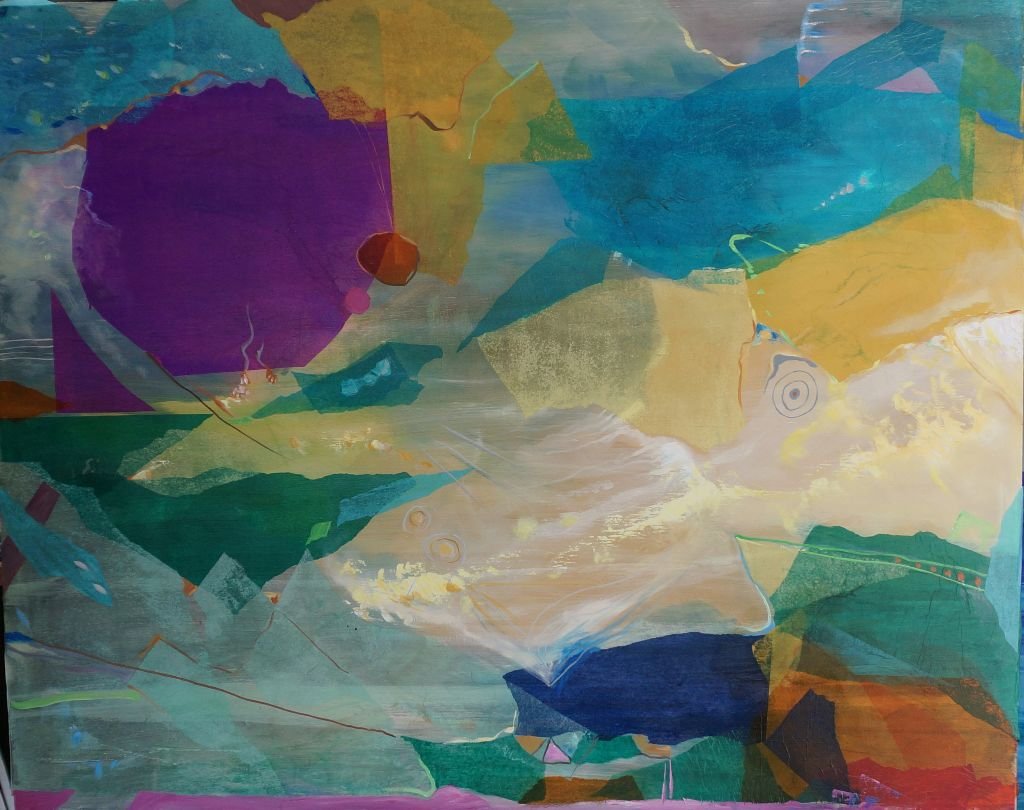
Also more recently,  after the drag painting is complete I will come back and study the work to ascertain just what patterns and what feelings seem to be emerging.  Then I will add by brush or again by squeege in more subtle strokes certain accents that play up those patterns and feelings.  There is the necessity of being sensitive to the painting, discovering what is trying to come out and be manifested.  Sometimes only light touches are required and sometimes more bold accents are added.  I have even begun to experiment with applying tissue paper by tearing and cutting strips and then varnishing them selectively in sections.  This creates in areas translucent and special reflective colorization.  For example a bright yellow tissue paper over a dark blue will create a striking green.  This kind of semi-accidental effect plays well with the underlying drag painting.  The painting in the example is done this way.

Posted on Leave a comment

Artistic expression

Our lives tend to be fairly linear following an ingrained and patterned series of actions.  School tends to reinforce these patterns.  When we declare our major it is assumed we are finally charting our own, personal course.  We know however that  societal ‘grooves’ are hard to deviate from.  Soon even our chosen vocation itself becomes a highly patterned and linear way of living.  04

It is only with great effort do we discover our true passions that give our personal lives meaning and value and purpose.  Life no longer is no longer along a straight line but our experiences begin to waver up and down from typical linear patterns.  We continue on with our jobs and our vocations and in one sense everything is the same, we are following the same patterns.  But there is now an inner spark and an inner purpose that begins to gain precedence.  We begin to make choices and decisions out of a personal relationship with this new personal precedence.  We feel alive.

For some the choice is artistic expression and it takes many forms.  Dance, music, painting, writing, sports and horticulture are some of the more commonly known means of artistic expression.  These activities begin to grow and expand as we get older providing our senior years with a degree of fullness and satisfaction.  Authentic artistic expression is when we are expressing ourselves most honestly – when we are not just copying established forms.  It could even be said that artistic evolution for ourselves as persons is very much about learning to be authentic.

We admire artists of the past such as Van Gogh, Cezanne, Picasso and Kandinsky because they seemed to be painting (for the most part) honestly and authentically.  This is not always easy to accomplish but ultimately brings the most joy and a sense of accomplishment.  As I have often said in these series of articles, Abstract art which comes from an inner resource is an important medium for expressing our personal selves.  By painting abstractly we can very effectively break free from those ingrained social patterns and begin to express our emotions and responses in ways that are in harmony with our own inner perceptions.  It is this ‘fine-tuning’ of our perceptions that will lead to an enhanced artistic experience and even to great art.

Posted on Leave a comment

Elements of color

We are a society consumed with form.  Randomness is not acceptable, so we cling to it and in fact almost embrace it.  Artists are no less vulnerable and you see them everywhere trying to interpret the forms they see about them.  Sometimes they do it well and sometimes the product is a disaster.  DSC02979

Ekhardt Tolle talks about how we must associate with form to make mental constructs that give us a false sense of security, of wholeness but it merely feeds the ego.  The entire effort is fruitless and it does not lead to happiness.  It is an identification with something outside us.  It prevents us from looking inside – the essence within us that links us to something very vast and very wonderful.

It us curious then that so many artists fall prey to the same beguiling enchantments perhaps because they are not trying hard enough or maybe someone just has not turned the light on for them.  When we take art down from its pedestal and we are staring at a blank canvas, can we put aside identification with form for just one painting?  Can we re-discover color for colors sake?  Try mixing a tone that pleases you and place it on the white canvas.  Study it.  What would go nicely next to it?  What would blend it nicely?  Curiously some colors tend to even express a certain shape (elicit a certain shape) and so now there are colors being placed with a certain shape and even rhythm.  This is a wonderful experience.

What is going on with this practice?  It is simply allowing yourself to experience pure color – the joy of color.  There are multiple variations to explore.  Free yourself of form, some grand theme and experiment with the application of color.  Try to do on a fairly large platform – not too small.  This is the beginning of abstract painting.  It is what you used to do as a child so you will find yourself coming full around.

Posted on Leave a comment

Authentic expression in painting

How to break free from the painting of forms? This question is not unlike that which Eckart Tolle poses – the realization that ultimate reality does not lie in form. For the artist even nature itself can prove a distraction because nature as pure as it is, confines us to perceived images. Nature itself is a reflection of form – though often beautiful.
When we as artists are no longer confined to representing nature or even know and familiar objects, when we break free from representation itself, we become in turn more able to express ourselves authentically. This should be the goal- to paint authentically and honestly. DSC02978
We live of course in a very complex paradigm. Volatile emotions, reactions and constantly bombarding impressions invade our private selves, our personal space for good or bad. Painting, especially abstract painting provides a means to interpret our responses productively. Just as a poet gropes for understanding in a poem by the use of metaphor, so does an abstract artist grope to discover him or herself by interpreting not what is seen in nature and not what is experienced externally in form, but by responding from a more natural, inner resource.
Abstract expressionist painting becomes a more reliable means of responding to these influences without being constrained to one rigid series of forms – beautiful or plain. For an artist seeking to discover ones’ own authentic and personal response to these constant external impressions, one answer is recognized and that is a turn to the well of internal interpretations. We develop a storehouse of these. We began to create them at a very early age. Art provides the means of expressing these internal responses. The advantage here is that these internal interpretations are wholly our own. We turn them over and over and are constantly juxtaposing them within the matrix of our personal mind and soul to suit our personal
needs. This is an invaluable resource. Surely one of the main purposes of painting in the abstract (even non-objectively) is to discover how to interpret these myriad of personal images by learning to paint more intuitively. It is certainly a process which can be developed – even learned.
There is a certain and distinct volition to this process which propels us to paint. Once it is discovered it is difficult to ignore. I have learned it is important to keep on hand enough canvases to be able to express these discoveries as they well up from within. When gold is discovered you will want to have a pick and shovel handy. These personal impressions which we store come from an unendending well spring. There is great joy in the process, a great joy of expressing something that comes inherently from within. This is why perhaps Kandinsky often painted over three hundred paintings a year- he literally could not keep up. The opportunities far exceeded the means of expressing them.
One interesting study is that of the English painter, Turner. He began as an artist of architecture. His drawings, watercolors and paintings of English City architecture is remarkable. He eventually gravitated to landscape and is now considered historically as one of the greatest landscape artists. His work however became increasingly abstract. In his last works before his death, it seems as if nature was only a mere springboard to express what he was experiencing internally as if his soul bridged across and a synthesis was created between nature and his own vast inner resource. Each of us also has a vast reservoir to tap.
I expect Kandinsky might have been impressed with his discoveries.

Posted on Leave a comment

PAINTING LINES AND CIRCLES

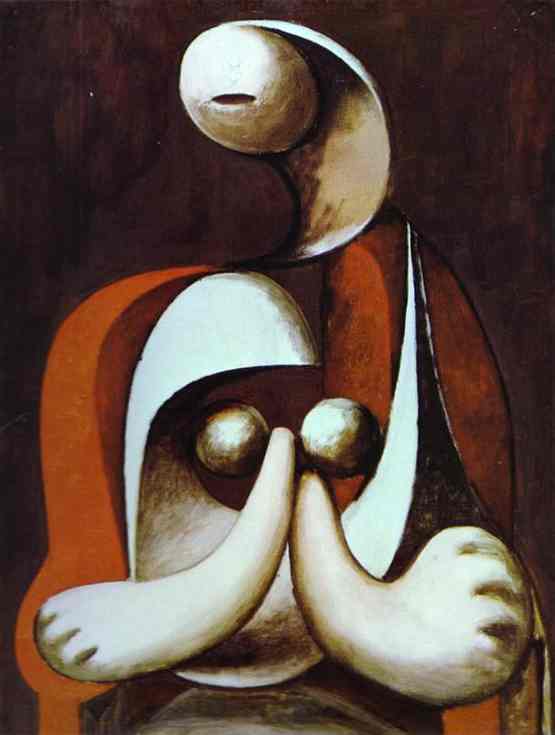
Abstract painting is not just masses and large painted fields of hue.  Painting lines and circles will often be required.  I never took any lessons on this but self-taught myself and so, along the way, discovered a few helpful tricks.  picasso-weeping-woman

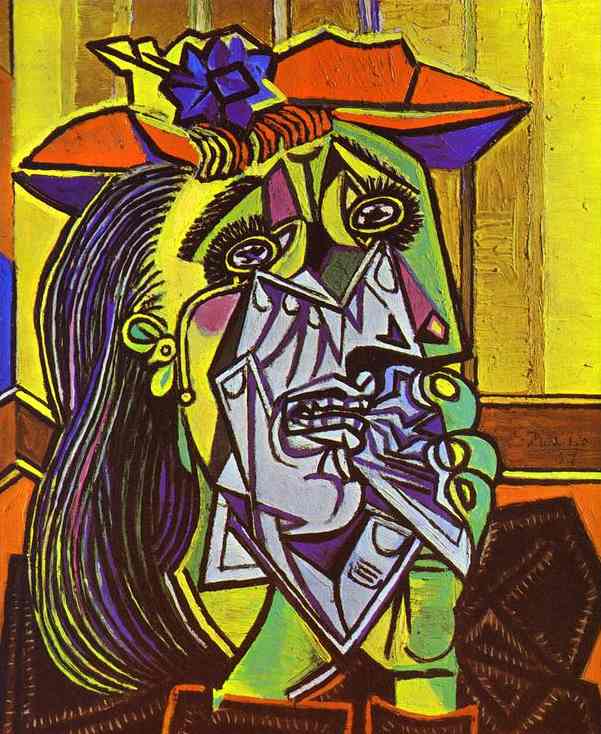
I am so impressed with how Kandinsky could create those perfect circles and sharp, crisp lines that gave his paintings such clarity and force.  In the beginning my own attempts were poor copies.  I kept practicing and so now, quite a few years later my lines, circles and tight shapes are much more professional and therefore, visually effective.  The example is obviously by Picasso who also used a variety of outlines in his work.

When I have the hue I want I mix it of course with thinners.  Every artist has their own formula but I use about 1/2 turpentine with 1/2 Gamblin Neo Megilp..(odd name I know).  The trick is getting the right formula and this only comes with practice.  Some brushes just will not perform and so you will have to experiment with the right natural bristle brush that truly cuts a good line.  The ‘angle brights’ are good and even the synthetic by Princeton does a good job.  I have two of the #12 Catalysts.  For very fine lines use the brushes that car detailers use – the angled liners.   It will be necessary to pay more for good detail brushes, but it is so worth it.  Keep mixing the hue with the thinners until you have the right consistency.

Have an extra small canvas handy and work on this until you get just the right flow.  With practice you will be able to draw a long line and have the paint flow nicely.  The trick is to have a good opaque line that is diluted only enough to let you drag it in a long line.  If the line is thicker, concentrate on one painting just one side of the line and then go back and paint the opposing edge.  When you have two good, sharp opposing edges, then fill in the center.

For circles, it is difficult without a precise drawing.  I can now paint a circle without a line drawing on the canvas but having a drawing makes it easier.  I  pull one half of the circle and then re-position my hand to draw (paint) the other half.  Try to be careful to not let the paint build up too much along the line.  Sometimes I will take the excess and carefully put it in the center of the circle for later use.  You want a nice, clean edge without excessive build up.  When you have the perimeter of the circle defined, then go in and paint the center of the circle.  For both lines and circles you will probably have to support your hand by a finger resting on the canvas.  Or use the rounded wood pointer that rests against the canvas.  It is important to be steady and this comes also with practice.

Posted on Leave a comment

When is a Painting Completed


When is a painting completed is a critical question you will be left to answer on your own.   There is the story of John Singer Sargent and how he completed his paintings.    After a work was 99% complete he would take it into another room.  In that room without distractions and in different light he would study it from time to time, between other commissions.  Then when he finally saw what was needed he would retrieve his pallete and brush and with just a few accents meticulously placed, the painting was finished.DSC02672

The story might be just hyperbole but it gives some insight for the advanced artist as well as the beginner.  There is always the burst of energy and inspiration and this eventually dissipates as the painting wears on.  It is not always easy to maintain the initial thrust of the work.  The tried and tested rules for a completed painting do not easily apply to abstract paintings which is my genre.  We can say a few things however that will point distinctly towards a painting’s completion.

Firstly it certainly must meet your demands.  Are you pleased with it?  Did it in fact capture some or most of what you had intended?  If accidents occur and they often do in abstract painting, are you pleased with them?  If not, can they be corrected?  Very often in my own work I ask myself if more contrast is needed and are the highs, high enough and the deep tones, deep enough.  Can the contrast or tension be increased without sacrificing the overall look of the painting?  Is there movement or is the painting for some reason just static and if it is static and flat, how can this be corrected?  When is a painting completed will ultimately be answered by you alone.

Sometimes an abstract painting is done primarily through a spontaneous effort, even completed in a day.  Going back and adding to or subtracting needs to be done with extreme care and attention, otherwise any corrections will look out of place.  It is important to not ask yourself what someone else might like in the painting – please yourself only.  If in painting there is an area that is remarkably effective and you feel you have exceeded your abilities then this is excellent.  If the rest of the painting is not quite as inspired this is ok.  This is progress.  The fact that part of the painting represents something remarkable is a notable achievement.  Sometimes small attenuations on the rest of the painting can even augment and enhance those high parts of the painting.

Certainly set it aside when you are practically complete.  Bring it out in a week or two and maybe even bring it in and hang it on the dining room wall.  Study it.  What else could be done, if anything?  I like my paintings to have a certain drama or force or energy.  One painting that I did had very good composition, good balance, good movement but the colors key was too flat.  I re-worked the entire painting with more intense hues and the painting was transformed.

Posted on Leave a comment

Corrections in Abstract Painting

In previous articles I have stressed the need to accept accidents in painting abstracts.  I have even gone so far to suggest that the accidental occurrences may even be more authentic and more alive than the attenuated brushstrokes.  Especially employing the techniques I use…that of drag painting,  it is impossible to determine precise outcomes.  It is shocking sometimes when effects are created which considerably exceed anything planned or anything executed by a skilled hand.  This is a wonderful thing.  It is like good jazz.  The static surface begins to resonate from an inner resource.  So, there is this constant tension as a painting develops between un-planned and planned executions of paint.  This tension creates a surface, visual dynamic.  The Title, Corrections in Abstract Painting, refers to the necessary process of harmonizing the various  tensions which appear all over the surface.  Visually, they should dynamically relate to one another…disharmonies need to be corrected.Alexander Sadoyan

It is important however to understand that as a painting nears completion there will inevitably be immensely strong areas.  These may result from semi planned accidents or specifically painted areas.  Conversely there  will inevitably be areas that do not work.  These are areas that are not in  harmony with the rest of the painting.  There is inconsistency in style, in rendering, in feeling or the color may be off.   This is when you will have to study your painting.  It may not be apparent at first.  You sense something is not right so you keep studying it.  The painting is basically almost done and you keep looking at it.  Lucien Freud insists he is not analytical but clearly his paintings indicate his countless refinements.  These refinements come from studying the painting carefully.  You will have to decide where the strong areas are and where there are weaknesses.  This sometimes needs to be done before the paint is dry.

Making corrections in abstract painting is critical to the final outcome.  By now you will have a good idea what the painting is trying to manifest.  You may be surprised to find that the painting is very close to what you had sub-consciously intended.  Still, your keen sense is needed now to bring those weak areas up to or near the level of the over-all painting.  Often a weak area cannot get to the high dramas (the more successful areas) of the painting but the weaknesses can be mitigated so that they do not detract from the whole.   This is what I mean by making corrections.  It is important that the entire painting works as a whole and that there are disengenuous parts that detract.  Sometimes a good artist friend who is honest can come in and give an opinion.  Regardless this is an important part of finishing up a painting.  One tip, look that there is sufficient contrast in the key elements.  Often times many of my corrections have more to do with contrast than with actual hue.

Posted on Leave a comment

Fear of Abstraction

Fear of abstraction stops a lot of good artists in their tracks.  Certainly understandable.  We were taught to view our art through the eyes of realism.  Imagine a famous pop artist  who gets on stage and begins to play a piece he has never played before.  His band is expected to follow along.  This kind of thing doesn’t happen does it?  Jazz however, is an exception and jazz can be brilliant. It takes a brave soul to play real jazz. This brief article will explore how to overcome this fear of painting abstracts in oil.

Where does the fear come from – this great hesitation to paint in abstraction?   Children have no problem with this, do they?  We admire their lovely free-form shapes, wild swirls, beautiful colors merging with each other.  Then something switches in our brains about the age of twelve or so.  Maybe it comes from our education system or maybe it is just a natural progression.  We start happily with finger paints and then, in adolescence  if we can’t paint a decent human figure or a discernable tree we are considered un-artistic.  Usually we give it up.

After that it is a difficult climb.   It is a slow process of undoing our brain synapses so we can envision an abstract piece.    How do we paint something we can’t see?  How do we paint un-reality?   For me I just kept painting and experimenting and I found over the years there was this need to exxagerate a color or shape.  It felt better and even more natural.  I began to read  the psychologist Jung and then Tolle.  I read a book by Gerhardt Richter.  In general I began to read more.  I was discovering the inner world that they spoke of.  It was for me like pulling away a long drapery of gauze and I saw behind it.  I began to experience Jung’s sub-conscious and what Tolle called the awareness of Presence.  I actually found myself becoming more aware – not only of the shapes and forms in my natural surroundings but also more aware of my own, unique inner experience.

I bought myself new canvas and more paint and in 2009 began to paint abstracts.  I was no longer painting what I could see externally.  I was now painting what I was experiencing internally.  I was painting a feeling, an emotion.  Sometimes I felt I was painting in response to something I had dreamed.   Remarkably I discovered that a painting could in fact develop on its own – it could itself dictate the next shape, the next color.  After that discovery whatever residual fear I had seemed to vanish.  It seemed I was more a facilitator than the creator.  I felt very connected to (I guess I should say), the greater Universe.  It felt like I was working out some solution when I painted abstracts.  I felt like I was a vehicle to manifest something that was very deep within my psyche.  This became enormously invigorating for me.

I must confess this was not an easy process and it took awhile.  I was sixty-one.  All my life I had essentially painted realistic forms.  There were small ventures here and there, experiments that hinted towards abstraction but the breakthrough for me was dramatic.  I am a believer in painting abstractions.  I think it should be taught in art schools right next to life drawing.   Any semblance of fear or trepidation could progressively  be canceled.  The world of music, of dance, of sound, of prose could be greatly expanded.  This type of art can be transformative.   It can help us better understand our own consciousness.  If we can understand our own inner presence, our real nature than we become more alive.   Abstract art can definitely foster this kind of discovery and bring forth a very personal and transformative creative experience.DSC02543.JPG

Posted on Leave a comment

Comparing Music to Abstract Art

Comparing music to abstract art is surprisingly straightforward.  I have shown in the photo various brushes I use for painting.  Whereas the musician uses an instrument such as a piano or clarinet or violin, the painter uses canvas, paint and brush.  These are tools for expression.

Abstract art is probably more closely related to jazz, especially in the development of a piece.  Jazz typically starts out with a fairly regular rythmn until the lead musician begins to experiment with improvisational riffs.  Abstract art will often employ established formats such as correct balance in a painting, but after these basic tenents are thought through then an artist can freely develop the painting.   In a good jazz piece there is an exciting sense of something being created fresh and new.  This also happens in abstract work.  One long, pure jazz note seems to beckon another spontaneously.  Also in abstract painting,  a certain color or shape will often beckon a different contrasting color or shape.  Both in jazz and in abstract painting the artist must pay attention to an inner source.  The development does not come from responses to exterior forms, but from (shall we say) sub-conscious responses.

Sharing this kind of psychology is one of the primary links between music and painting – especially abstract art.  Kandinsky was a musician before he was a painter and was fascinated with how the two mediums would cross- pollinate each other.   What makes music interesting is the various crescendos, then falls, then long riffs that make for a dramatic piece.  Abstract painting, when it is successful needs to also contain these dramatic elements.  Though a painting is essentially static, it can appear to the senses to be alive and moving, sensual and profound.  This is accomplished by the intelligent use of color, contrast, shape and movement in a piece.


DSC02551