
Latest posts by michael wilson (see all)
- JORDAN RIVER - February 5, 2019
- Inspired Art - August 2, 2018
- Waiting for Inspiration - July 31, 2018
- The Bridge between Painting and Photography - July 31, 2018
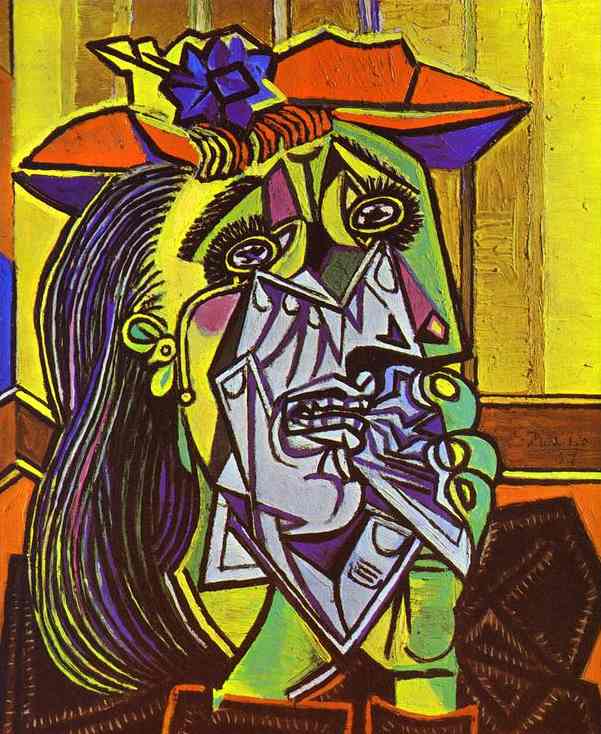
Abstract painting is not just masses and large painted fields of hue. Painting lines and circles will often be required. I never took any lessons on this but self-taught myself and so, along the way, discovered a few helpful tricks. 
I am so impressed with how Kandinsky could create those perfect circles and sharp, crisp lines that gave his paintings such clarity and force. In the beginning my own attempts were poor copies. I kept practicing and so now, quite a few years later my lines, circles and tight shapes are much more professional and therefore, visually effective. The example is obviously by Picasso who also used a variety of outlines in his work.
When I have the hue I want I mix it of course with thinners. Every artist has their own formula but I use about 1/2 turpentine with 1/2 Gamblin Neo Megilp..(odd name I know). The trick is getting the right formula and this only comes with practice. Some brushes just will not perform and so you will have to experiment with the right natural bristle brush that truly cuts a good line. The ‘angle brights’ are good and even the synthetic by Princeton does a good job. I have two of the #12 Catalysts. For very fine lines use the brushes that car detailers use – the angled liners. It will be necessary to pay more for good detail brushes, but it is so worth it. Keep mixing the hue with the thinners until you have the right consistency.
Have an extra small canvas handy and work on this until you get just the right flow. With practice you will be able to draw a long line and have the paint flow nicely. The trick is to have a good opaque line that is diluted only enough to let you drag it in a long line. If the line is thicker, concentrate on one painting just one side of the line and then go back and paint the opposing edge. When you have two good, sharp opposing edges, then fill in the center.
For circles, it is difficult without a precise drawing. I can now paint a circle without a line drawing on the canvas but having a drawing makes it easier. I pull one half of the circle and then re-position my hand to draw (paint) the other half. Try to be careful to not let the paint build up too much along the line. Sometimes I will take the excess and carefully put it in the center of the circle for later use. You want a nice, clean edge without excessive build up. When you have the perimeter of the circle defined, then go in and paint the center of the circle. For both lines and circles you will probably have to support your hand by a finger resting on the canvas. Or use the rounded wood pointer that rests against the canvas. It is important to be steady and this comes also with practice.