
When is a painting completed is a critical question you will be left to answer on your own. There is the story of John Singer Sargent and how he completed his paintings. After a work was 99% complete he would take it into another room. In that room without distractions and in different light he would study it from time to time, between other commissions. Then when he finally saw what was needed he would retrieve his pallete and brush and with just a few accents meticulously placed, the painting was finished.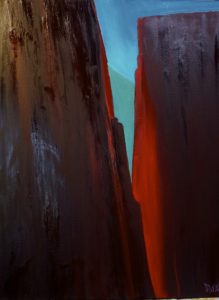
The story might be just hyperbole but it gives some insight for the advanced artist as well as the beginner. There is always the burst of energy and inspiration and this eventually dissipates as the painting wears on. It is not always easy to maintain the initial thrust of the work. The tried and tested rules for a completed painting do not easily apply to abstract paintings which is my genre. We can say a few things however that will point distinctly towards a painting’s completion.
Firstly it certainly must meet your demands. Are you pleased with it? Did it in fact capture some or most of what you had intended? If accidents occur and they often do in abstract painting, are you pleased with them? If not, can they be corrected? Very often in my own work I ask myself if more contrast is needed and are the highs, high enough and the deep tones, deep enough. Can the contrast or tension be increased without sacrificing the overall look of the painting? Is there movement or is the painting for some reason just static and if it is static and flat, how can this be corrected? When is a painting completed will ultimately be answered by you alone.
Sometimes an abstract painting is done primarily through a spontaneous effort, even completed in a day. Going back and adding to or subtracting needs to be done with extreme care and attention, otherwise any corrections will look out of place. It is important to not ask yourself what someone else might like in the painting – please yourself only. If in painting there is an area that is remarkably effective and you feel you have exceeded your abilities then this is excellent. If the rest of the painting is not quite as inspired this is ok. This is progress. The fact that part of the painting represents something remarkable is a notable achievement. Sometimes small attenuations on the rest of the painting can even augment and enhance those high parts of the painting.
Certainly set it aside when you are practically complete. Bring it out in a week or two and maybe even bring it in and hang it on the dining room wall. Study it. What else could be done, if anything? I like my paintings to have a certain drama or force or energy. One painting that I did had very good composition, good balance, good movement but the colors key was too flat. I re-worked the entire painting with more intense hues and the painting was transformed.