Every aspect of a painting cannot be dominant. There is always the need for what I might call ‘peripheral passages’. These are those subordinate areas in a painting that support the main elements of focus. Typically unseen by the viewer (seen but not especially recognized) these support elements are vital to the success of the painting. Because they are subordinate passages they are not seen as critical to the entire image yet they play a key part in getting the message across. They enhance the areas of main focus. They provide a substantive base for the painting in general.
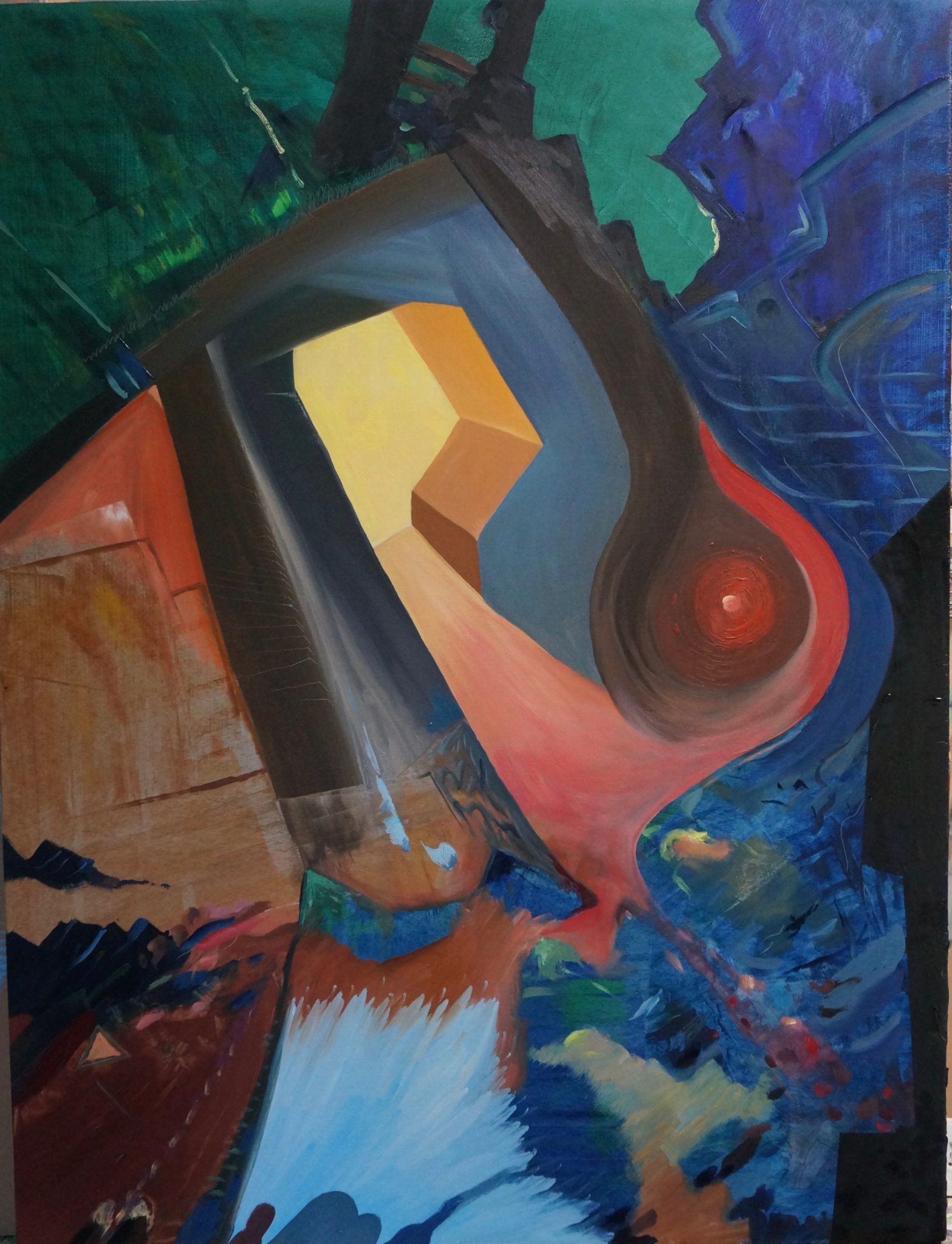
Emergence, 2017, oil on panel (drag painting)
Peripheral passages are those areas that direct the eye towards key elements. They often provide a mood and they will often be different one from the other. In the recent painting Emergence, there is a brown area on the left side of the panel that has been applied and then carefully scraped to reveal the texture of the panel underneath. Then in the upper right is an area predominantly Prussian Blue and Ultramarine Blue, very dark that functions to set off the centered and key elements of the painting. These are two examples of painted passages that uphold and provide a base for the general painting. By passages I merely mean areas of the painting that when looked at closely are distinct from other areas – they have their own distinct characteristics.
If these subordinate areas of a painting are not rendered carefully, if they are not in balance and in harmony with the rest of the painting the overall result will be ineffective. Artists will often say that a painting is only as powerful as the subordinate elements and by that they mean that if these peripheral passages are confidently rendered they give the required force and energy to the main focus of the painting. They cannot be casual, in-elegant and un-related areas of the painting. They must relate to the entire painting dynamically…they must relate to each other as well as the main design elements of the painting. So consequently there is the interplay of structures. The painting Emergence was set aside when it was about 80% complete. Several weeks later I studied it and by analysis of the elements it was clear that the peripheral passages were not adequately related. One area in particular was dynamically weak compared to the rest of the painting. The painting was out of balance. By correcting these faults I was able to bring the painting to a satisfactory completion. The main focus of the painting was fine and intact but it took correcting the peripheral elements or passages to bring a wholeness to the painting, where every element seemed to complement and relate to all the other essential elements.
We have come to understand that in the pursuit of good design we often place the symphony of pure color in second place. I am reminded of Tubular Bells by Oldfield and how fascinating the relatively simple patterns he creates stir us so deeply. Essence of color in painting comes when we begin to place color as the foremost element. Color after all has its own essence, its own purity. It is even possible to abandon design entirely in creating beautiful art. This is done by being sensitive to the purity of color itself, such as the relationship between tan/gold tones against those of blue and red combined or purple. Those two properly and carefully juxtaposed creates a very unusual and effective dynamic.
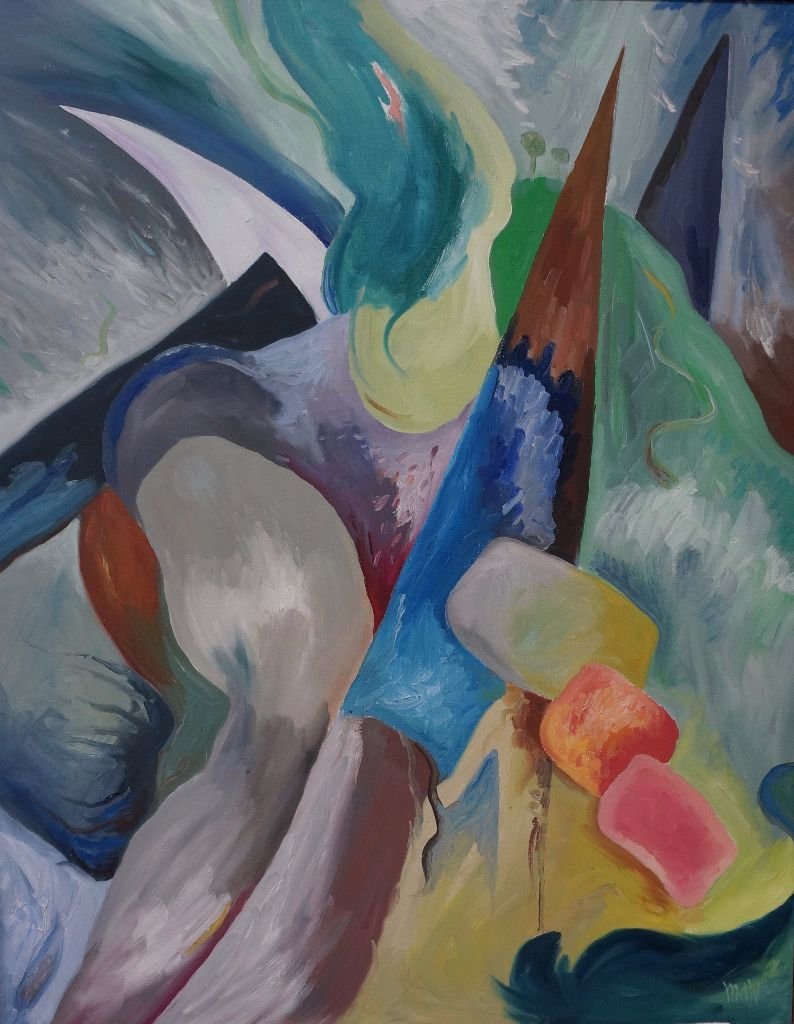
Symphony 20, 2017. Original painting by Michael A. Wilson
What we can call essence of color, where color itself is center stage depends greatly on contrast of hue and intensity. A blue against gold as mentioned above is striking but when the contrast is deepened the energy increases proportionally. There are no rules in this kind of arrangement but a heightened awareness is necessary. Some colors seem completely muddied without employing proper contrast. Though Rembrandt exercised extreme restraint for maximum results, the impressionists broke free from classic modeling to create scintillating dynamic compositions based essentially on pure color. Blending of colors gave way to placing pure colors side by side to create a more vital, energetic effect…a dark hookers green placed adjacent to viridian (without blending) was discovered to be far more emblematic of nature itself.
Pluck one string on a guitar and then pluck an adjacent string in the same range creates a simple but resonating quality. It seems the Tubular composition was after something like this – the subtlety of tones being predominate over particular style. Painting with pure color arrangement, that is the dynamic of color effect and sublimating all design elements to the vitality of color is an exercise vital to the development of an artist’s maturity. Tubular Bells by Oldfield depends on overlays. This can also be accomplished with color arranging. It is a fascinating process when executed skillfully. In my own work I often start with hard-pressed drag painting. This is done with dragging pigment across a hard primed panel. This method creates wonderful though accidental effects. These elements provide an excellent and dynamic base for a painting primarily concerned with the essence of color. I then apply multiple overlays and critical accents. Whereas Kandinsky would often title his paintings ‘Composition 20’ or such I find that composition does not suit this particular style of painting – this creative effort. Though I made four or five preliminary sketches prior to beginning, I ultimately chose none of them but began to paint directly unto the panel. The first layer was selective drag passages. After that came multiple overlays and thus the reference (right or wrong) of Tubular Bells. Then later, particular accents, deepening contrasts and adding some elements of design. Therefore it seemed that the work was more of a symphony of color combinations rather than a composition per sey. A symphony in my mind is a process of adding multiple instruments to create a complete structure, a complete piece of music. Painting in this way seems to be very close to this creative process in music. Spontaneous may not be accurate because though a painting like this stems from no particular composition, the work follows a process nevertheless, but it is a process that builds as it develops. Each layer invites or evokes the next and myself the artist makes critical decisions which to choose. Spontaneous tends to imply a impulse over thought but a painting like this definitely requires careful attention. There must be a very conscious awareness of what the particular passages are ‘saying’ – what they elicit, what they require to follow. I have titled this piece then, ‘Summer Symphony 20’ . This painting represents very clearly what occurs when essence of color takes precedence over compositional design. Summer Symphony 20 represents an important milestone for me personally because of this practically complete observance of painting where color itself is the predominate element.
By the way I wish to thank my brother Jim and my sister in law Pam for their recent visit to my studio. They spent considerable time looking over my work, even the several stacks against the walls. It was fun sharing my work with them. Both of them have a remarkable ‘keen eye’.
I watched a short video recently and when it was finished I asked myself where can the consumer buy abstract art worth buying? The artist explained how he had drawn fairly freeform but distinct forms on the canvas. The video was taken in his studio. It was a fairly large canvas. He was talking as he executed the piece and explained that the next process was to smear paint on the canvas and create a sense of chaos. He mentioned this several times – the creation of chaos. So in the short video we watched him do some of that – very free form smearing of paint with a fairly large brush. He said that after this was done he would typically come back and add detail…this detail might hint of something tangible or recognizable. He spoke about how he would start with something fairly distinguishable and then create chaos and then bring the piece back in to something we could relate to. I asked myself if this is ‘abstract art worth buying.’
Curious but in my own work I do not consciously attempt to create chaos. Just sifting through all the myriad impressions I receive seems a fairly chaotic process in itself. Deliberately creating chaos strikes me as an entirely foreign process. No doubt this works for the artist in the video. It is his way of creating personal art and an art that resonates for him. I think this was his way of getting at something spontaneous – a more free way of expression, a way of loosening certain boundaries first and then re-establishing them based on his own personal assesments. Just a guess at a hypothesis. It is very clear that every artist approaches his or her craft with entirely different backgrounds and motivations. There is no right way. Those who love art and wonder what abstract art is worth buying have their work cut out for them. They have to discover what resonates for them. Is the piece provacative? Does it give joy? Is it challenging? Does it contain inherent beauty? Is it an honest piece and does it strike one as genuine or is it just repetition, just another mindless waste of pigment?
Of course any time I see another abstract artist or watch a video of someone creating abstract art, my own work is challenged. I ask myself just how genuine is my own work? Am I creating something that speaks back to me with certain, distinct clarity? How close did I attain what I had sought for? Was something special discovered along the way, something intangible that helps me understand my own psychology just a little bit better. Does my art create a better world? Do I hide behind my painting or am I willing to expose myself? An artist just like anyone else can fool themselves. It takes effort to express honesty and in the process an artist can become quite disturbed – at least that is my experience. I am speaking in generalities because in art there is no rule to guide us. There are so many ways to interpret our world. There are so many ways to manifest our own inner and personal psychology. The one unifying factor is that every artist recognizes the need and value of creating art. We start out painting or dancing or composing out of sheer desire, out of joy. The trick it seems is to wind up at the end with the same simple motivations. As one gets along in years, continuing to paint, then the ability to technically create a beautiful image becomes easier. One recognizes good passages more quickly and more assuredly, one is able to distinguish a good honest line from a weak one. Execution improves. Facility becomes a much longed for friend – at last. If the artist mentioned finds his process of creating chaos and then restablishing his own interpretation of reality and it gives him joy, well then, we have to give him his due as well.
In the creative visual arts world there tends to be an inbalance which leans heavily towards inspirational force. Technical skill becomes undervalued. It is the great theme, the inspired idea which is paramount and true skill in handling becomes the third rate cousin to the creative process. I have become increasingly fascinated with comparing the visual art process with all the other arts such as music, dance, writing and architecture. Can you imagine a wonderfully choreagraphed dance where the dancers clearly lack experience and technical skill to execute the choreograph movements? The performance would be a failure. Imagine a majestic piece of music where the pianist clumsily transitions between notes, or an inspired idea for a story but the author lacks the ability to create simple and proper sentence structure. Especially as we mature as artists then we realize how critical ‘technical skill’ to the success of a painting. In fact, it might even be said that a mediocre idea for a painting, if skillfully rendered will be perceived as evocative and even beautiful.
Especially in the past several years I have developed the habit of consciously pulling out paintings which were conceived several months prior. I consider it a period of gestation. The original painting was put down with the intent of keeping intact an original idea, a first impression. I find it is often difficult to get an idea ‘set’ and then also to carry it out with all the technical skill necessary for full completion. They often comprise two fairly distinct efforts. A form may be put down accurately but the edges are not refined or they do not blend in with adjacent forms. Choice of the original color hues may often need refinement. An area that is a wash may need to become completely opaque or line quality needs to be rendered more carefully. This is the second effort relying now on the artists technical skill. The beginning artist therefore must be patient in developing these necessary skill sets.
There is much to be said and appreciated for that initial inspiration, that great bust of energy that brings an artist to the canvas in the first place. I love the story of how Frank Loyd Wright kept putting off the design of the now famous Falling Waters Home. When the owner grew impatient and announced he would be driving up to the architects studio in six hours Wright brought his apprentices in to the studio. They kept sharpening his pencils as he furiously drew out the concepts for Falling Water. When the client arrived and Wright presented the drawings the couple were astonished. No doubt Wright had been pondering and conceiving of the structure for months prior to actually drawing it out on paper. That was the inspired moment, the inception, the spark but it would be many months later when finally the technical drawings were completed. In terms of technical skill the builders and carpenters and masons had to then re-create those drawings in to a three-dimensional world. Architecture in my view is an almost perfect example of the fairly sharp distinction between the ‘concept development’ and the requisite technical skill that must follow. Good and skillful workmanship must accompany good architecture.
We admire the masters because they tirelessly mastered their craft, became skillful with the brush, with design and with proper justapositions of color, hue and harmony. The so-called simple and straightforward portraits by Rembrandt are spellbinding because of the great technical skill he employed in manipulating paint and light on the surface plane. I admire the brilliant watercolors by Sargeant because of the great skill he employed in rendering light in nature. The history bending painting, Nude Descending the Staircase has a remarkable luminosity and harmony that had not been seen before and this could not have been succesful without unusual skill with the brush and without an uncanny eye for color. It appears rapidly executed but was in fact rendered with great care and skill and intention. For those of us desiring to improve our own work, we can take heart. By tirelessly devoting ourselves to improving the quality of our brushwork, the consistency of our lines, the blending of forms and backgrounds we can transform even a common representation to something that truly is art.
There are certainly times, especially when listening to inspiring music when I feel I am the envious artist. Music has so many fluid capabilities. It can begin with just the quietest, softest flute and then build little by little to a grand orchestral finale. Music is by its nature, transitional. There is movement, crescendos…the rise and fall creates unremitting interest and intrigue for the listener. The visual artist stands mute before this energetic display of expression. It seems to be almost constant in all veins of music and there is a tendency by composers to begin quietly and then to build in increments often relying on a consistent theme which supports the entire piece as it develops. I am speaking as a non-musician but this seems to be a very clear advantage in conveying mood and emotion, the concept is revealed in successive stages, draws us in and captivates us by its initial subtlety.
When I was nineteen I had the fortune of traveling Europe drawing and studying from many of the great masters. I drew perhaps six or seven careful drawings standing and sitting before the David. When I returned my mother selected three of them and had them framed by a rather prudish fellow who was in the business and belonged to our church. He was appalled especially at the one which concentrated on the pelvic region, the abdomen, thighs and penis. He almost declined the work. Sculptor seems to be even more static than painting and yet here was this fellow being quite emotionally offended by a simple drawing of a nude marble statue. This was quite a revelation to me at that young age. Since that time I have thought much about how the visual arts can in fact evoke an emotional force, a dynamic even when it lacks the inherent fluid qualities of music. My conclusion (though still in discovery) is that the playing field is in fact quite different. For example going to the extreme far right and discussing an even less fluid medium, photography I will mention the iconic image of the four men having lunch in New York. They are at an immense height sitting together on a steel I beam, resting and their lunch buckets have been neatly set out. It is the construction of a high-rise and far down below are the city streets. Though the image is fixed, definitely static somehow we are captivated by this scene. We keep looking at it trying to detect all the nuances of the subject. There seems to be a particular story evoked by each of the four men sitting. Why is that one man without a hat? How can they be so un-afraid sitting on that narrow beam? How much could they be paid for such dangerous work? Why didn’t they go down to the street level to have lunch and what unusual clothes they are wearing? So we must agree that though the image is fixed, the images that our minds conjure up are actually quite alive and fluid.
This small example then tells us something about just how we respond to a piece of framed art. Whatever emotion is evoked stems in great part from our own experience, our own longings, our own desires and indeed, our own fears and anxieties. The artist by ‘freezing’ an image focuses our attention. In our imagination there are certain events that preceded the event that we now see and then we imagine those which may follow. Though the image is static, thanks to our imagination and our own memories, our minds seem to experience a larger and more fluid whole. There is a term in music which describes the beginning, the first tempo that leads to the heart of the composition. With the visual arts we are not given such an opportunity…the entire concept is seen as an entirety. There is no graduation, no build-up, no crescendo. The entire painting is laid quite bare before us. The more the painter develops the painting, the more exposed he becomes until finally the painting is complete and all is forever frozen – a moment, an event, an experience, an emotion or in the case of an abstract Kandinsky, unrecognizable forms. These forms we are now discovering refer us to ancient motifs and these motifs refer us to very old myths that have played a very large part in shaping our culture. Visual attenuations therefore resonate with us because we respond to them internally. Abstract art that brings us out of naturalistic settings and in to unknown territories places these forms before us. Everyone responds differently because those visual contexts we are used to seeing, are not present.
We see then how the visual arts can have vitality then even without the aide of musical constructs. This very different playing field relies then on each individual memory, each unique set of experiences when viewing the so-called static image. This is what gives that iconic black and white photograph such interest – we naturally compare our experiences with those we are looking at. Also, those very ancient myths have been passed down through the centuries in my cases, by way of motifs. Internally we respond to these visual motifs because they represent the make-up of our consciousness. Art then, in its best manifestation is a truer reflection of our own consciousness through the eyes of the artist. So then, art or sculpture that is apparently static and fixed has the opportunity to express remarkably ancient symbols, myths and motifs when the artist is sensitive enough to recognize them. This is one reason why the brilliant psychologist, C.J. Jung frequently had his patients create and paint mandalas. These mandalas had the uncanny characteristic of repeating dynamic human themes. These proved quite helpful to the therapist in treating patient psychosis. In any event the composer and the musician plays on, the sculptor chisels away and the painter keeps spreading paint across canvas. It is only inevitable that the painter will feel envious of the musical arts. Perhaps we will grow to realize that in this age where we are accustomed to being overwhelmed with images and information, the artist is the one who helps us to focus. Images drawn from the deep well of our consciousness desire then to be revealed. It is these that will hopefully shed light on our circumstances, our civilization and those elements that are of value. We need not treat our trade disparagingly. We can refine the purpose within the medium. The great joy that we experience across the artistic stage comes from the exploration itself. Every small reflection and expression of what we feel inside tends to lead to joy. It is within the context of this inner jubilation that we come to know ourselves more fully. We become less confused. We become more aware. Personally abstract art provides an excellent medium to explore these often hidden and ancient motifs…freezing these on canvas in some ways represents for me lamp posts along the way of discovery, the evolution of our own society and perhaps even the fabric of our civilization. We may not understand them but they resonate for us. As artists then we can only play our small part in this evolution.
What can be more fundamental in any artistic endeavor than developing concepts? This represents the beginning, the essential kernel that spawns the artistic project. However I feel that artists are stymied when their concept (however it is conceived) is not fully developed, either emotionally or visually in the case of the visual painter. All of my articles are essentially about the visual painter as artist but it is quite easy to see how many of these written constructions also relate to the other arts such as music, dance and sculpture. We begin with a concept and then the process begins with developing those concepts.
In my own case I rarely am fortunate enough to begin a painting with a fully developed concept or idea. There is a germ, a spark, a feeling but this is often all we can go with. We have to rely on that to begin. We have to believe that this small spark of an idea can lead us into a finished product, a painting. The process of developing a concept is however quite different than the actual process of completing a painting which is I think, often misunderstood in the art world. Gerhardt Richter has a very large, expansive studio. His process is to take a ‘so-called’ finished painting and bring it physically in to another room. This room is uniquely un-cluttered and separated from where the painting had been conceived. In the entirely new environment Richter will study the painting on and off for sometimes several weeks. He studies it to ascertain how technically this painting should be completed, what nuances should be added, what tones need adjusting, if the painting ‘works’. Most of us do not have the space or opportunity to remove our painting in to an entirely different environment for study. The point is that the initial thrust of the painting strives to attain the concept. The second part of the work is done by technically bringing the painting to its full completion. Shapes and forms may have been articulated but in the second part of the painting’s development, those shapes and forms should be carefully delineated and the brushwork refined.
This refinement is noticeable in Kandinsky’s work. Each shape is technically refined and beautifully rendered. In the developing concept this would have been impossible…it is enough to get the concept down in terms of location, design and coloring. The second part of the process is necessary to bring the painting to its fullfillment. In my own experience this is best done by studying it a week or two after the painting had been initially developed. It is very rare when I find a painting that does not need further attention. Elements inevitably need modulating. Perhaps the best example might be the sculptor who works with the chisel to establish the basic shape of the form. He or she gets it quite close to the concept or idea. After that, however begins the long, tedious work of sanding and refining the various shapes. Without this final attention the work is not truly ready, not truly finished.
Visualizing abstract art projects is the essential first step in creating a painting. Visualizing (or developing a concept) is the process of creating a basic construct of the painting in your mind. Through practice this process can become a more natural and less forced mental effort. We all realize how incessant our mental activity is and often it is only with great difficulty that we can shut down our mental activity. The visualization comes by channeling that mental energy towards your goal of creating art. The mind then becomes a useful tool for the artist. We can play with images, move them around, distort them and place them in different arrangements to fit what we are imagining. This is not unlike a musician working up a new song or a choreographer imagining a dance routine or an athlete picturing a practiced extension to achieve a desired result.
This is however not always immediately effective. Patience is required. Sometimes our imagination will give us just a hint or suggestion and a sensitive artist will pay attention to this and meditate on this bare image. Personally I try to keep a sketch pad handy in several areas of the home or studio to quickly sketch the suggestion. These seem to be sub-conscious images that creep up in to our minds in small segments. I have found with practice I can freeze, in a sense, these images and then begin to develop them mentally. By directing our mind away from unimportant thoughts to those of the desired art image we begin to use our mental constructs to advantage. For the artist this visualizing process tends to go with the trade – artists by nature can ‘see’ the forms mentally. There are times when an image will keep re-occurring over and over when I meditate but nothing seems to follow. There seems to be nothing beyond the simple form presented, even after several days of mulling over that particular simple image. In those cases I will go out to the studio and prepare to paint that simple image. Often and remarkably after that initial start, the painting will begin to suggest the next form or color or shape. The painting then develops, for lack of a better word, organically. It seems to come from its own quite naturally. There is a sensitivity required to this natural development. Past experience is fused with these new developments. Personal preferences and color choices are employed to enhance the developing painting and curiously the imagination begins to expand as the painting develops.
Conversely a painting is often more thoroughly imagined before it is begun. In this case the visualization process is taken to a more complete stage. It is remarkable in these cases that a painting can be so substantially established even to the point of color selections. On these occasions it is essential to have a drawing pad handy to draw out the development. Fortunately once the drawings are made (and sometimes I will do several) the image becomes fairly locked in mentally. The drawings are signposts and I find that inevitably the painting will become considerably changed and refined as the paint is applied. In these cases I do draw out the visualized image on the canvas or board. Between these two extremes of something starting from just the smallest seed or idea and from a highly visualized starting point are many, many variations that artists employ to begin a painting. The point behind this article is to encourage the mental or meditation visualization process. With practice you will discover that it becomes a fairly natural process to use the mind as an effective tool – tool of the imagination. There seems to be a deep and vast wealth of sub-conscious material that is waiting to be discovered, waiting to be manifested by the abstract artist. The key is patience. Allow the images to come without forcing them but once they arrive (however small and insignificant) pay attention to them…begin the visualization process.
There are some songs, some tunes that just seem to draw us in. We feel almost entranced. Some Beatle tunes are like this and we feel like hearing them over and over. Music transcends and takes us to a different state. Good music enhances our daily lives. My brother is a musician and he is constantly learning new pieces or refining ones that he learned years ago. He loves all kinds of music and plays the piano beautifully. Music of course comes to us audibly – it comes to our ears and creates a vibration that can literally affect our soul experience. The magic of color comes to us in a slightly different way.
The visual artist, specifically the painter finds entrancement in color. For the abstract artist color is often not specifically seen as a view of nature but is realized internally – color is imagined. This no doubt stems from a particular collective storehouse. It seems as if the brain, trained to discern color combinations keeps a type of record – almost like a slide show of color combinations that are constantly being inter-changed and compared. It seems to be a mental process aided by the imagination. Last week I was admiring an American Robin which has a most peculiar shade of orange fully on its chest. It is coppery, darkened apricot and not I expect, especially easy to duplicate on the pallete. The particular shade is distinctly now logged in to my memory and I think, for the time being at least, locked in. Bringing it out and manifesting that exact shade comes only with practice. I own several excellent books that describe how to inter-mix shades to get accurate results. They are carefully arranged with a certain shade of crimson running horizontal and then a shade of blue (Prussian) running down vertical and then they cross in multiple combinations of white. Then it gets complicated by adding cadmium yellow and these run down a column. There are thousands of combinations. Personally I rarely refer to them. My experience is more, shall we say, visceral and intuitive. I just start mixing small experiments and trust my eye to match what my mind has stored up.
It is helpful to be undistracted because it seems the transference is not especially an easy one. Mental elements have to be retrieved. There seems to be this intricate filing system and as I mentioned – a type or series of multiple slides carefully arranged and logged, perhaps according to my own specific preferences. This then has to be mentally interpreted, the colors at hand need to be manipulated on the pallete by the brush quite carefully and it is often the case that the established hue is just not quite it. When it is found there is a distinct excitement of discovery. Not unlike discovering a tune or song that seems to exactly represent the intended mood or feeling that we want to play it over and over. For the abstract painter there is no specific tree, no sky, no stream for color reference. This then opens up endless possibilites but also seems to demand unusual sensitivity to the stored up mental categories of color combinations. Today I keep turning in my mind a particular image…it is not actually so much an image as a combination of three hues : a dark umber, a very shaded white with a slight tint of cadmium yellow and remarkably, a grey tone with a touch of red. Through the day I can bring those exact three hues up in my mind and review them. I can mix them in various design schemes – I can manipulate them. The exact hues however just came to me unexpectedly. I did not go searching for them. They were apparently and previously logged in separately and then brought forward in my mind as partners. Those three and only those particular three were brought forward for my mental review. This of course is an interesting process to experience. It lies at the root perhaps of why an artist paints at all. I mean, after all I can either ignore the prompting which cosmically seems like a terrible waste, or I can respond to it and see what might be manifested when I do go and prepare a pallete of these shades – or try.
The actual merger of a conscious idea with the universal un-conscious is essentially the synthesis in abstract painting. It is an actual process where an idea is given form. This form is then transmuted by the un-conscious or as some would say, the sub-conscious. Without this critical merger there is no real synthesis to depend on.
I like the story by one biographer of Picasso where he relates how Picasso would stand hours before a painting in study. The painting would be one third complete – he had given it the initial conscious beginning, the conceptual idea. Now he studied what was before him to understand what the painting was trying to say… what the sub-conscious was wanting to manifest. Without that merger there is no force, no real dynamic that underlies the painting. It would be foolish to believe that our limited consciousness can fully grasp the vast universal un-conscious. We can begin, we can start but it quickly becomes a process of carefully responding to these seemingly hidden universal themes. This is the synthesis. We occupy, after all two distinct spheres of influence – conscious form (that which we see and experience by our natural senses) and the hidden un-conscious which essentially motors our responses. By becoming aware of those two distinct spheres the artist by degrees becomes adept in responding to a dynamic synthesis.
The genius behind the painting Nude Descending a Staircase by Duchamp represented a giant leap in exactly this kind of merger. At that time there were the Futurists painters who were infatuated with motion. They thought this was the next universal transition for painting. The other presiding camp were the cubists led by Picasso and Braque. They felt that form should be understood in terms of prismatic effects. Duchamp effectively merged those two concepts with remarkable sensitivity in the painting Nude Descending the Staircase. As a result Modern art was literally catapulted from figurative painting. That one painting spawned an entirely new awareness in the artistic community.
Today we are unsure exactly where our art will take us and how abstract painting will evolve. The advances in psychology and the broader understanding of the distinction between the conscious and the un-conscious should prove enormously helpful to the sensitive artist. Evolution of concepts is inevitable. The merger, the synthesis of natural conscious form with the universality of the subconscious will potentially lead us to a vigorous and dynamic abstract expression.
Universal themes in abstract art are at best, a difficult subject to truly comment on. Realistic, thematic art is the more common medium for describing universal truths. Abstract art comments on universal truths on a very different playing field. Surprisingly I find that expressing those truths and those feelings are more directly felt in the medium of abstract painting. Pure color for example can be manipulated to elicit strong feelings among people of all age and all race. Rothko is an example of an artist who completely minimized design so that color could predominantly transfer the intended feeling.
When the song was written To Dream The Impossible Dream we immediately feel the universality of that particular song. It is impossible to not feel a universal sense – as if my dream is comparable to yours, that in each of us we carry our own personal dream and this in affect draws us universally together. It is characteristic of excellent music to lift one from relative unconsciousness to an awareness of everything that binds humanity. Common spiritualitys become apparent. There is that same beating of the heart. By becoming surly, by closing oneself in spiritually to what is good, to what is universal we naturally are drawn to those preaching isolationism. It suits our temperament because we are already closed off.
Blue Horizon
Painters will sometimes discover while painting the mundane, the common and those natural forms all around us, a special resonance. Through study and attention they can begin to find a universal thread which enlivens their work. It is precisely this kind of discovery that leads a painter to pursue Universality as a goal: yet that is where the slippery slope begins to develop. It does not seem to be attainable by a straight line, by a pre-established theme. It varies in this way from an inspiring song which places the universality in the context of word images and we know that word images hold incredible power. The abstract painting seems to manifest only by direct experience – that is by an immediate response, as the painting develops. There apparently is something about the mind, the hand and the attenuation that operates between them. Add the muse or spiritual experience or what ever you want to call it and you have a fairly rare stew needed to create anything truly Universal. It is a wonderful thing when it does appear. When it does and when it becomes apparent on the abstract landscape it behooves the artist then to respond sincerely, carefully and yes, selectively. The muse may be a force, a universal force but tends to create images beyond our capacities. It is the artists responsibility then to selectively choose those images which he or she can manage effectively. We say an artist is great when he is able to realize this – the harnessing of those impressions in line with the ability to translate. After all, what is the purpose of this realization if nothing can be made of it – not even a line of response, not even a simple drawing of interpretation?
This is perhaps why artists rarely engage in things non-universal in scope. They have realized the futility in trying to raise form to a better, higher level – that is without a very comprehensive view of humanitarian universality. Besides, so much effort is required to truly improve the craft of painting there rarely is time to engage intelligently on matters political. Curiously if we live honestly and if we respond sincerely to our emotions then we cannot help but be moved by those human elements that hunger for universal acceptance. We are reminded of the Biblical story – the Good Samaritan. How powerful is that simple story that Christ told ? Yet in many ways that simple story describes most poignantly God’s view of us. The universal part comes in that we all fit within the grandeur of that grace – that is every person of every race. By degrees we are all slowly coming to this understanding. An artist certainly must understand this for any true and positive effects. There is a certain sensitivity required here, again a humanitarian and universal response to the world. This falls short of course to a true purpose or understanding. Strategically we know that painting anything with a universally dynamic image seems to always manifest beyond pre-conceived images. The painting develops from one segment to another and until one area is defined there are no road maps for the next. This is the difficulty. This is the challenge. Becoming more and more conscious, more aware is so very much needed. Tolle came along at the right time for me – when I was ready. When I truly wanted to know. I concur with him that in every reasonable respect we have only the moment before us. Responding to that moment (this moment) honestly, accurately and sensitively is how we mature as artists. After all, down through the ages we have relied on the artist to give us that sense of Human Universality – those all-important images that freeze for us our sense of compassion. The abstract painting however requires an entirely new form of expression. An entire shift in sensibilities is needed to creatively express that desired universality. There are so many avenues of interpretation – fortunately that can be at our disposal. Van Gogh might have had a premonition of his early death and so, was in a hurry. He was in a hurry to comprehend those deeply human and universal characteristics which define our civilization. He detected that over-arching spiritual quality that envelops all of nature and all of mankind. That is why in the great galleries men and women huddle before his paintings in awe. Compared to say, Michelangelo or even against El Greco he was a clumsy draftsman. His paintings however came alive by the spirit he captured in his paintings. Every race of man is moved by his crude attempts to manifest a sense of Universal art. We then are able to ignore his incapacities by embracing and understanding those simple and direct responses given up by his brush.
Van Gogh of course dealt primarily with natural images yet he saw within those very natural elements that surrounded him – simple cafes, crows in the field, a tired man cutting wheat, a particular heart cry of humanity. He embraced these as his own. But understanding and awareness of the human and universal spirit need not be melodramatic to be authentic. In fact we almost revere humor in our lives. We find ourselves delighted at the simple wisdom of Charlie Brown, the dry humor of Snoopy and the cunning of say, Will Rogers. When we are poked fun at, we become more sympathetic but also more vulnerable. It is not an easy task to create a truly humorous cartoon – one that speaks to the universal condition and one that someone of any race might understand and smile at. It is however a rare artist who can find humor in his or her discoveries. We see little humor in Van Gogh’s work but many years later in abstract artists such as Kandinsky we do find, if not humor, a distinct joy of creation, joy of life and this amidst the backdrop of the second world war. Through color and design now void of any reference to natural form, abstract art transports us to a more visceral awareness of the human condition – especially in the manner in which we respond. Abstract art as history progresses provides an entirely new and positive dynamic for expression. Life seems to be more complex. Abstract art has the capacity to reflect that complexity and convert it into a more linear expression. This again must refer to an artists capacity – what he able to do, the level of his technical skill. Regardless, as Hemingway would say, ‘if it is authentic, if it is truly spoken then it is good art.’