Posted on Leave a comment

Contemporary Art


Contemporary art as a style goes back as far as Picasso and Kandinsky from the 1050’s.  Contemporary art typically refers to art that no longer relies on realistic images for subject matter.   I recently visited the showing of abstract art here in San Diego which featured works from Gauguin to works as recent as 1960.  These represented a wide range of artists with very different styles.   Apparently the show started progressively with Gauguin because he was one of the first to abstract and flatten planes into modular colors.  Depth and perspective became less important.

Fortunately artists today can choose from a wide range of styles that can be classified as contemporary art or ‘modern art’.   Broadly speaking, any work of art that varies from natural forms and realistic perceptions can be considered contemporary.  Technically when  an artist purposely abstracts realistic images it would be more accurate to say that they are an abstract painter.  This is more narrow, precise way of describing this type of art under the umbrella of Contemporary Art.

It is interesting that work from the 1950’s and even earlier can be classified as contemporary art, along with work produced now in 2014.   This broad umbrella of style allows for multiple genres.   As an artist who prefers to leave naturalistic images and to explore abstraction there are many varied styles to choose from.  With experimentation it is possible to find the style and manner to express your own feelings on canvas.  For example we know how different Jackson Pollack is from Rothko or from Kandinsky.  There are artists today who have studied these past masters and have developed their own unique expressions.

Contemporary or abstract art is not for everyone.  The majority will prefer to view something that is recognizable,  something pleasant and bucolic such as the paintings of the commercial artist Kinkaid – the so called ‘painter of light’.  Abstract art pursues those realms that are not so easy to identify.  They stir up feelings which may run deep but we are not sure why.  We have to appreciate those artists who are willing to explore these other dimensions.  There is a certain adventure and energy in this type of exploration perhaps because it invokes not only the natural responses but also sub-conscious responses.   Translating these sub-conscious responses requires greater sensitivity to our inner feelings.   We can sense this thread of exploration even back from the early contemporary, abstract art of the 1950’s.  It will be exciting to see what turn the abstract artists of our era produce.

Posted on Leave a comment

Oil Painting Tips – Psychology


A paintings’ psychology could also be called the theme.  There is an intention that should be established going into a painting.  In the world of abstract painting where naturalistic forms are not available, an intended theme should be established.  This theme will usually come from your own psychology, your personal inner persona.

My uncle who is still painting in his 80’s is working on a new (for him) psychology.  No longer abstracts his images now are of specific locations with figures which are identifiable, even to the point of their expressions.  It is interesting to see the carry-over from previous work in abstraction.  This is notable in the backgrounds he uses which are almost swiped affairs like controlled accidents.  After this swiped background  dries he comes back with the various figures and forms and a hard line detail.  It creates a lyrical painting and there is an established  theme to his new work.  A fairly precise painting is executed over an imprecise background…this is the psychology or the theme of this new work.  Often the figures or the scene depicts a certain mood and this mood has sometimes a sense of ‘longing’.  The important thing is that something had been pre-determined or was detected and allowed to unfold as the painting developed.  This thematic quality of allowing a painting to develop partially on its own works very well with abstract constructions.

Recent work by myself has begun to explore locations as a theme.  My new paintings place the viewer in a specific location and are asked to visit this location and to discover the intended abstraction.  By doing this the viewer begins to understand my psychology and begins to get the feel of this particular location or the drama or sense of this location – this exact frame in space.  Painting is after all a process of ‘freezing time’ and expressing a composite of feelings into one single visual element.  This is different than far more random expressions where composite harmony is more difficult to discern – which is a style of abstract painting which I also enjoy.

Posted on Leave a comment

Abstract Art Definition (2)


Studying art literature and what artists have to say about their work will not yield masses of material.  Artists historically have not written much about their process.  Kandinsky is a notable exception though his small book, Concerning the Spiritual in Art is not an easy read.  This may be due to the translation from German to English.  He does talk about an artist’s need to express the ‘inner feeling.’  He attempts to discuss how color and compositional design can effect those inner feelings.  It becomes apparent just how careful he was with color, even in apparently random paintings.  His paintings could not be classified as random and he makes efforts to place art in a position where art is meant to lift us spiritually.  He feels art should raise the consciousness of a civilization and in fact the ‘Arts’ in general are uniquely capable of this task.  He calls it a noble task, a noble responsibility.

The departure from naturalistic forms into the abstract is considered a more direct line towards this responsibility.  The constraint of fusing natural settings with inner feelings hampers this direct relationship.  Abstract art is considered more responsive to an artists’ inner feelings.  As I mentioned before in previous articles, Ekhart Tolle explains this expansion of consciousness more completely and more thoroughly.  He explains how we can more fully appreciate our own inner consciousness.  As an artist I have found this to be helpful.

Abstract art can be defined then as primarily a response to an inner feeling rather than to natural forms.  Attenuation of forms can get in the way of a more spontaneous response to an interior drama.  We immediately think of a Jackson Pollack whose work is completely free of any reference to natural forms.  Gerhardt Richter uses the process of dragging paint and relies upon this as an accidental effort to create spontaneously.  We might call it ‘controlled accidents’ because he is obviously carefully choosing where to place the colors to be dragged and which hues to implement.  In any case Abstract art, by definition divorces itself from copying natural forms .  This effort brings to bear new disciples such as a refined approach to color sympathies.  Paradoxically rythmn and composition becomes even more valuable and more important to the concept of the painting.  Kandinsky speaks of the harmony that needs to take place in an abstract painting and this must come from the jumble of inner feelings – that is, a certain order from the drama of our inner feelings.10

Posted on 21 Comments

Abstract Oil Paintings for Beginners

Are you new to oil painting in general or just to oil painting of abstracts?  In either case you will want to have an understanding of what defines the Abstract genre.  What defines Abstract and Non-Objective painting?  If you can have a clear aim in sight, this will help you develop your work, right?

Kandinsky attempted to define what he was doing when he worked as a teacher at the Bauhaus.  He wrote the small book titled, Concerning the Spiritual in Art.  Considered the ‘Father’ of Abstract art it was apparently necessary for him to define his new directions.  We read for example of his painting from an inner need and from an inner compulsion.  This required a break from conventional known or recognizable forms.  I think the book explains his position fairly well and his departure from object forms.

It is an interesting comparison in reading Ekhart Tolle’s book, The Power of Now.  This book talks about the relative illusion of form.  He describes a process of seeking a higher consciousness by recognizing form as being an illusion.  He points out that true reality lies within and is quite separate from what we perceive as form.  This seems to resonate with what Kandinsky wrote fifty years ago when he states the need to paint from an inner resource and to give that inner feeling expression.  Tolle however is able to give us a more clear understanding of that inner dimension.  His book is a valuable resource for an artist.

I was watching a Facebook video clip of a niece, just three at work on a painting.  The painting was nearing completion and she was standing before it brush in hand.  There were all kinds of swishes and circles and dashes of varying colors – a very exciting painting.  She began to mix on her brush some reddish tones and then carefully reached up and put two deliberate swatches of red near the top but separate from each other.  Why did she choose to do that?  Why were they the final strokes to the painting?  This process should be similar to our own means to create Abstract art.  We should be studying the canvas and placing shapes and colors in response to an inner feeling.  We should also be sensitive to the other colors and shapes on the canvas so that we create a symphony.  As in a symphony all the various components work together to create an effect.  08

Ultimately painting an abstract oil should be a joyful expression.  We should not worry about ‘wasting’ paint.  This should be our time to draw out our inner feelings and to express them with relative freedom unrestrained by the forms we see around us.  This is what makes Abstract art, for me so special and so intriguing.  The other advantage is that we have a more broad free range of colors to implement.  As a painting develops we can creatively use colors that best suit the needs of the painting – we need not be bound by ‘what is before us’.

Posted on Leave a comment

Contemporary Wall Art

Contemporary wall art can add incredible drama to a room or office.  When considering what kind of art for your room there are several important considerations.  Large, bold realistic scenes, paintings of abstracted forms or non-objective paintings are three choices.  Each of these styles will impart a different feeling to an interior.  There is considerable difference between an original art work and a print.  By searching you will be often surprised at the quality of original paintings with affordable pricing.

I personally feel that it is vital to consider scale.  If your wall space is large, you will want a larger sized canvas.  In fact sometimes a client will prefer to hire an artist for a mural that covers the entire wall.  This however is not necessary.  A well chosen piece of art will effectively contribute to the mood of the room.  Some paintings will reflect a meditative mood and another will be vibrant and exciting.  Decide what kind of mood you wish.  The painting will dramatically influence that mood, especially if it is a large painting.

The frame you choose for the art does not necessarily have to be elaborate.  Many famous abstract paintings hanging in galleries have very simple wood frames.  Sometimes an artist will paint the edge of the canvas in which case a frame is not necessary.  I do prefer however a frame which sets off the painting.  The background wall color should not ‘fight’ with the wall art.  The chosen wall color should enhance and be a suitable background for the painting.  Muted colors are best and sometimes white is preferred.

Hanging contemporary wall art will require professional lighting and often more than one spot.  Purchase natural, full-spectrum light bulbs that brings out the true colors of the painting.  The cost to install proper lighting is often considerable, so factor this in to your budget.   Contemporary wall art will often be of the abstract or non-objective style  This ‘Kandinsky’ would look stunning in a well-lit living room or dining room.  So, remember it is important to consider the scale of the painting – that it matches in proportion the wall.  Use a muted background wall color to enhance the painting and then add appropriate lighting for night time appreciation.  Of course always choose a work that appeals to you emotionally and spiritually.kandinsky sketch for painting

Posted on Leave a comment

Buying Abstract Art

Jennifer-Perlmutter-2Architecture, furnishing and art should have, ideally a certain relationship.  Frank Lloyd Wright was noted for carrying a theme or motif throughout a building.  This kind of thoughtful design created a consistent harmony in the structure.  Realizing the importance of being thematically consistent he would also design the furniture pieces and these would reflect his particular chosen motif.  The affect was almost always dramatic.

Those who can afford bolder, contemporary homes will also purchase furniture pieces that reflect this kind of design.  Abstract art is a perfect reflection for this type of home or business.  Especially larger art works will often exude a bold, dramatic, colorful impression that enlivens an interior environment.  When you are buying abstract art you will want to find something that truly enhances your interior space.  However, your fist criteria will be to ask if the painting truly resonates for you, does it stir you, is there a mystery to the piece ?  Space is always a consideration.  Often a contemporary home will have large, tall and well-lit areas.  There would be no point in putting a small painting on a large wall.  The scale would be wrong.  Good interior design is about proper scale.  An abstract painting should be appropriate for the space.  This painting by Jennifer Perlmutter is charming.Jennifer-Perlmutter-2.jpg

For my clients I suggest adding the furnishings around the intended work of abstract art.  They shouldn’t ‘fight’ each other in terms of design or color.  If all components, the design of the home, furnishings and art work are all working together it becomes a wonderful interior synthesis.  A well chosen art piece can bring that extra, magical dimension to an interior space.  In my view, good abstract art is successful when it offers a transcendent feeling.  Because many abstract paintings respond to sub-conscious or inner feelings and impressions, these paintings then resonate with our own inner selves.

When buying abstract art it is so vital to light the piece properly.   Well placed lighting will truly bring an artwork to life.  Now we have access to excellent natural lighting.  High tech lighting fixtures can be utilized to bring out all of the paintings colors and textures.  Find paintings that speak specifically to you and then place them in a suitable location considering scale.  Then light them properly for full appreciation and enjoyment.

Posted on Leave a comment

Oil Paintings for Sale

13When looking for oil paintings which are for sale, a buyer has some very good options. The first major consideration is to buy
a print or an original. Prints of course, are considerably less money and are easily shipped, often in tubes. If you want to buy an
abstract of a well known artist such as Kandinsky or Picasso the print is the only option. There are numerous sites that will sell you
a good, quality print. You may find however that a large painting will be reduced in size for the print copy. A good print of a master
will run between $200 – $600.

A print, compared to an original will be flat, un-textured and relatively static but it will usually have good color reproduction.
If you wish to broaden your search for Oil paintings for sale and wish to consider an original there are also numerous sources. Today
there are very accomplished emerging artists who are posting their work on art sites. Expect to pay $550 and up to $7,000. Sometimes you
will find an artist who has just begun to show his or her work and prices are still moderate. Other artists who have had success have
incrementally increased their prices. Keep in mind that many use a broker site and will be paying as much as 50% to the broker. One
definite advantage to buying an original piece is that the value may very well increase. Also if you want a large painting an original
is the only option.

Framing art is major consideration. Usually neither prints or original works are shipped framed. A professionally framed piece of art
can be as high as $600. The larger the painting, the higher the cost to frame. A print could be framed for as little as $250, but may
require glass. Original oil paintings are not typically put behind glass. One of the reasons original paintings are not shipped framed is
to save on weight. Also, the artist would only be guessing at what type of frame to apply – everyone has different tastes in art frames.
Still, I prefer to sell my abstract paintings with a simple hardwood frame in part because it presents the piece so much better. This adds
about $40 to shipping but I think it is worth it. A buyer can then take their time choosing an appropriate frame while enjoying
having it hung on the wall with the simple supplied hardwood frame.

Posted on Leave a comment

What is Abstract Art

For those who know their history Picasso, Braque and Gris led the way with cubism. Cubism
was considered one of the true breakthroughs in art. Those three artists however never really
pursued abstract art – that is, 15 they always identified something tangible in the picture frame.
There was always some visual source, some connection to the physical world.

Kandinsky however made a very distinct departure from known, recognizable reality sources.
In the height of his career his paintings are highly dramatic with intense feeling but these
come from forms, patterns and colors never experienced before. Surprisingly the art world
at that time eventually embraced his new abstract work. Some critics go to great lengths
trying to explain and ‘read into’ his non-objective forms. Paintings such as his however
lie beyond any superficial explanation or ties to reality.

There is now a new genre in music, especially piano where the music is continuous and
experimental and spontaneous. It builds on its own notes and the musician say that these
notes and passages come from an inner feeling. Good abstract art is constructed in a similar
fashion. It begins often with a faint concept and then develops through sensitive, inner
responses. Abstract art comes from an inner consciousness and then is manifested through
paint, line and form. Remarkably we can respond to these kinds of paintings almost more
than we can to bucolic scenes of nature or Cityscapes. When abstract art is done well by
a seasoned artist we can very definitely understand the mood and force of the painting.

Posted on Leave a comment

How to Start an Abstract Painting

How to start an Abstract painting

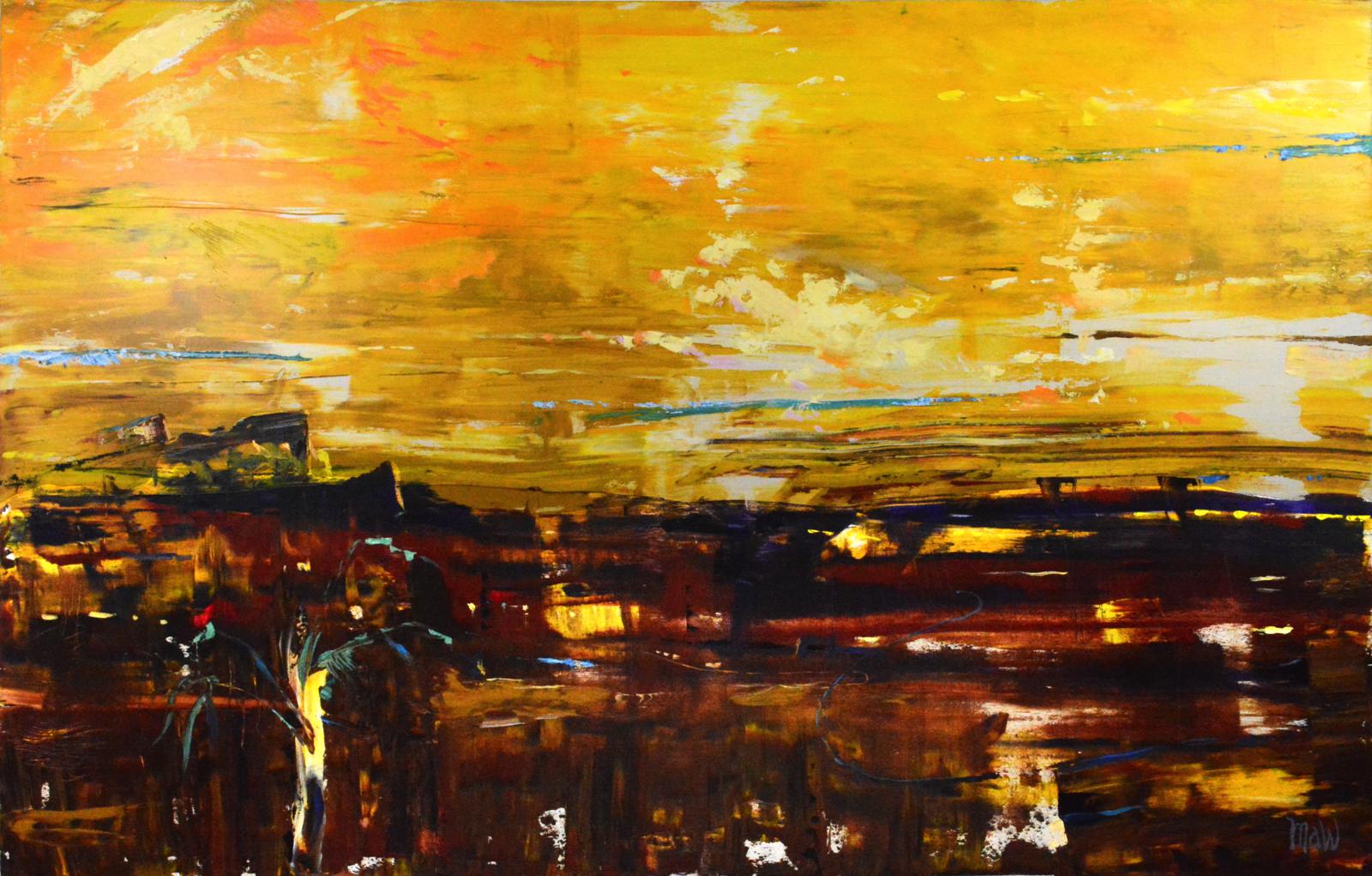
03Especially for the novice painter, commencing an abstract painting can be intimidating. There are no visual clues or subject references which realistic painting offers. I will briefly describe the process I often use – the ‘drag painting’ technique. Gerhardt Richter is probably most noted for this method. I recommend using hardboard or primed plywood panels, preferably large and reinforced to keep them straight. Using the board instead of canvas takes more setup but helps immensely with the process when it comes time to literally drag paint across the surface. This drag technique is an excellent way to start an abstract painting.
It is best to work flat. Squeeze out the colors you want across the board, with a liberal use of white. These might appear as semi-planned globs on the hard panel. Take a squeegee and pressing hard go from one side to the other in a firm, deliberate pass across the board. Keep working yourself down the panel in this manner,dragging the pigment horizontally. Try to be quite firm to leave a minimum of paint on the surface. Stand back and admire the accidents and surprises that will come from this effort. I am always surprised at the affects that are created. It is necessary to wipe and clean off the squeegee through the process so that each swipe is fairly clean.
This can be done in one sitting. I rarely consider this the final step in developing an abstract painting but this provides an excellent background or base to work from. I set this aside to dry for about two weeks. If I am anxious to work on it, setting it out in the sun speeds up the drying. I try to have a couple of these laying around to work on after they dry. The purpose of this brief article is to give you an idea how to start an abstract painting. This drag technique will give you an excellent way to get paint on the surface. It is certainly possible to make it tonally very deep or very light depending on the colors you use. White will quickly be absorbed. You will quickly discover the best locations to apply the ‘gobs’ of pigment. Admittedly this does tend to waste expensive oil paint. What you do get, as a beginner or a novice is an very creative way to create a base for your painting. It already has the look of an oil painting.
Canvas of course can be used though the effect is not as dramatic. If you use store bought canvas, I suggest at least two coats of gesso first to fill the exposed pattern of canvas — in other words the smoother surface, the better. I intend in the near future to do a demo video which will quickly explain this process more completely.

Posted on Leave a comment

STYLES OF ABSTRACT ART by Michael A. Wilson

As a serious painter, someone intending to paint often, it is necessary to define your particular direction. Defining your own style will help you to chart your progress and also knowing your style allows you to seek out other artists who share a similar path. This does not imply that your style will change because it certainly will, so when it does you will chart that style and approach as something new and unique to you.
Understand that if you are not a Naturalist, you will not be trying to infuse something from nature. If you an abstract artist, then stay with that without retreating back to that of a Naturalist. Keep moving forward. As an abstract artist you might have the following direction – that of a Geometrist where lines and planes sharply collide. For the Geometrist the edges between planes become important and when done well will exhibit a sustaining resonance – the line vibrates with tension.
Sometimes critics will use the term Organic to define abstract work which has no sharp lines. THe expression is made with broad, sweeping masses of color. Precise edges are not required because the masses seem to collide against one another. Precise lines would negate that kind of energy. THis style is also sometimes called Expressive Organic, which is essentially the same means – great, dramatic color within large shapes and these contrast with smaller, subordinate though balancing smaller shapes.
Recently I have begun to experiment with dragging paint across a hard, primed ply surface which has been sanded smooth. THe paint is dragged across with a squeegee and this creates some dramatic ‘accidents’ on the hard surface. Now I have completed several where I use the drag effect in a smaller capacity, with smaller squeegees and drag in smaller sections. It is almost like having a different kind of paint brush. During the course of painting I will go back and forth from the drag effect to painting in masses and shapes with an actual brush. This often brings about a very dramatic effect which I like.