Posted on Leave a comment

Corrections in Abstract Painting

In previous articles I have stressed the need to accept accidents in painting abstracts.  I have even gone so far to suggest that the accidental occurrences may even be more authentic and more alive than the attenuated brushstrokes.  Especially employing the techniques I use…that of drag painting,  it is impossible to determine precise outcomes.  It is shocking sometimes when effects are created which considerably exceed anything planned or anything executed by a skilled hand.  This is a wonderful thing.  It is like good jazz.  The static surface begins to resonate from an inner resource.  So, there is this constant tension as a painting develops between un-planned and planned executions of paint.  This tension creates a surface, visual dynamic.  The Title, Corrections in Abstract Painting, refers to the necessary process of harmonizing the various  tensions which appear all over the surface.  Visually, they should dynamically relate to one another…disharmonies need to be corrected.Alexander Sadoyan

It is important however to understand that as a painting nears completion there will inevitably be immensely strong areas.  These may result from semi planned accidents or specifically painted areas.  Conversely there  will inevitably be areas that do not work.  These are areas that are not in  harmony with the rest of the painting.  There is inconsistency in style, in rendering, in feeling or the color may be off.   This is when you will have to study your painting.  It may not be apparent at first.  You sense something is not right so you keep studying it.  The painting is basically almost done and you keep looking at it.  Lucien Freud insists he is not analytical but clearly his paintings indicate his countless refinements.  These refinements come from studying the painting carefully.  You will have to decide where the strong areas are and where there are weaknesses.  This sometimes needs to be done before the paint is dry.

Making corrections in abstract painting is critical to the final outcome.  By now you will have a good idea what the painting is trying to manifest.  You may be surprised to find that the painting is very close to what you had sub-consciously intended.  Still, your keen sense is needed now to bring those weak areas up to or near the level of the over-all painting.  Often a weak area cannot get to the high dramas (the more successful areas) of the painting but the weaknesses can be mitigated so that they do not detract from the whole.   This is what I mean by making corrections.  It is important that the entire painting works as a whole and that there are disengenuous parts that detract.  Sometimes a good artist friend who is honest can come in and give an opinion.  Regardless this is an important part of finishing up a painting.  One tip, look that there is sufficient contrast in the key elements.  Often times many of my corrections have more to do with contrast than with actual hue.

Posted on Leave a comment

Starting an Abstract Painting

03.jpgIt is possible, to some degree to remove the mystery in starting an abstract painting.  There are painters who suggest it is a magical and spontaneous affair,  that it cannot be defined and that the process cannot be understood.  In my own experience I do not find this to be the case.   Kandinsky broke down his own work into several ‘categories’.  When we read how he separated these categories it is clear that he was identifying the process.
In this brief article I will suggest several styles or directions to you.   I think this will be helpful to get you started.  If you already are painting abstracts this might suggest a new direction for you to discover.  The most well-known abstract ‘living’ artist today is Gerhardt Richter.  He is best known for his drag paintings.  This is a method of applying paint to one end of a canvas or board in fairly random gobs and then dragging these across horizontally with a wide, flat squeege.  With his very practiced eye, he produces some wonderful effects.  These effects are part by accident and part by planning.  Not knowing the exact outcome is what makes this process so intriguing.  I have found this to be an excellent way to free oneself from repeating realism.

A second method for abstract painting is what I classify as free form shapes applied by brush.  There are many YouTube videos of this style.  Artists seem to be attracted especially to this means of expression.  Large and small shapes are created in swirling patterns giving the canvas a very free-form, spontaneous effect.  The challenge in this type of painting is having some good fundimentals in color harmony.  However, color can be quite forgiving when one color is juxtaposed adjacent to another.  Often sharp, contrasting lines are added to this type of abstract expression.  This type of art reminds me of good jazz.  There is nothing recognizable, it is definitely spontaneous and relies on sub-conscious responses.  Some artists would say it is an effort to express an inner feeling or a composite of inner feelings. Hans Hoffman was one of the first to paint in this fashion.

A third example of abstract art seems to stem from the cubist movement begun by Braque, Picasso and Juan Gris.  Also the tightly constructed work of Marcel Duchamp.  These are typically more thought out compositions.  They may even have recognizable elements.  Objects, colors and shapes are in defined planes.  Abstract paintings such as these often appear geometric or architectural.  If you have painted realistic scenes of buildings and landscapes and are wanting to express yourself more freely, this type of transitional abstract painting may be an excellent springboard for you.

These are three to consider.  There are of course many.  Starting out with one of these will no doubt help you to define your own vernacular and your own special means of expression.  Emulating another style provides a direction and by studying the abstract artists of the past gives us an opportunity to choose our personal path.

Posted on Leave a comment

Fear of Abstraction

Fear of abstraction stops a lot of good artists in their tracks.  Certainly understandable.  We were taught to view our art through the eyes of realism.  Imagine a famous pop artist  who gets on stage and begins to play a piece he has never played before.  His band is expected to follow along.  This kind of thing doesn’t happen does it?  Jazz however, is an exception and jazz can be brilliant. It takes a brave soul to play real jazz. This brief article will explore how to overcome this fear of painting abstracts in oil.

Where does the fear come from – this great hesitation to paint in abstraction?   Children have no problem with this, do they?  We admire their lovely free-form shapes, wild swirls, beautiful colors merging with each other.  Then something switches in our brains about the age of twelve or so.  Maybe it comes from our education system or maybe it is just a natural progression.  We start happily with finger paints and then, in adolescence  if we can’t paint a decent human figure or a discernable tree we are considered un-artistic.  Usually we give it up.

After that it is a difficult climb.   It is a slow process of undoing our brain synapses so we can envision an abstract piece.    How do we paint something we can’t see?  How do we paint un-reality?   For me I just kept painting and experimenting and I found over the years there was this need to exxagerate a color or shape.  It felt better and even more natural.  I began to read  the psychologist Jung and then Tolle.  I read a book by Gerhardt Richter.  In general I began to read more.  I was discovering the inner world that they spoke of.  It was for me like pulling away a long drapery of gauze and I saw behind it.  I began to experience Jung’s sub-conscious and what Tolle called the awareness of Presence.  I actually found myself becoming more aware – not only of the shapes and forms in my natural surroundings but also more aware of my own, unique inner experience.

I bought myself new canvas and more paint and in 2009 began to paint abstracts.  I was no longer painting what I could see externally.  I was now painting what I was experiencing internally.  I was painting a feeling, an emotion.  Sometimes I felt I was painting in response to something I had dreamed.   Remarkably I discovered that a painting could in fact develop on its own – it could itself dictate the next shape, the next color.  After that discovery whatever residual fear I had seemed to vanish.  It seemed I was more a facilitator than the creator.  I felt very connected to (I guess I should say), the greater Universe.  It felt like I was working out some solution when I painted abstracts.  I felt like I was a vehicle to manifest something that was very deep within my psyche.  This became enormously invigorating for me.

I must confess this was not an easy process and it took awhile.  I was sixty-one.  All my life I had essentially painted realistic forms.  There were small ventures here and there, experiments that hinted towards abstraction but the breakthrough for me was dramatic.  I am a believer in painting abstractions.  I think it should be taught in art schools right next to life drawing.   Any semblance of fear or trepidation could progressively  be canceled.  The world of music, of dance, of sound, of prose could be greatly expanded.  This type of art can be transformative.   It can help us better understand our own consciousness.  If we can understand our own inner presence, our real nature than we become more alive.   Abstract art can definitely foster this kind of discovery and bring forth a very personal and transformative creative experience.DSC02543.JPG

Posted on Leave a comment

Comparing Music to Abstract Art

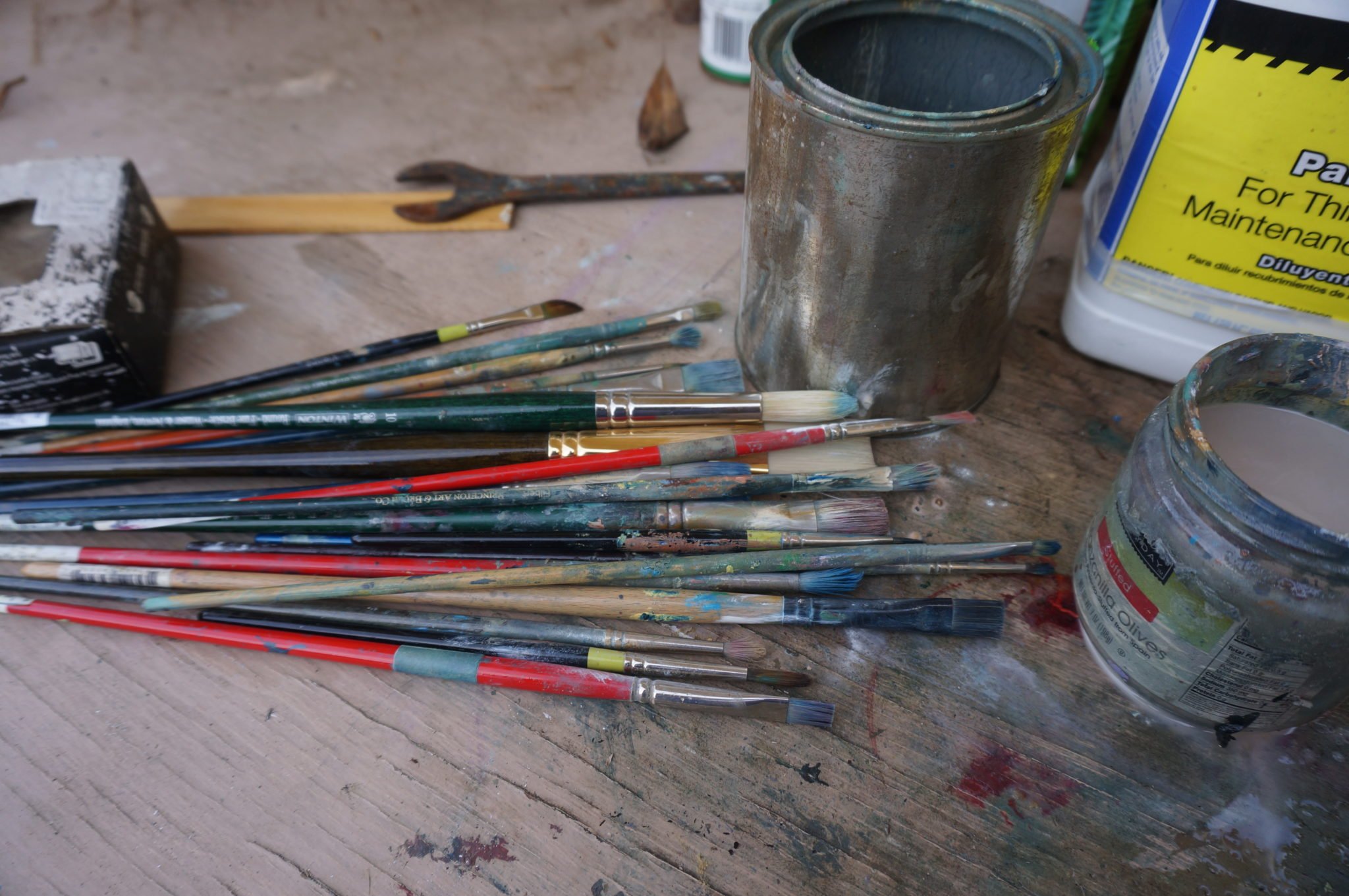
Comparing music to abstract art is surprisingly straightforward.  I have shown in the photo various brushes I use for painting.  Whereas the musician uses an instrument such as a piano or clarinet or violin, the painter uses canvas, paint and brush.  These are tools for expression.

Abstract art is probably more closely related to jazz, especially in the development of a piece.  Jazz typically starts out with a fairly regular rythmn until the lead musician begins to experiment with improvisational riffs.  Abstract art will often employ established formats such as correct balance in a painting, but after these basic tenents are thought through then an artist can freely develop the painting.   In a good jazz piece there is an exciting sense of something being created fresh and new.  This also happens in abstract work.  One long, pure jazz note seems to beckon another spontaneously.  Also in abstract painting,  a certain color or shape will often beckon a different contrasting color or shape.  Both in jazz and in abstract painting the artist must pay attention to an inner source.  The development does not come from responses to exterior forms, but from (shall we say) sub-conscious responses.

Sharing this kind of psychology is one of the primary links between music and painting – especially abstract art.  Kandinsky was a musician before he was a painter and was fascinated with how the two mediums would cross- pollinate each other.   What makes music interesting is the various crescendos, then falls, then long riffs that make for a dramatic piece.  Abstract painting, when it is successful needs to also contain these dramatic elements.  Though a painting is essentially static, it can appear to the senses to be alive and moving, sensual and profound.  This is accomplished by the intelligent use of color, contrast, shape and movement in a piece.


DSC02551

Posted on Leave a comment

Oil Painting – a Direct Medium

Oil painting – a direct medium, may sound like an odd title but is in fact a very distinctive truism in the art world.  We often hear how sad to read the book, that it would be so much better to see someone live, that the words don’t do justice to the message –  to the essence of the message.  Well, in the world of painting in oils there is not such a restriction.  The medium allows for full unexonerated expression, limited only by one’s vision, energy and skill.

There is an unlimited range, certainly in the pallete of colors but also in the area of subject and visual impression.  We have a vast storehouse of artistic expression to historically go back and feed from.  Are you convinced?  Want to start painting?   Or are you stuck in the world of black and white print?

Don’t get me wrong, the ability to transfer feeling, emotion and psychology through print to our minds is undeniable.   I once ventured into the writing of a novel.  What started out as a creative jaunt turned into a four year struggle to see it completed.  It definitely stretched my abilities but also patience to nurture something for that long,  tweaking it until it has just the right effect and  the painfully correct nuances.  Yes,  good writing can do much but more for the actual author  than the reader.  However the oil painter has a medium (a vehicle) that provides for endless opportunity.  As a painter’s skill develops then one is compulsed to see what can be done next.  That is, the painter  takes from each experience definite improvements of skill.  It is only natural to want to explore these new skills.  Sometimes what we want to say needs improved skill to convey what is wanting to be conveyed – especially those more subtle but important psychological statements.

If we think that ‘A Direct Medium’ is a more pure means of expression, we are getting close.  I often listen to music when I paint because it is often that a very pure note is hit or a very beautiful song and that beauty, that integrity and that purity does transfer into whatever it is I am painting.  Music I would likewise consider a Direct Medium though of course, less tactile that the medium of painting.  Can you imagine carving away at a block of granite!DSC02551

Posted on Leave a comment

Negative Space in Abstract Painting

Negative space in abstract paintingpicasso-three-musicians-1024x922 can be a critical element in the development of your painting.   I had one instructor who especially emphasized the awareness of negative space in both drawing and painting.

Negative space in drawing helps immensely to define and measure the positive image.  In Painting however it creates impact and power by defining typically highlighted elements of a painting – often those important  elements that we want the eye to draw upon.  Negative space tends to recede and of course positive space or (elements) come forward.

It is interesting to discover for yourself how certain colors work towards this negative recessive part.  These colors are often muted and often darker in tone and thus help to thrust an image forward.  Some artists think in terms of contrast which is fine, though heightening awareness of those negative spaces and interweaving them adds a certain vitality to a painting.  Balancing negative and positive spaces should always be considered, even in a free-flowing abstract piece.  It is even true with work by Jackson Pollack.  Studying his work you will see very definite balance of these elements.  This is striking considering the apparent randomness of his so called drip paintings.

One interesting practice is to start with negative forms and let them develop the positive forms rather than the reverse.  By giving these negative forms good shape and by balancing them, the formation of the positive elements will gain even richer, more dramatic force.

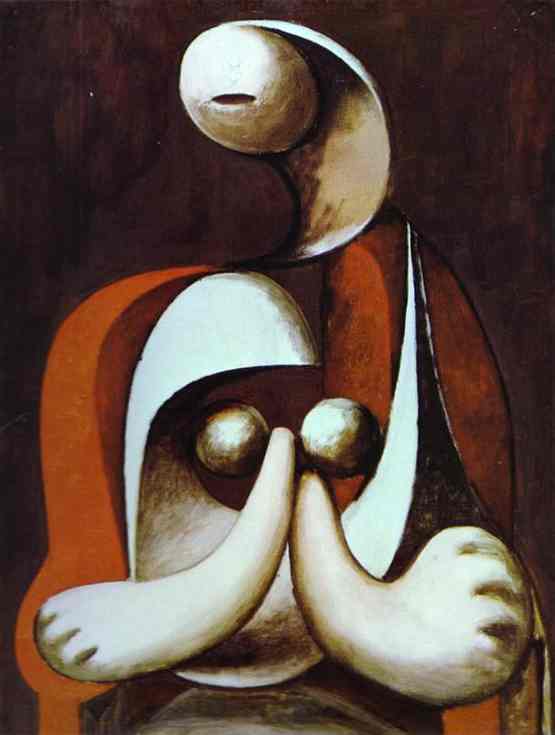
Painting example by Picasso.

Article by Michael A. Wilson